Hoosiers enrolled in the Healthy Indiana Plan — an Indiana Medicaid expansion program that provides health insurance to low-income households — will soon have to prove to the government that they are working at least 80 hours a month to keep receiving benefits.
The change stems from a 2025 law that will finally take effect January 2027. But the effects will kick in sooner for Hoosiers planning to apply for the program in January, as the three-month lookback provision would require January applicants to demonstrate that they were working as far back as October 2026.

Critics say the impending shift will be a disaster for Hoosiers on Medicaid, increasing pressure on a system that already leads the nation in Medicaid disenrollment. They argue that the increased paperwork load will inevitably end up booting eligible recipients from the program.
But proponents of the law say it will ensure Indiana’s resources are used responsibly after the state’s Medicaid spending ballooned due to increased enrollment and encourage recipients to become financially stable long-term.
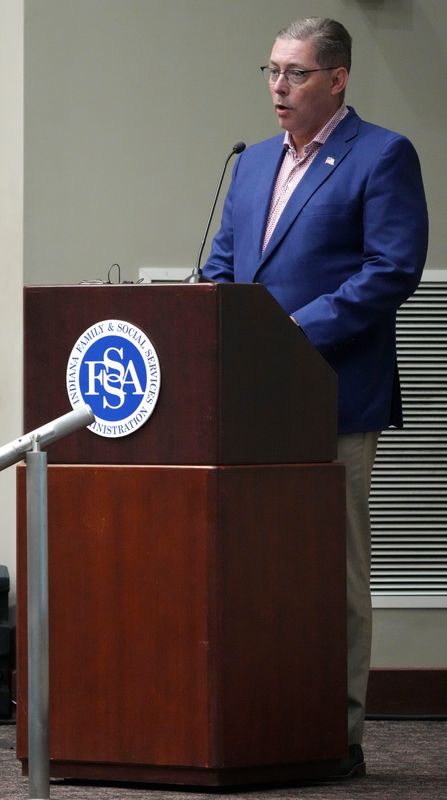
“When society chooses to create a publicly funded benefit such as Medicaid, it carries responsibilities on both sides: an obligation on government to administer the program fairly for both the recipient and the taxpayers,” Family and Social Services Administration Secretary Mitch Roob said, “and transparency and an obligation on the recipient to participate responsibly.”
The details of the law
Under the new law, HIP recipients who are not exempt must engage in one or more “qualifying activities” for at least 80 hours per month, according to a news release from FSSA.
That includes some type of formal employment, job training, education or community service. Recipients can also satisfy the requirement by earning at least $580 per month, according to FSSA.
The law only applies to non-disabled adults aged 19-64, with exceptions for people who are pregnant, caregivers, medically frail or recently incarcerated. Indiana’s version is far more stringent than the federal law, contained within President Donald Trump’s “Big, Beautiful Bill,” too.
To ensure recipients are complying with the law, the state will review eligibility on a quarterly basis using existing data, and reach out to recipients for proof when that data is not available — a process that Roob said will incur additional costs and require more staff. The agency plans to keep recipients informed of the new requirements through monthly notices, town halls and explainer videos, Roob said. Recipients will be able to upload documents to prove their status and receive notices through their benefits portal beginning January 1.
“Challenges will arise — no roll out this size is seamless,” Roob said, “but as issues surface, we will work through them transparently and quickly.”
Critics of the law, like Tracey Hutchings-Goetz from the community organization Hoosier Action, aren’t quite as optimistic. While she was expecting a decline in enrollment over the past year, she said the speed and scale of the shift — a 20% hit from March 2025 to March 2026, according to the health policy nonprofit KFF — has shocked her.
“What is happening is extraordinary and terrifying,” she said.
Adding more paperwork churn to the issue will only make it worse, she said.
Policymakers have attributed the sudden decline to the end of continuous enrollment, a policy that paused disenrollment during the pandemic. According to KFF, Indiana’s Medicaid enrollment was 2% higher than pre-pandemic levels as of March 2026.
Contact breaking politics reporter Marissa Meador at mmeador@indystar.com or find her on X at @marissa_meador.
This article originally appeared on Indianapolis Star: Indiana is rolling out Medicaid work requirements. Here’s what will change
Reporting by Marissa Meador, Indianapolis Star / Indianapolis Star
USA TODAY Network via Reuters Connect
By Marissa Meador, Indianapolis Star | USA TODAY Network