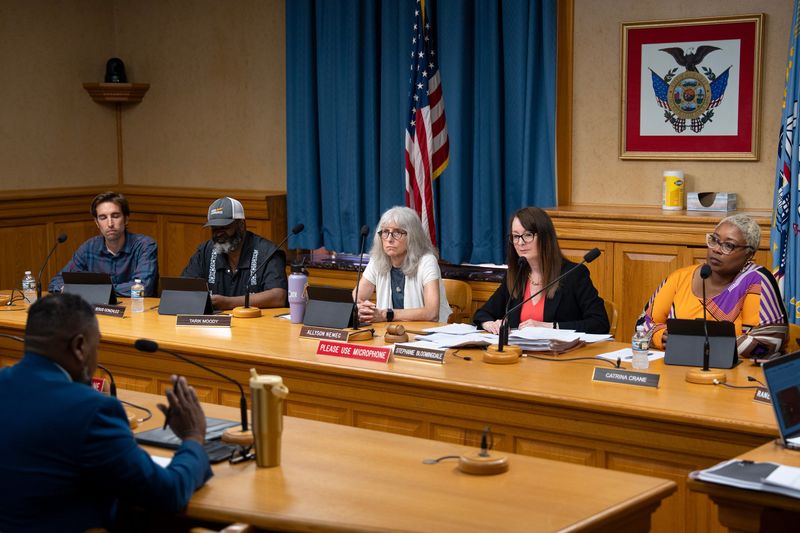
Milwaukee’s Plan Commission punted a decision to approve a redevelopment for a long-vacant Walmart in Midtown Center after a seven-hour meeting on June 29.
The decision came after numerous critics raised concerns about a computing facility they described as a data center that was part of the proposal.

Months of fierce public push-back had mounted against what developers called a proposed “computational research facility” when the redevelopment plan was announced in April. City officials and developers have denied that the facility is a data center.
The motion to hold the decision passed without dissent.
“It was a long meeting, and people testified, and they got to share their point of view with the commission, and ultimately, the commission made a decision, and we will discuss it at another time,” Plan Commission chair Stephanie Bloomingdale told the Journal Sentinel after the meeting. She said she doesn’t know when the future discussions will take place.
Both City Development Commissioner Lafayette Crump, who is a member of Mayor Cavalier Johnson’s cabinet, and Ald. Mark Chambers Jr., whose district includes the site, supported the proposed redevelopment for 5825 W. Hope Ave. Chambers and Crump appeared with developer Trent Overhue at the June 29 meeting, which was attended by around 70 people.
“Obviously, we got more work to do,” Chambers told the Journal Sentinel after the meeting. “It was a dialogue. The residents came, which is democracy at its best, so I’m not bothered by it at all.”
In addition to the overall redevelopment proposal, the Plan Commission on June 29 delayed a deviation request from the Midtown Center Development Incentive Zone Overlay to allow for the “computational research facility” and an adjacent self-storage unit, which would take up a majority of the site.
The two units require deviation from the overlay, which was established in 2000 and meant to “guide development in a manner that fosters an active and engaging retail center,” according to the commission’s staff report.
The redevelopment would also include a public library and a space reserved for city-related uses, as well as an affordable housing unit across the street.
While most Plan Commission votes are advisory recommendations to the Common Council, the commission gives final say to deviation requests from overlay zones established before 2019. The commission consists of seven members appointed by the mayor and confirmed by the Common Council.
Conditions were not enough
Citing a city staff report, Tanya Fonseca, the city’s planning director, initially recommended approval with 12 conditions that the “computational research facility” conduct routine maintenance open to the public and meet noise and environmental standards.
But during the meeting, members of the commission suggested additional conditions of a public, independent study that documents the experiences of residents who live next to similar existing facilities owned by the developer, as well as an environmental impact study and an inquiry into solar power feasibility.
“Given the sensitivity of this proposal, we must overdo it,” said Willie Smith, a member of the Plan Commission. “Data center, it’s really a hot button item right now, so I just feel like we need to address the issues that were raised amongst those who spoke against this.”
“It’s not like a manufacturing facility that we know what it’s like, that we have 200, 300 years of experience,” Bloomingdale also said. “We don’t have a lot of experience in a 19,000 square-foot data computational research facility.”
However, the conditions weren’t enough.
After a failed vote to approve the proposal under the additional conditions, which would have meant that the city would not issue a permit for the redevelopment until conditions were met, a vote to hold the decision until reports were reviewed also failed.
The only motion that passed was one to put the proposal on indefinite, unconditional hold.
City supports redevelopment
Crump began the meeting by acknowledging the “understandable concerns” about energy use, environmental harms and equity that have risen in response to the proposed “computational research space.”
“The fact is, this is not an AI data center,” he said, emphasizing that the 19,000 square-foot facility would be “extremely small” compared to hyperscale data centers elsewhere.
The first phase of Oracle and OpenAI’s data center in Port Washington spans 672 acres, or 29 million square feet, and Microsoft’s facility in Mount Pleasant is set to total 8.7 million square feet.
The redevelopment would include a public library and an additional space reserved for city uses, including early voting, Crump emphasized.
“This plan will represent a positive step forward for the Midtown Center,” he said.
City analysis shows that the redevelopment plan would meet the goals of the overlay and improve the site’s aesthetics, Tanya Fonseca, the city’s planning director, also said, noting that the self-storage and computing operations would be located at the rear of the building.
Chambers also spoke in support of the redevelopment, emphasizing that his constituents don’t want the property to remain vacant and describing the recent proposal as a compromise between city and developer interests.
“To leave it as it is is not a neutral choice,” he said. “It’s a decision to accept stagation.”
After the meeting, Chambers still said he was hopeful about the redevelopment.
“There’s always hope,” he said. “As the alderperson for of the second district and the alderperson for the Midtown Shopping Center, my responsibility is to bring something that’s vibrant and not blight it.”
Public testimonies challenge plan
For three hours, around two dozen individuals offered testimonies, speaking overwhelmingly in opposition to the redevelopment plan and at times veering into personal insults against Overhue.
Steve O’Connell, who said he lives across the Walmart site, said the neighborhood has higher priorities over the proposed redevelopment, including regular flooding and reckless driving.
Warren Enstrom, who said he lives in Grasslyn Manor, five blocks from the site, also said it’s not sensible that the city would rent space for a public library and voting from a private developer.
Ald. Peter Burgelis, who, along with Chambers, is co-sponsoring an ordinance to strictly limit data centers within city limits, asked what kind of enforcement mechanism, such as fines or revocation of occupancy, the city would turn to if the developer breaks noise or energy agreements with the city.
Even if the ordinance is approved, it would not apply to the Midtown Center redevelopment since its application was submitted before the ordinance’s implementation.
While he recognizes that his proposed ordinance would not apply to the redevelopment, he would like to see similarly enforceable limits imposed on the site’s “computational research facility,” Burgelis told the Journal Sentinel in an interview.
Fines and cessation of occupation are possible mechanisms for enforcement, Crump later said.
Decision extends years of efforts
This is not Overhue’s first attempt at redeveloping the former Walmart, which has sat vacant since 2016.
After acquiring the property in 2022, his company filed a proposal in 2023 to redevelop the building into a self-storage facility, which the Plan Commission rejected because “the only non-speculative use proposed for the site at that time was for self-service storage,” according to the commission’s staff report.
In addition to the 108,000-square-foot self-storage operation, this year’s proposal includes a 17,000-square-foot public library and 34,000-square-foot space for the city, as well as the 19,000-square-foot “computational research facility.” An affordable housing unit across the street tied to the plan was also approved by the Plan Commission in April.
The developer acknowledges that the self-storage and computation research facilities are “secondary to the housing and community-serving use,” the Plan Commission’s resolution says.
While the redevelopment proposal was set to face a Plan Commission review at a May 18 meeting, Chambers pulled items about the Walmart redevelopment from that meeting and opted to host three open houses throughout June, calling the move a response to “a lot of misrepresentations of the project.”
At the open house meetings, critics characterized the “computational research facility” as a data center that did not sufficiently support local interests and create jobs.
The city also received approximately 300 emails regarding concerns about the proposed redevelopment, citing energy demand, water usage, and noise and air quality impacts, Fonseca, the city’s planning director, said.
This article originally appeared on Milwaukee Journal Sentinel: Plan Commission punts decision on Midtown Walmart redevelopment
Reporting by Jaeha Jang, Milwaukee Journal Sentinel / Milwaukee Journal Sentinel
USA TODAY Network via Reuters Connect
By Jaeha Jang, Milwaukee Journal Sentinel | USA TODAY Network