Two armies occupied New York City and western Long Island in 1776. The first was the rebellious Continental Army, with George Washington joining them in April. All able hands, white and Black, furiously dug in and built defenses for the city. But the British warships still controlled the harbor. They loomed over the islands, with crews cleaning their cannon barrels and demanding supplies.
New York experienced the American Revolution as a civil war.

Both sides knew the value of New York harbor, and not just strategically. Whoever controlled New York City could open the markets for farm produce, which would help build political support throughout the region. Yet New Yorkers found that soldiers made terrible guests, no matter which side they served.
History happened here: See photos of these 16 Revolutionary War sites to visit around New York.
Thousands of people had already fled the city in 1776. Some bunked with relatives in the countryside, while others had enlisted for the march to assault Quebec. The civilians who remained in town griped about the unruly soldiers and their terrible disruptions.
Many New Yorkers zealously supported a war of resistance against Great Britain. They bristled when New Englanders accused them of lagging behind. True, some New Yorkers hesitated to take the final step toward independence, but others were eager for the promises of free trade and expansion into Haudenosaunee territory.
Plenty of New Yorkers also remained loyal to King George III. They had served the British Empire proudly and enjoyed the trade connections that had helped them flourish. Rebellious New Yorkers fretted about these Loyalists or “Tories,” some of whom were furtively supplying intelligence to the British. They rooted out suspected Tories in Queens, Brooklyn, and upstate. In Manhattan, Loyalists reported that the rebel soldiers were harassing clergymen, damaging homes, and using up all the fuel and food. The rebels, meanwhile, complained about the high prices charged by Loyalist merchants.
Explore and visit: See photos of some of New York State’s treasured views and historic sites.
It wasn’t a great time for free expression: in November 1775, a group of Connecticut soldiers destroyed the Loyalist press of James Rivington and sent him fleeing to England. The Rev. Charles Inglis reported that another group of soldiers burst into Trinity Church and menaced the worshippers who still prayed for the health of the king.
In June 1776, a massive British fleet, and thousands of British and German troops on transports, began arriving off Staten Island. Now an anti-Loyalist panic seized the Americans. Militiamen and residents rampaged through the town, attacking known Loyalists. Two hundred people formed a crowd that pelted Christopher Benson with stones.
A few days later, another group of men burst into the bedroom of Isabella Ryan, recovering from a pregnancy, and dragged her out of bed. The men were looking for Isabella’s husband Cornelius, but the Loyalist spy Lorenda Holmes had warned him ahead of time. The men strip-searched Holmes, looking for incriminating letters, then exposed her at the window in front of onlookers.
A larger group of New Yorkers stripped a few Loyalist men naked and bounced them on wooden rails through the streets in front of jeering crowds. They beat an enslaved woman so badly that she died soon afterwards. The next day, Benson begged Washington for protection. Washington denied that his men had had anything to do with it.
New York had given its conservative delegation to the Continental Congress no authorization to vote for Independence. New York had experienced such radical upheaval that the colony’s conservative leaders were afraid of what further turmoil might bring. But plenty of New Yorkers were ready for the Declaration when it came.
After Washington ordered the reading of the Declaration of Independence on July 9, a crowd pulled down the golden statue of King George III astride a horse off its pedestal in Bowling Green. The gold surface was covering a lead interior: the crowd chopped off the head and sent other pieces to Connecticut to be melted into bullets.
The British, hoping for a reconciliation in New York, lamented the political sea change. Meanwhile, they waited to gather more forces before making their move to Long Island in late August. To welcome them, Washington’s men set the farms around Brooklyn on fire. A New Jersey chaplain said his “Heart fluttered…To see the Ravages of War.”
Washington’s army was so plagued by illness, misbehavior, and desertion that he was worried his army wouldn’t stand tall when the British attack finally came. On Sept. 15, the British stormed Manhattan island, sending the Continental troops into a panicked retreat to the heights above Harlem.
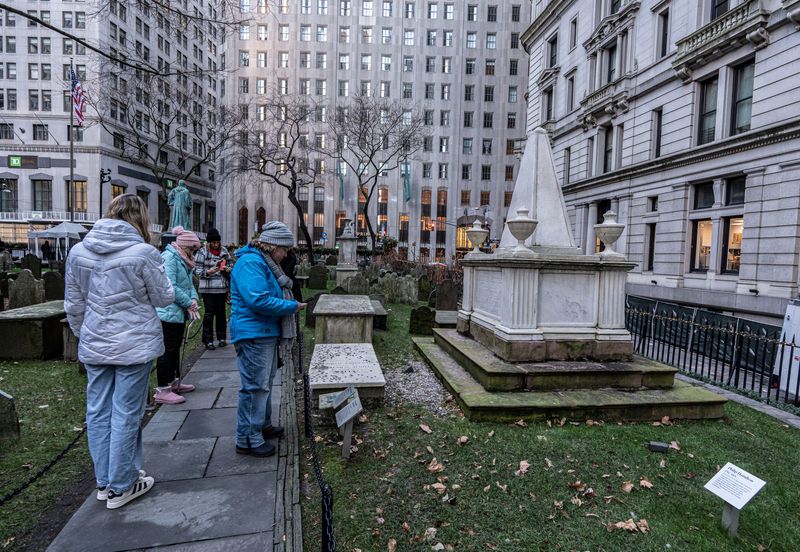
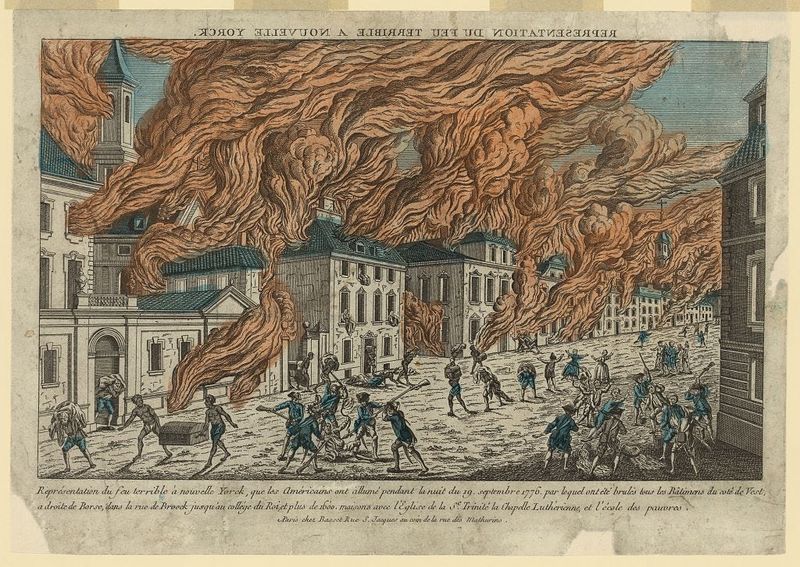
The British were now in charge of New York City. Loyalist women tore down the rebels’ flag, trampled it underfoot, and raised the Union Jack in its place. Loyalists began returning to their homes, but they were in for a nasty shock: six days after the British occupation, rebel saboteurs tried to burn down the entire city, and succeeded in burning a fifth of it, including Trinity Church.
British soldiers caught several fire-starters in the act: a mixed-race man from Connecticut, a woman in a basement behind St. Paul’s Chapel, and American officers. The redcoats threw them in prison or executed them on the spot.
Some Black and Native men—like the mixed-race man who helped burn New York— served with the fleeing Continental Army. While many enslaved Black men received offers of freedom in exchange for military service, in some cases their enslavers later went back on their promises.
The British offered freedom to Black men who fled their rebel enslavers. Now that the British army was in reach, many Black freedom-seekers served as soldiers in the Black Pioneers and other British units, as harbor pilots that guided British ships, and as spies throughout the city and countryside. Meanwhile, the Mohawk Joseph Brant also found himself in New York harbor, on the way back from diplomatic negotiations in London. White men also flocked to form Loyalist military companies.
The British wanted to restore the country to peace, but their rowdy soldiers and soldiers were just as violent—particularly toward women—as the Continentals had been. The Crown refused to allow the restoration of New York’s civilian government. The British occupation also put enormous strains on food and fuel supplies, making it difficult for civilians to survive the harsh winters. They kept thousands of rebel soldiers in dismal prison conditions aboard ships in Brooklyn’s Wallabout Bay.
This article originally appeared on Rockland/Westchester Journal News: The Revolution in New York felt like a war between neighbors | Exclusive
Reporting by By Benjamin L. Carp., Special to the USA TODAY Network / Rockland/Westchester Journal News
USA TODAY Network via Reuters Connect
By Benjamin L. Carp., Special to the USA TODAY Network | USA TODAY Network