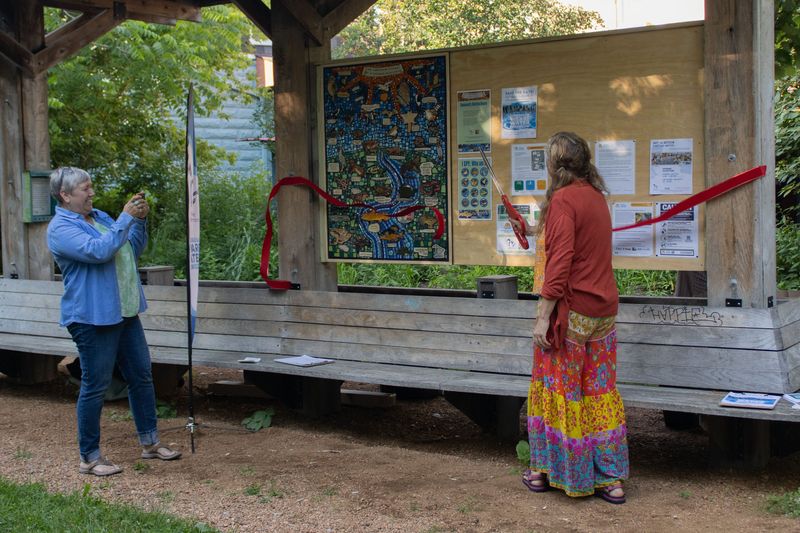
Community members gathered at the Beerline Trail on June 25 for the unveiling of two mosaics at the center of a new community information board in Riverwest.

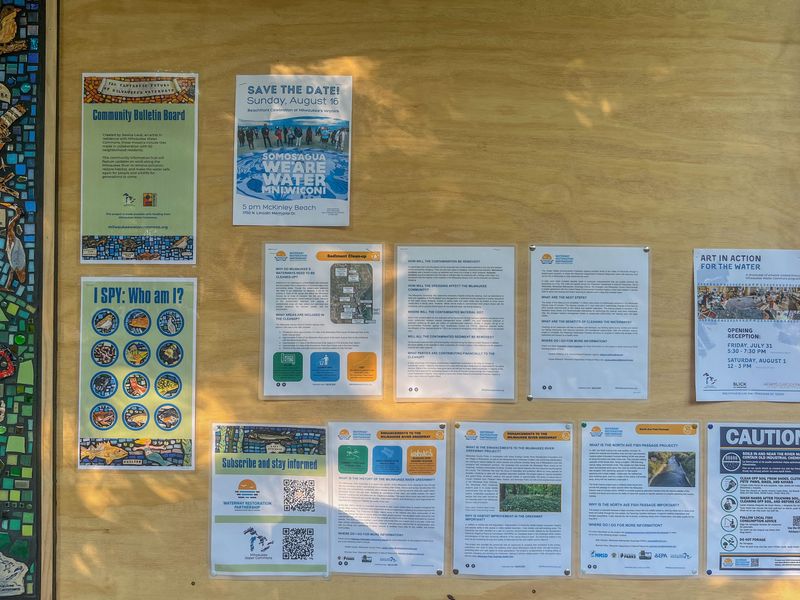
The board around the mosaics will be regularly updated with documents explaining upcoming efforts to restore the Milwaukee River, particularly work to remove toxic sediment and restore habitats.
The two mosaics depict native birds, fish, reptiles and other animals whose reappearance will serve as an indicator of river recovery. They were created by local artist Jessica Laub in collaboration with the Milwaukee Water Commons, a cross-city nonprofit that aims to increase community engagement in decision-making about public water.
“One of the ways that we engage people is through the arts,” said Melanie Ariens, creative art manager at Milwaukee Water Commons. “We really believe in the power of the arts to capture people’s hearts around water issues and that artists communicate in a different way that invites people into engaging.”
Fifty neighborhood residents helped create the animal tiles for the mosaics at a tile-making workshop with Laub, who is currently an artist-in-residence at the Milwaukee Water Commons. Residents were presented with clay, rolling pins and a picture of one indicator animal to which they connected. Many spent over an hour shaping and painting their animals.
“I told them to try and make it as realistic as possible,” Laub said. “It was really fun. I think people really enjoyed the tactile experience of working with the clay.”
Laub later took the tiles back to her studio at the Toy Factory, which is also on the Beerline Trail, where she fired them, clear-glazed them and fired them again. She built the rest of the mosaic world around the animal tiles.
She chose the project after attending Milwaukee Water Commons’ Water School, an annual program that takes attendees around the city to learn and create art about water. There, Laub learned about upcoming water restoration projects.
These projects are going on throughout the Great Lakes region to restore the most polluted water sites. One such place is the Milwaukee Estuary, which includes the lower reaches of the Milwaukee, Menomonee and Kinnickinnic rivers as well as nearshore areas of Lake Michigan. It’s one of four sites in Wisconsin.
For decades, industrial pollution – namely PCBs, or polychlorinated biphenyls – have sat on the riverbeds degrading the health of ecosystems and wildlife and posing a risk to people.
Laub, who has lived in Riverwest for over 20 years, was startled to learn that restoration would involve dredging the river for toxic sediment, which will be transported to a new storage facility by Jones Island, and clear-cutting the sides of the river to get rid of invasive species and replant native species.
“As a person who uses those river trails regularly I know that if I walked down there and saw the sides of the river being clear-cut I would be very upset about it,” Laub said. “Because to me, it’s a place I go to to find peace and refuge in nature and be by the river.”
To Myron Edwards, environmental justice adviser to the Milwaukee Water Commons, avoiding these kind of negative reactions is the motivation behind establishing the mosaics and information board, especially because these types of project can take years.
Edwards hopes that the bulletin board will serve as a community outreach center and that the information on them will ensure residents know about upcoming work well in advance and are aware of the long-term benefits.
Because ultimately, the goal of these projects is to return these waterways to a state where they can be used by surrounding communities, whether that’s beach days during summer heat or fishing.
Completed projects in Milwaukee County are already returning waterways back to the community.
There are now two fish passages along the Milwaukee River: one around the Kletzsch Park dam and the other around Estabrook Falls. And this summer, beachgoers will enjoy their first full summer at Bay View’s South Shore beach after it was moved and rehabilitated thanks to the area of concern program.
“Through these projects we can reconnect and rekindle our relationship with nature, especially given the fact that we’re cleaning up pollution that happened decades ago,” said Edwards. “It’s important we develop that community affinity now so that we don’t go through something similar all these decades into the future.”
This article originally appeared on Milwaukee Journal Sentinel: Community mosaics bring attention to Milwaukee River restoration
Reporting by Milwaukee Journal Sentinel / Milwaukee Journal Sentinel
USA TODAY Network via Reuters Connect
By Milwaukee Journal Sentinel | USA TODAY Network