Recently released data as part of a study concerning the working poor in the greater Rochester and Finger Lakes region indicates a good news, bad news state of affairs — mostly the latter, although there is a bright spot and possible way forward.
On the one hand, roughly one in three households throughout the six-county region cannot afford necessities such as housing, food, childcare and transportation even while working.

On the other hand, Ontario County bucked the trend, showing a meaningful reduction in the number of financially struggling households even as its population grew, which is significant, according to Jamie Saunders, president and CEO of United Way of Greater Rochester and the Finger Lakes.
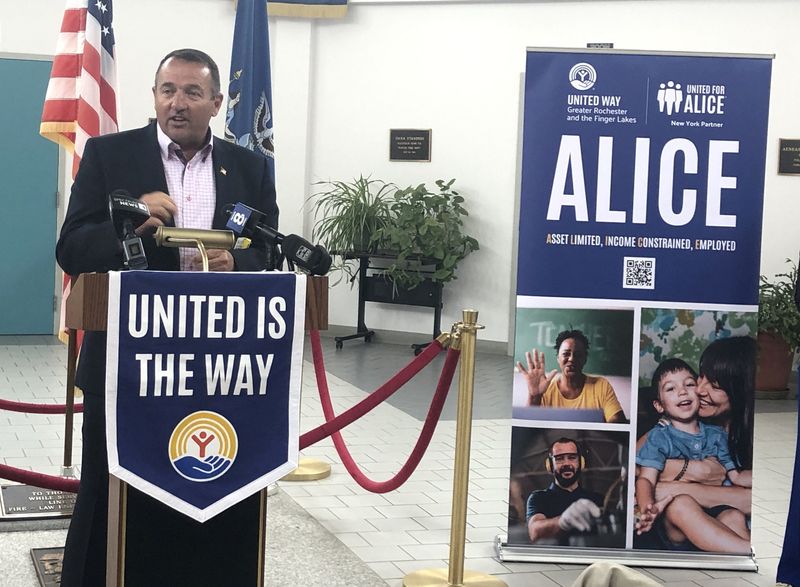
In praising Ontario County government, nonprofits and employers at a press conference June 25, Saunders said this movement does not come by accident. County and community leaders leaned into honest discussions about poverty and changing how this community talks and responds to financial hardship rather than look away.
The data suggests that willingness created conditions that led to progress, Saunders said.
“You can’t fix what you are not willing to face,” Saunders said.
What is ALICE?
The acronym ALICE stands for asset limited, income constrained, employed.
So-called ALICE households earn just over the federal poverty line of $33,000 for a family of four and $15,960 for an individual but still cannot make ends meet.
If a family makes $33,100 a year, they’re not counted as living in poverty, but they are still struggling, Saunders said.
A report published through United for ALICE, a national partnership of local United Way organizations, is meant to give a ground-level, honest look at how working families are faring, Saunders said. The data shows across the country, New York and Finger Lakes region — including Ontario County — what many already suspect.
“Families are under real pressure,” Saunders said.
Ontario County Administrator Chris DeBolt said county leadership and the Board of Supervisors believe strongly in what this data shows.
What did Ontario County do about poverty?
The county continually directs investment in workforce development and relies on a network of dedicated nonprofits that help families obtain those necessities.
The county also used a portion of its more than $4.3 million of federal American Rescue Plan Act funding — a program meant to help in the aftermath of the COVID-19 pandemic — to bring the ALICE at Work program to 19 local employers, such as UR Medicine Thompson Health, the county’s largest employer.
ALICE at Work is an empathetic program designed to help employers rethink poverty and support employees who are struggling financially by focusing on ways to create more equitable, supportive and productive workplaces. That could lead to changes in pay or work schedules, for example.
Ontario County is the first in the region to sign on, and it’s now in its second year.
“It gives us the ability as a community to have a different conversation about what poverty looks like, what poverty means and more importantly, what poverty feels like,” DeBolt said.
Here’s what the numbers show since it was introduced.
ALICE households in the county fell from 14,097 to 13,121, a drop of 976. Households in poverty fell from 4,875 to 4,542.
DeBolt said gaps simply cannot be filled alone and praised staff members and leadership from the Board of Supervisors as well as the United Way and a network of dedicated nonprofit partners for their efforts in attempting to do so.
“I think that’s really the story, that it takes a community to try to move things forward in a positive direction,” DeBolt said.
Bringing ALICE into the workplace
Michael F. Stapleton Jr., president and CEO of UR Medicine Thompson Health, was presented poverty data early on, which showed him and the health system’s executive team that while Canandaigua is known as the Chosen Spot, it’s the Chosen Spot for a chosen few.
“There are a lot of people in our community who are in great need,” Stapleton said. “We took this data to heart.”
For example, that led to programs that allow employees to work and go to school part time to advance their careers, with a stipend helping with salary and tuition.
Calling it “wildly successful,” Stapleton said, “We want to keep bringing those opportunities forward.”
In all, 19 organizations took part, ranging from banks and financial services companies to nonprofits to educational institutions such as Hobart and William Smith Colleges in Geneva.
It’s a start.
The need to address poverty continues
While the Ontario County numbers are worth celebrating, Saunders said, families in the other counties in the region showed increases in poverty and families continuing to lose ground. Even in Ontario County, some 12,000 households remain at the ALICE level or in poverty.
“The need out there in the community is significant,” DeBolt said.
The issue is complex and ever changing, and the situations are precarious for families across the region, Saunders said. Continued advocacy, education and partnerships are necessary.
“No county, no community has solved this,” Saunders said.
For more on ALICE and poverty
For details on the report, visit https://unitedwayrocflx.org/what-we-do/alice/.
Mike Murphy covers Canandaigua and other communities in Ontario County and writes the Eat, Drink and Be Murphy food and drink column. He can be reached at mmurphy@messengerpostmedia.com. Follow him on X at @MPN_MikeMurphy.
This article originally appeared on Rochester Democrat and Chronicle: Ontario County finds a way to help the working poor
Reporting by Mike Murphy, Rochester Democrat and Chronicle / Rochester Democrat and Chronicle
USA TODAY Network via Reuters Connect
By Mike Murphy, Rochester Democrat and Chronicle | USA TODAY Network