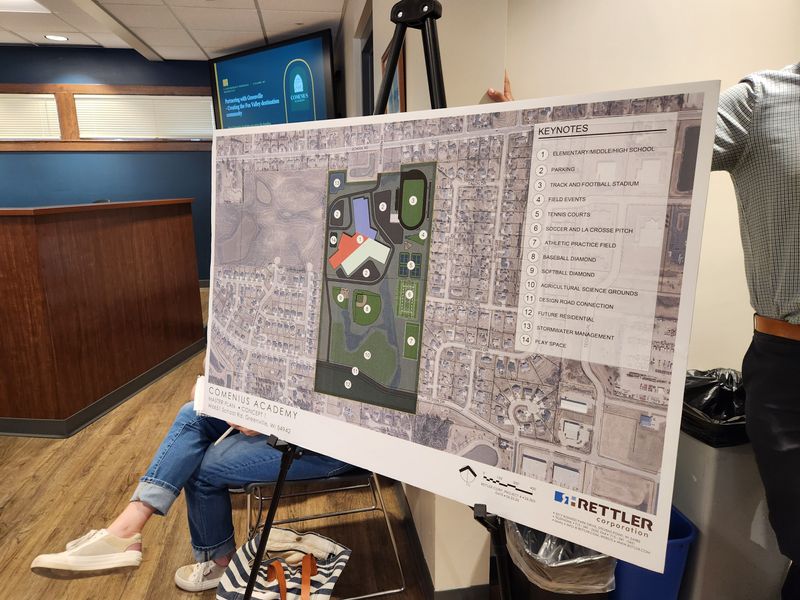
The team planning a new Christian school in the Fox Cities now has a timeline for development and a potential site in Greenville.
But the site at W6651 School Road will first need to be rezoned to institutional use. Additionally, the cofounders of Comenius Academy – U.S. Venture chief marketing officer Bill Ryan and Alliance Church pastor emeritus Rev. Dennis Episcopo – will have to overcome concerns from potential neighbors and other Fox Valley residents.

Those concerns, including traffic on School Road and Comenius’ financial impact on local public schools and the community, came to the forefront at a public information meeting Ryan and Episcopo held at Greenville Village Hall on June 24.
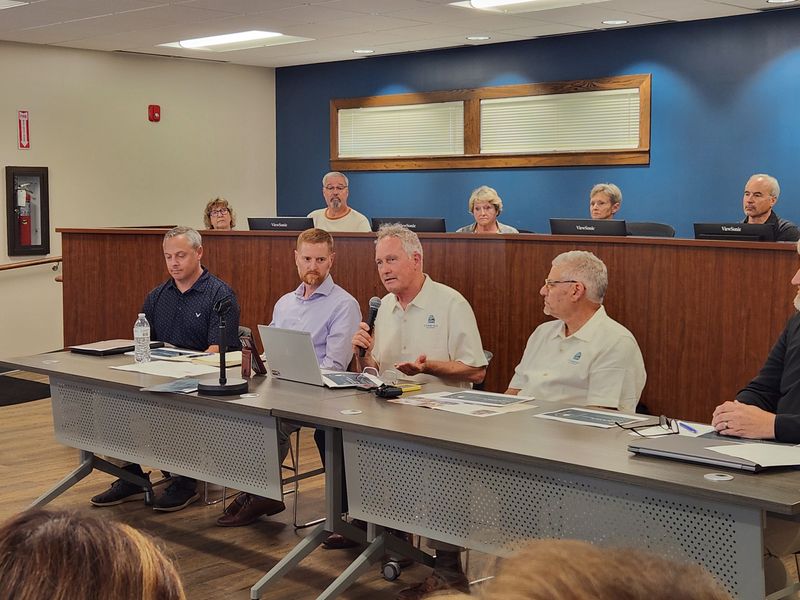
The meeting had two parts: new information about the school’s potential location and timeline, and an open Q&A session with the attendees. About a hundred people packed the village hall, with standing room only at the beginning; while the meeting was planned for one hour, it ran well over two.
About 20 people lined up to speak during the Q&A. It included residents near the proposed school site, candidates for public office, pastors and local public education advocates. Most of them brought concerns — and, in several cases, pointed questions.
Full timeline includes moving ‘potential’ start date to 2029
During the first part of the meeting, Ryan and Episcopo, along with John Kneer from the Rettler Corporation, Mark Ver Voort from the Boldt Company and Jody Andres from Hoffman Construction, presented their plans for the new school.
Episcopo said in this part that he and Ryan hope to pursue “excellence in education and build character,” “cultivate a relationship with God,” find academic and spiritual mentorship and have academic tracks for college prep and the trades. Their goal is to enroll about 2,000 K-12 students once the entire school is built, estimated to be in the early 2030s. They also said they plan to participate in the Wisconsin Parental Choice Program, which offers tax-funded vouchers to lower-income households who send their children to an accredited private school.
Andres presented an updated timeline for Comenius: the design phase in spring 2027, construction beginning in spring 2028, and the elementary and administration buildings “potentially” open in time for the beginning of the 2029-2030 school year, with the high school, outdoor athletic fields, auditorium and aquatic center to come later, depending on funding.
Ryan told The Post-Crescent that while they had originally envisioned having the elementary school open for the start of the 2028-2029 school year, they moved the opening date a year out to meet their milestones.
In the near term, Comenius leadership hopes to start a traffic study in fall and have the property re-zoned. The School Road property sale to Comenius is contingent upon whether re-zoning is successful, Ryan told The Post-Crescent. According to its listing on Loopnet, the property, 72.45 acres near the Savannah Heights Residential Development, is valued at about $2.3 million.
While Comenius Academy is a separate organization from Alliance, the school will be a non-denominational Christian school. Episcopo said that makes Comenius distinct from other Christian schools in the Appleton area, the majority of which are Lutheran or Catholic.
Community members question school’s location, mission and impact
After the presentation, about 20 attendees lined up, three or four at a time, to have their say. Most of them were concerned about the project, offering questions and criticism. At times, the conversation turned heated, as the audience responded to the speakers and the panel with applause and shouts. Ryan asked the gathered crowd at one point to maintain a civil discussion.
The speakers’ questions and comments mostly fell into two broad categories: the proposed location’s impact on its neighbors and the nature of the school itself, especially as it related to vouchers.
Several speakers called for impact studies to track the school’s effects on the immediate neighborhood, particularly how Comenius Academy would impact traffic on School Road. Others praised Hortonville Area School District, which oversees the village’s public schools. Still others criticized the school’s plan to participate in the voucher program. Some expressed concern about what they saw as a lack of transparency in how the school would be governed and track student outcomes.
One Greenville resident, Mary Hayes, said during the meeting she was concerned about their ability to build out a curriculum according to their vision, as well as having a “parallel education system” in Greenville. She said she would “fully expect” an impact report that included how the Comenius might impact public schools in the area and elsewhere in the Fox Valley.
A bus driver with Hortonville schools, John Julian, also questioned the project’s impacts on the public schools and the land, pointing out that construction on School Road had just finished; he thought that the road didn’t have enough lanes to accommodate pickup and dropoff for the potential student count.
During the Q&A, candidates for local office took turns at the podium: State Assembly 56 candidates Shawna Riley and Grace Abitz, District 19 state Senate candidate Emily Tseffos, and Congressional District 8 candidate Katrina deVille. All are running for the August Democratic primary ticket to represent Greenville.
Both Riley and deVille questioned Comenius leadership about their stance on the LGBTQ+ community. To both, Episcopo said the school would teach according to the Academy’s Statement of Faith: “God created a complimentary design for male and female and ordained marriage as only between one man and one woman.”
Tseffos and Abitz, meanwhile, raised issues relating to the project’s impact on the surrounding community. Abitz asked about whether infrastructure changes would raise costs for the village and that she was concerned about whether there was a demand for a large K-12 private school. Tseffos pointed out that a private school Comenius’ size would affect enrollment throughout the Fox Valley and that private schools aren’t federally mandated to serve students with disabilities the way public schools are.
“Choices have community consequences,” she said, “and those consequences have to be part of the conversation.”
As they responded to all of the speakers, Ryan, Episcopo and other members of the panel said they would engage further dialogue with the community, show transparency as a nonprofit and in education outcomes and ensure they’re a “value-add” to the surrounding community, such as compensating the village for public infrastructure, like added police and fire personnel and sewer lines, used to support the school.
Still, those statements weren’t enough to assuage concerns from some. Throughout the meeting, Ryan compared education outcomes to a product, which several speakers and audience members criticized.
“It’s really concerning when I hear children being talked about as a product,” deVille said to the panel, later adding: “This isn’t Build-a-Bear. It’s a child, it’s a human. If I put them in a dangerous situation where you close their mind off to what is out there, then they become closed off to people that are out there.”
Comenius co-founder says conversation was ‘very healthy’
In a follow-up interview with The Post-Crescent, Ryan explained Comenius leadership wanted to “leverage concepts out of business and apply them to raise children of God,” as he put it. Everyone, he believed, is created by God with unique talents and gifts. He said part of developing Comenius is looking at the current market and equipping students to succeed in that market once they graduate. He also compared the educational landscape to a marketplace, with parents choosing to invest in education on behalf of their children.
He acknowledged those analogies have their limits: “These are beautiful souls, not material (things),” he said.
Ryan said he thought the June 24 meeting was “very healthy,” with “genuine concerns” coming forward. He believed community concerns were not insurmountable. He reiterated their commitment to further dialogue with the community, showing “how we’re performing in the market” and ensuring they wouldn’t be a “net negative” on village resources.
He said Comenius leadership would have another public information session before going before the zoning committee in Greenville. As of June 25, the time and place for that meeting was unknown.
Rebecca Loroff is an education reporter for the USA TODAY NETWORK-Wisconsin. She welcomes story tips and feedback. Contact her at rloroff@gannett.com.
This article originally appeared on Appleton Post-Crescent: New Christian school has potential site, timeline. Some have questions
Reporting by Rebecca Loroff, Appleton Post-Crescent / Appleton Post-Crescent
USA TODAY Network via Reuters Connect
By Rebecca Loroff, Appleton Post-Crescent | USA TODAY Network