SOUTH BEND — Printed in thick, all-caps letters and inked onto the front page, “AUTO OUTPUT TO END HERE” and “Studebaker will assemble cars in Canada” greeted residents as the South Bend Tribune evening paper made its way around the city on Dec. 9, 1963.
The decline of Studebaker Corp. could no longer be ignored. In fact, it stared residents in the face, a looming cloud leaving many families wondering how their lives were about to change.

But for almost 111 years before the devastating news hit, Studebaker was a pillar in not only South Bend’s success but also as a contributor to the American story via its role in westward expansion, war efforts and immigration.
The company acted as a beacon, a light that drew in Americans from all over the country and immigrants from, primarily, Europe for a secure, well-paying job.
Then it all ended, sandwiched between the assassination of President John F. Kennedy and Christmas.
Tribune reporter Jack Colwell broke the news that cold December day in 1963 and wrote that Studebaker would end 61 years of automotive production in South Bend and shift all assembly operations to Canada, although automotive part assembly and military truck production would continue locally for some time.
The next day, Dec. 10, 1963, Studebaker’s chairman, Randolph Guthrie, told the world in a New York press conference that Studebaker had lost $40 million since 1959.
“Studebaker lacked the resources to compete in the most competitive market in the United States, especially as we got towards the middle ‘50s and ‘60s,” Studebaker National Museum Archivist Andrew Beckman said. “They survived the Great Depression. They survived many obstacles in their path, but they did not have the margins of safety to weather the market in the ‘50s and ‘60s.”
Studebaker’s decline felt sudden for many, but the startling news opened eyes to the reality of years of declining sales and shrinking staff numbers that ultimately led to its closure.
The beginning
Studebaker got its start in 1852 when brothers Henry and Clement Studebaker opened the H & C Studebaker blacksmith and wagon shop at the corner of Michigan and Jefferson streets in downtown South Bend, according to the Studebaker National Museum.
Meanwhile, while his brothers were running their blacksmith shop, John M. Studebaker headed to California to look for gold. After making wheelbarrows for prospectors, John returned in 1858 with $8,000 to invest in his brothers’ wagonworks, The Tribune previously reported.
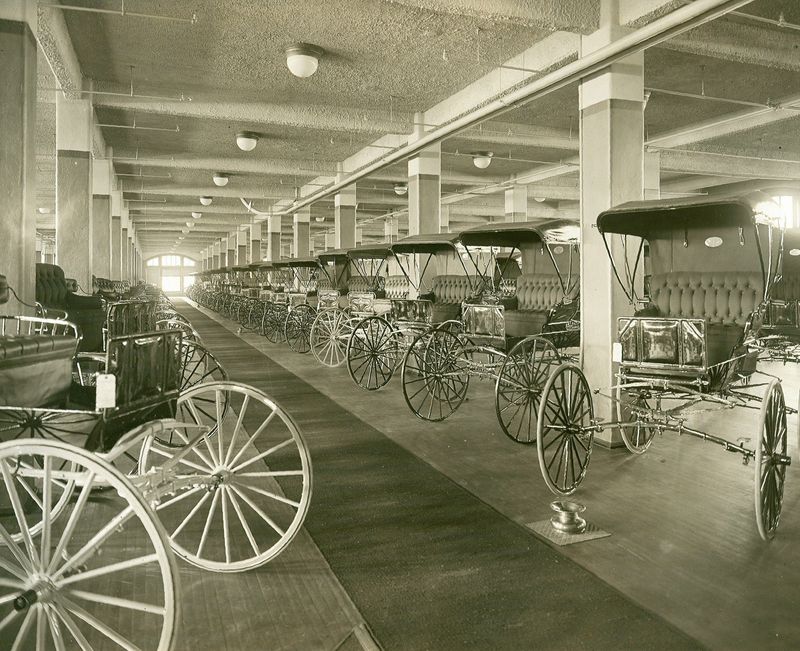
Beckman said Studebaker became the world’s leading horse-drawn vehicle manufacturer, and the company even began to supply them to the Union Army during the American Civil War.
In fact, on April 14, 1865, President Abraham Lincoln traveled to Ford’s Theatre in Washington, D.C., in a Studebaker carriage. That night, John Wilkes Booth assassinated him during the performance.
Studebaker became well known among travelers moving westward. According to the National Park Service, Studebaker wagons were widely recognizable and parts from the blacksmiths were used in nearly every wagon making the journey toward the west.
“Peter Studebaker, one of the five brothers, set up sales outlets as far out as he could,” museum archivist Beckman said. “One of the first ones was in St. Joseph, Missouri, which at the time, was really one of the jumping off points for settlers heading west.”
By 1874, the company reached $1 million in sales. A fire destroyed the production plant the same year, but Studebaker quickly rebuilt, according to the Studebaker museum.
“It’s a fascinating history for a company that started in the horse-drawn vehicle market and grew from a two-man blacksmith ship to become the world’s largest builder of wagons and buggies,” Beckman said. “Studebaker was kind of the universal brand. They were a global manufacturer.”
The brothers established outposts further west in the 1880s and 1890s, Beckman said, allowing them to have a nationwide and even international name recognition.
Before the turn of the century, Studebaker became a pioneer for electric vehicles. The company first started making bodies for the New York Electric Vehicle Co. in 1897 and then manufactured its own battery-powered passenger cars and commercial vehicles until fully switching to gas-powered automobiles in 1911, The Tribune previously reported.
The new century brought new opportunities for Studebaker. Sales reached $4.8 million and over 2,500 South Bend residents worked at the plant. Business continued to grow after World War I started in 1914, and Studebaker became a major supplier to the allies during the war.
But the year 1920 specifically marks a stark transition for Studebaker as the company prepared to leave horse-drawn vehicle production in the past.
“They saw the ultimate demise of their primary market when horse-run vehicles went out of favor,” Beckman said. “The automobile came to the forefront.”
The height
Studebaker wasted no time starting automotive production in South Bend, and in 1920, the Light Six was the first-ever South Bend-built automotive. Beckman said the company as able to transition to automobiles successfully, which was something no other horse-run vehicle manufacturer was able to do.
And Studebakers cars were certainly put to the test. In 1932, the company entered a five-car, factory-backed team at the Indianapolis 500 and left with a third-place finish.
Things looked to be on the up for Studebaker until the company was placed in receivership in 1933. The impact of the Great Depression nearly destroyed the company, and according to the Henry Ford Museum, Studebaker’s chief executive at the time, Albert Erskine, was known for cutting prices to boost sales, leading to a few successful years of business.
But when the Great Depression hit in 1929, a combination of over production and paying high dividends to stockholders meant Studebaker burned through most of its money, Beckman said, and Erskine lost his job to his cost-conscious managers.
“Erskine truly believed prosperity was just around the corner, and he saw value in maintaining Studebaker stock price by continuing to pay out dividends,” Beckman said. “That was a very undefined-sighted practice because it drained Studebaker’s coffers, and ultimately they were broke by 1933.”
Erskine died by suicide the same year, The Tribune previously reported, and the company was left in the hands of Paul G. Hoffman and Harold S. Vance.
Eventually, Hoffman and Vance convinced the judge that the best way to satisfy their creditors was to continue production. Studebaker scaled down its model lineup and sold off its Pierce-Arrow motor car division and left receivership in 1935, Beckman said.
The start of World War II brought unexpected business to Studebaker as it began to supply United States troops and allies with thousand of trucks, bomber engines and all-terrain Weasels, known to the army as the M-20, The Tribune previously reported. The general public wasn’t buying cars, Beckman said, but the company’s military sales totaled $1.2 billion by the end of the war.
“People were struggling to put food on the table. An automobile was very far down on many people’s list of priorities,” Beckman said. “For the lower manufacturers, like Ford and Chevrolet, it was much easier to sell a low-price car during this period. But Studebaker was not in the low-price field. They were medium-to-upper-medium-priced cars.”
The company survived by the skin of its teeth, Beckman said, but while competitors were waiting to release new lines, Studebaker jumped into the postwar lifestyle and released its “First by far with a Postwar Car” campaign in 1946.
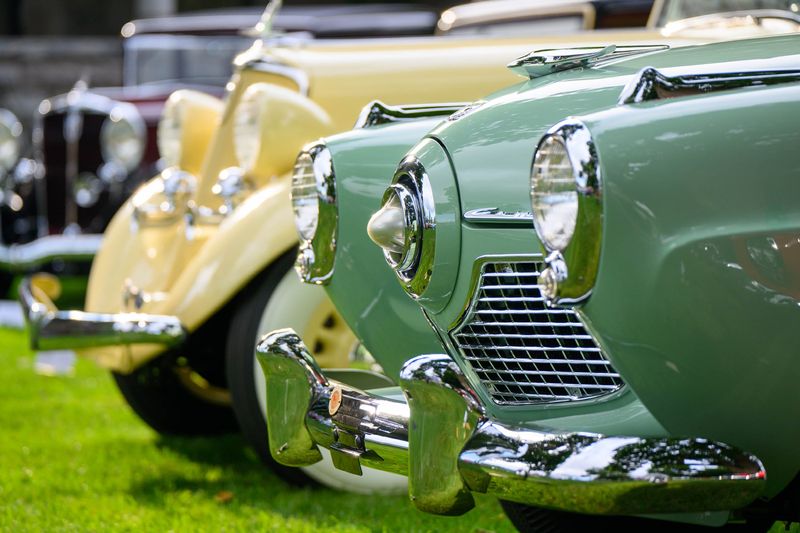
Studebaker began to solidify itself as a styling leader, according to the Studebaker museum, thanks to French-born American designer Raymond Loewy.
In 1950, Tribune staff writer Ray Gregg reported that South Bend was gearing up for another banner year in industrial employment and production. The forecast seemed especially optimistic for the automotive industry, Gregg wrote after Studebaker president and board chairman Vance described 1949 as the “greatest in history” for the company.
“I don’t want to say it’s a miracle Studebaker survived that period, but it’s certainly very close to that for what they were able to do and keep going,” Beckman said. “The depression saw so many famous automobile brands just fall by the wayside.”
The decline
Despite trying to tap into the low-price market and boost its sales with more affordable options, such as the Studebaker Champion, the company found itself in a hard place after celebrating its 100th anniversary.
Sales hit a record $503 million in 1951, but by the next year, car sales began to fall. Studebaker tried to enter a new market and opened an auto plant in Brunswick, New Jersey, to produce jet engines in hopes of combating the declining sales, The Tribune previously reported.
But alas, the falling sales greatly impacted the business and led to the elimination of the night shift in South Bend. In another attempt to save the company after a loss of $26.2 million, Studebaker merged with Packard Motor Car Co. By 1955, Studebaker’s employment declined from around 22,000 to 7,000 following a labor dispute that year that slashed production efficiency, The Tribune previously reported.
“Studebaker had generally a very favorable labor contract. They paid on average higher wages,” Beckman said. “Studebaker’s management was unwilling to take a strike to get their labor costs back in line. … All of this came to a head in the early ‘50s.”
The company eventually had to negotiate a new labor contract to align costs with other car manufacturers’, and even then, labor costs were still higher than the industry standard, Beckman said.
Unfortunately, management wasn’t willing to lower labor costs until it was too late, Beckman said. The company released its new Lark car in 1959, which was a huge success until General Motors, Ford Moter Company and Chrysler Corporation introduced compact cars in 1960, according to a United Auto Workers Studebaker document.
By 1963, auto sales were on the rise for most companies, except for Studebaker. The company’s board of directors voted Dec. 9 to shut down the South Bend plant and move auto production to Hamilton, Ontario, The Tribune previously reported. But production in Canada did last long.
“The company continued producing cars at their Hamilton, Ontario facility until March of 1966,” Beckman said. “The last Studebaker was completed St. Patrick’s Day [March 17] at 8:11 a.m.”
The aftermath
After being a national primary mode of transportation in both wagons and automobiles collectively for a century, Beckman said, Studebaker played a supporting role in the nation’s development.
“So many things that Studebaker was able to do, other manufacturers were not able to do because Studebaker was such an established vehicle manufacturer and really knew the way to be a successful manufacturer,” Beckman said.
Having national and global distribution centers meant the company knew how to get product out to retail outlets, which gave it a big advantage over other automotive companies at the start, Beckman said. But eventually, that was no longer enough.
The closure of Studebaker was devastating in South Bend because the company was a part of the community’s fabric for over 100 years, Beckman said. And for some people, it was all they knew.
“I can’t imagine someone straight of high school went to work for Studebaker, and suddenly there’s no longer a job for them,” Backman said.
Up until about 10 years ago, the company still had a presence in South Bend through parts and service operations, Beckman said, but those jobs have since moved down to southern Indiana.
South Bend has lost upward of 25,000 residents since 1960, according to Stats Indiana, which is around the same number of workers, Beckman said, Studebaker had at its peak.
On Dec. 11, 1963, Paul D. Gilbert, president of Gilbert’s Men’s Clothing, gave the city stern words two days after The Tribune broke the news about Studebaker’s closure as community leaders gathered to plan what would happen with the company’s facilities.
“This is not Studebaker, Indiana. This is South Bend, Indiana,” Gilbert said. “We’re going to come out of this bigger and better than we ever were.”
Unemployment in South Bend rose from 2.1% in November 1963 to 9% in early 1964. But by September 1965, it was back down to 2.6%, The Tribune previously reported. South Bend wasn’t the only city in the Rust Belt that was experiencing factory and manufacturing closures, but, Beckman said, the city worked hard to find stability again.
“The healing took decades,” Beckman said. “South Bend rallied. Paul Gilbert said we’re going to have to work harder. We’re going to have to pull together, and that’s exactly what the community did.”
Email South Bend Tribune business reporter Jessica Velez at jvelez@usatodayco.com.
This article originally appeared on South Bend Tribune: From wagons to automobiles, the rise and fall of Studebaker
Reporting by Jessica Velez, South Bend Tribune / South Bend Tribune
USA TODAY Network via Reuters Connect
By Jessica Velez, South Bend Tribune | USA TODAY Network