“Where do we go from here?
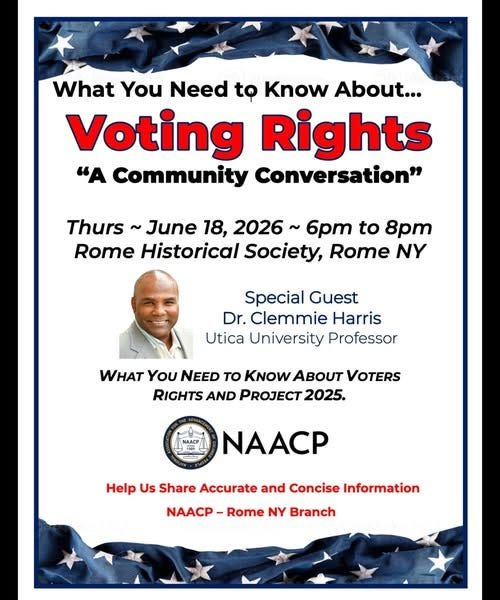
That is the question the audience was left to consider at the conclusion of a what you need to know about voting rights: A Community Conversation” presentation on June 18.

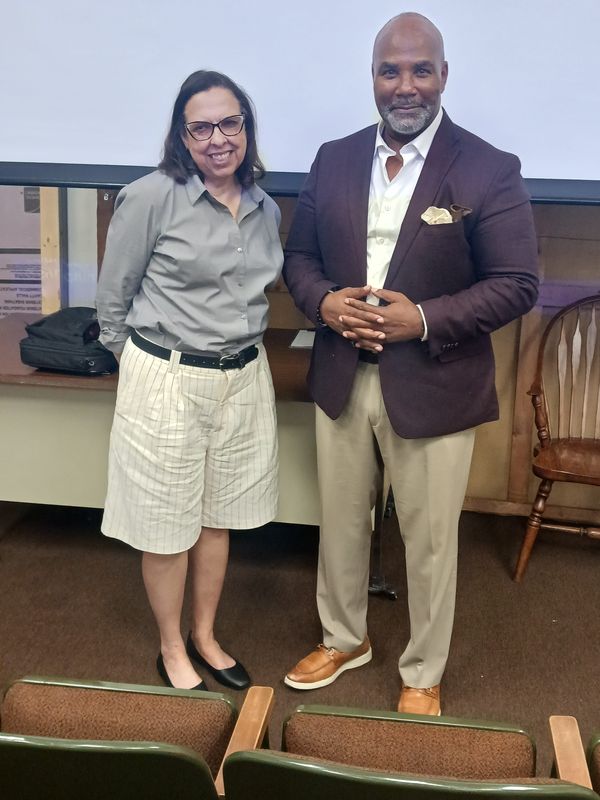
The presentation was led by Clemmie L. Harris, an author and authority on African American political history. He also is an associate history professor at Utica University.
Harris also spent time during the presentation addressing the Fourteenth Amendment.
It was sponsored by the NAACP, Rome Chapter and hosted by the Rome Historical Society.
The program walked the community back through the history of voting rights in order to face them forward to fight for them.
In her introduction of the host, the special guest, and the topic of the evening’s event, Rome NAACP President Jacqueline M. Nelson reminded the diversely attended event, “The most important thing is not to lose sight of your voice – that’s what counts.”
Rome Historical Society Executive Director Colin Havener credited Nelson with her recent advocacy for the passage of the Rome Board of Education Budget to a gesture of applause from the gallery. The original budget failed to pass by 24 votes, while the revised budget passed by only 39 votes, reflecting the deep partisan division impacting communities.
Said Nelson, with commitment, “we will work with anyone, anywhere … for the children, for their teachers.”
About the event
Nelson and her organization convened the voting rights presentation as the Mohawk Valley prepared to celebrate the Juneteenth holiday, established around the eventual liberation of former slaves in Texas who did not know and had not been informed that they were in fact freed until June 19, 1865, two and a half years after the Emancipation Proclamation.
The date was enshrined as a national holiday by President Joe Biden on June 17, 2021.
About Harris
Harris is the director of Africana Studies and an associate professor of history and public policy, He holds a B.A. from SUNY Albany, a Masters in American History from both SUNY Albany and University of Pennsylvania (Penn) and a Ph.D. in American History, Africana Studies Metropolitan Studies, and Public Affairs from Penn.
He is also the author of Lead author in: If There Is No Struggle, There Is No Progress: Black Politics in Twentieth Century Philadelphia, published by Temple University Press and author of Reconstructing Philadelphia: The Persistence of Racism and the African American Struggle for Political Power and Civil Rights in the Urban North, currently being edited by University of Pennsylvania Press, a case study exploring electoral and protest activism in the urban north from Abolition into the 1980s.
Talking voter rights
Harris led the gallery through an efficient and at once elegant journey through America’s history of voting rights from the Fourteenth Amendment to the U.S. Constitution in post-Civil-War-era 1868 through the Civil Rights Movement and Voting Rights Act of 1968 to the 21st Century conservative shift of the U.S. Supreme Court, defined in part by the systemic disempowering the Fourteen Amendment and the equal protection of voting rights.
Harris expressed being glad to be there to “discuss a very important issue ahead of primary day – voting rights.”
After reviewing that 19 states have passed 34 laws that limit access to voting, while 32 laws in 17 states equate to election subversion, Harris posed this to attendees…
“What does it mean to be a citizen of the United States,” Harris questioned. “Who should and should not count as a citizen?”
Voting in America and the Fourteenth Amendment
The Fourteenth Amendment, which establishes birthright citizenship, due process, and equal protection around voting rights and Congressional representation, was ratified in July of 1868.
“The 14th Amendment,” said Harris, “inspired of history of freedom.”
In the wake of Jim Crow laws using state and local laws to disempower the amendment and reveal challenges in its enforcement, the Civil Rights movement of the 20th Century led to the passage of the Voting Rights Amendment almost 100 years later in 1965 by President Lydon Johnson. The VRA empowered the Fifteenth Amendment, which prohibited restricted the right to vote based upon race, color, or “previous condition of servitude.”
“Civil Rights Movement could not wait any longer,” said Harris of the timing of the signing of the into law.
Harris noted “Inclusion and equality represent the very meaning of freedom and who should receive the full right of freedom.”
“WEB DuBois said of Black folks,” Harris shared, “Voting is how we express our power in democracy.”
Harris highlighted the current administration’s Executive Order intended to end birthright citizenship, as protected by Section 1 of the 14th Amendment – currently awaiting a decision in Trump vs. Barbara by the U.S. Supreme Court – and the SAVE Act, proposing the requirement of show documents proving citizenship, such as passports or birth certificates, at the polls before voting.
“This bill,” said Harris, “seeks to restructure the Constitution itself.”
Harris walked the audience through the 21st Century history on the issue of voting, beginning with the 2013 SCOTUS decision in Shelby County v. Holder where a 5-4 decision with Chief Justice John Roberts casting the deciding vote, effectively eliminating federal “preclearance” of any changes to redistricting maps or voting laws to ensure the rights of minority voters.
In the 2021 SCOTUS decision in Brnovich v DNC, the high court made it more difficult to enforce Section 2 of Voting Rights Act by creating a new, more flexible, legal standard for determining whether a voting law is discriminatory.
“With that 6-3 decision,” said Harris, “the Court continues to move right.”
The 2023 SCOTUS in Allen vs. Milliganactually struck down the State of Alabama’s gerrymandering efforts to limit its cohort of Black citizens, reflecting almost 30% of its population, to a majority in just one of its seven Congressional districts. SCOTUS deferred to the ruling of the State courts, ordering the state to ensure that at least two of the seven districts reflected a majority of black voters.
“Leaving us to trust State legislatures,” posited Harris.
Currently, the Trump Executive Order, “Protecting the Meaning and Value of American Citizenship,” of Jan. 9, 2025 effectively ordering an end to the Birthright Citizenship protected by Section 1 of the 14th Amendment, has had Oral Arguments on Trump v. Barbara heard by SCOTUS who are again challenged to uphold multiple state and federal court rulings, where action is suspended till a SCOTUS ruling expected in late June or early July.
Said Harris, “If this case is supported by SCOTUS, it strikes to our very core.”
“Understanding our history is so critically important,” implored Harris, “because what we are dealing with as not been resolved.”
In Feb., 2026, the U.S. House of Representatives passed a revised version of the SAVE ACT, requiring substantial voter documentation to prove citizenship. It failed however to achieve the 60% vote in the Senate so is currently suspended.
“What we are witnessing today is not merely a systemic campaign initiated by Project 2025 to restructure the federal government’s liberal policies and structural foundations,” said Harris. “At the heart of the matter is the Fourteenth Amendment.”
This article originally appeared on Observer-Dispatch: Rights, 14h Amendment among topics of Rome NAACP voting presentation
Reporting by Cara Dolan Berry, Utica Observer Dispatch / Observer-Dispatch
USA TODAY Network via Reuters Connect
By Cara Dolan Berry, Utica Observer Dispatch | USA TODAY Network