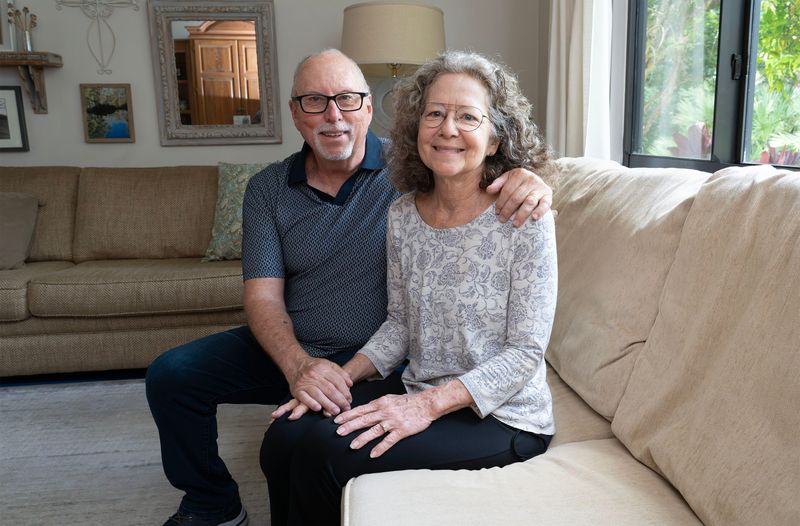
The 1,000-piece jigsaw puzzle Suzette Gregg’s piecing together in her Florida home is no mere pastime — this is part of her prescription for warding off nothing short of a deadly fate her DNA warns of.
Tests have shown Gregg, 68, carries a double copy of the gene with the highest risk that genes can indicate for developing Alzheimer’s disease, which is the most common cause of dementia, a condition expected to afflict 42% of all those currently older than 55 in their lifetime.

“I’m looking for the ones with a straight edge,” Gregg muses as she examines the puzzle pieces one by one and sorts them into piles to solve how she’s going to construct this picture of a koi pond full of flowers.
She is part of a growing number of people who are searching for some way outside conventional medicine to outrun this disease that officially doesn’t leave any survivors. In Gregg’s case, the traditional treatment for early-stage Alzheimer’s — the latest class of infusion drugs — resulted in a rare complication that hospitalized the retired Palm Beach Gardens social worker for five days. So now, she and her husband, 68, are pursuing another treatment path that insurance doesn’t cover, ready for whatever it costs.
“Her health and her well-being is priceless — that’s the word I use,” said her husband, David Gregg, a businessman who met his wife of four decades when they were both students at neighboring Palm Beach County high schools.
The disease has loomed large for the couple — Suzette Gregg’s mother developed it and died, and her father stayed with them for the last four years of his life as Alzheimer’s slowly robbed every aspect of his individuality.
How do anti-dementia drugs work and are there side effects?
Now, Suzette Gregg is grateful that she’s recovered from a potentially fatal brain bleed that they’ve come to understand was the result of anti-dementia drug infusions of LEQEMBI. The drug, approved in 2023, is one of the two drugs in the latest class of anti-dementia drugs that targets the plaques thought to be clumping on disease-afflicted brain neurons and interrupting the communication between them.
But these drugs — covered by Medicare and regarded as the leading edge of Alzheimer’s treatment — come with a warning about brain swelling and brain bleeds.
On July 11, 2025, Suzette Gregg’s habit of memorializing each day’s activities in notebooks for posterity shows exactly when that side effect hit.
“Could be my last entry if my eyes don’t get normal,” she wrote, apparently trying to stay calm about a blazing headache and dimming sight.
Nearly a year later, and months into this treatment that’s not covered by Medicare, Suzette Gregg said she’s improving. But she wouldn’t say that she’s 100% back to her old self, even if the aroma of the elderberry crumble, made of elderberries she grew in her backyard and baked one recent morning, fills her spotless home.
“I start to read and I can’t even get through two pages and I start wondering, ‘What did I read?’” she said.
How common is Alzheimer’s?
The Greggs are facing a disease which more than 7 million Americans older than 65 are living with. And, given the rate that the nation is aging, that number is expected rise to nearly 13 million by 2050, according to the Alzheimer’s Association.
Florida, with a huge growing senior population expected to surge in the next 10-20 years, is ground zero for it all.
Mainstream science doesn’t recognize a cure for it, only treatments that slow its progress.
Brain fog can be a foreshadowing of Alzheimer’s
After watching the progression of Alzheimer’s up close, the Greggs were determined to take advantage of any advances in treating the disease that hadn’t been available to their elders as soon as Suzette Gregg started to feel what she describes as a “brain fog” coming over her in late 2023.
David Gregg said his wife’s friends started coming to him and asking, “Have you noticed that she’s repeating herself, saying things that she said just a little bit ago and forgetting appointments that we made for getting together?”
David Gregg said he had, so they made an appointment with the neurologist, and from the neurologist’s office, went straight to the testing lab, which revealed her genetic disposition to the devastating disease.
The infusion drug was recommended and she began treatment.
After four treatments, though, they then discovered the treatment presented a more immediate crisis for her wellbeing. What she describes as “a migraine on steroids” coupled with the vision loss described in her journal prompted her husband to call her neurologist.
“He said, ‘Get her to the emergency room and have them give her a brain MRI, stat,’” David Gregg recalled. “And that showed severe swelling of her brain.”
What is the Bredesen Protocol and how does it help contain Alzheimer’s?
Suzette Gregg was hospitalized for five days of intensive treatment for the bleeding and swelling in her brain. There, they met with Jill Shutes, a geriatric nurse practitioner and gerontological clinical coordinator at Jupiter Medical Center, who had just become certified in what’s known as the Bredesen Protocol, that was first introduced via published paper in 2014.
For the Greggs, meeting Shutes was one of two “by the grace of God,” things that happened after the brain bleed hit.
“We are people of faith, and that has been a tremendous component in this along the way,” David Gregg said. “First of all … we were led to the secondary neurologist in the hospital, and then after that, meeting Jill Shutes, who has been a tremendous support and confidante along the way. She is the one who then introduced us to Dr. Bredesen.”
Since then, David Gregg has read all the books of Dr. Dale Bredesen, a California neurologist, whose titles include “The End of Alzheimer’s: The First Program to Prevent and Reverse Cognitive Decline” published in 2017, becoming a New York Times bestseller, and “The Ageless Brain,” published in 2025.
Shutes, last year, was certified in what’s known as the Bredesen Protocol ReCODE Training. It involved 30 different units of learning and then taking an exam. Her excitement shows in talking about the results of a small, nine-month clinical trial announced this year that documents that 84% of the participants with early-stage Alzheimer’s exhibited “significant” improvement in symptoms, notably better than those who received the standard of care.
“In about a third, (standard of care drugs) slow the progression of disease, but then the disease continues to march along because we didn’t address the root cause,” Shutes said.
That result is currently undergoing peer review.
There’s growing Alzheimer’s interest among Florida professionals
Shutes can now refer people interested in this approach to physicians who are practicing it, such as Dr. Maria Gutierrez Horn, whose practice is called Beyond Hormones in Jupiter. Horn became certified in applying Bredesen’s protocol in 2023. Learning about it a few years ago convinced her to give up her conventional endocrinology practice, even if it meant converting some of her business to a cash one, instead of billing insurance companies for a significant part of her services.
Horn said her practice is now about bringing people back to health, rather than simply addressing what’s wrong with them. She calls it “functional medicine” and it may mean taking dozens of supplements, strict exercise routines, no longer eating certain foods and playing brain games, like piecing together a complex puzzle.
“What the public should know is that, my goodness, don’t take the word that there’s nothing you can do” about Alzheimer’s, Horn said.
Not all the doctors that the Greggs have met in the pursuit of forestalling Suzette Gregg’s disease made them feel comfortable about pursuing a nontraditional path as Horn does, however.
One practice, that they’d rather not name, called to verify that the Greggs intended to keep their appointment multiple times after they made the appointment, one occurring even as they pulled into the parking lot, David Gregg recounted.
There, they were informed that signing up for treatments over a couple of weeks would cost $30,000 if they had cash and $45,000 if they wanted to finance it.
“What we perceived as a high-pressure tactic … we weren’t comfortable with it,” David Gregg said.
Also, part of the proposed treatment was transfer of plasma exchange. Medicare covers that procedure, also known as plasmapheresis or blood purification, to remove harmful substances — antibodies, toxins, or inflammatory proteins — for a handful of conditions. It’s often indicated as a last-ditch treatment for auto-immune diseases like scleroderma and lupus, when the body attacks healthy tissue. Alzheimer’s is not among those covered conditions Medicare lists and one session can cost in the neighborhood of $10,000.
After Suzette Gregg’s stay in the hospital, the description of the treatment held little appeal, David Gregg said.
What do medical experts think of alternative ways to treat Alzheimer’s?
Blood purification is not on the menu of options in the Bredesen’s approach calls for.
Bredesen’s bestselling books and prominent online presence has attracted high-profile detractors for going off the track of conventional medicine. The Alzheimer Society of Canada says Bredesen’s approach offers “false hope,” in 2023, and the Alzheimer’s Association’s chief medical officer and medical affairs lead says the association does not recommend it as an option for those looking for treatment currently.
“It should not be ‘sold’ as having proven benefit,” Maria Carrillo, wrote in an email. Carrillo, a researcher, has her doctorate in neuroscience and oversees the association’s research initiatives.
David Gregg acknowledges that the protocol has its naysayers, but believes he and his wife will carry on just the same.
“The only thing we can speak to is personal experience,” he said, referencing his wife’s brain bleed. “Fortunately, God was able to heal her from that, and then that provided the foundation for which we could build on.”
Anne Geggis is statewide reporter for the USA TODAY NETWORK FLORIDA, reporting on health and senior issues. If you have news tips, please send them to ageggis@usatodayco.com. You can get all of Florida’s best content directly in your inbox each weekday by signing up for the free newsletter, Florida TODAY, at https://palmbeachpost.com/newsletters.
This article originally appeared on Sarasota Herald-Tribune: Florida couple takes an unconventional path to outrun Alzheimer’s
Reporting by Anne Geggis, USA Today Network – Florida / Sarasota Herald-Tribune
USA TODAY Network via Reuters Connect
By Anne Geggis, USA Today Network – Florida | USA TODAY Network