Steuben County, 108 years ago, was grumpily complying with the state mandate to establish a county tuberculosis sanitarium. New York had calculated how many TB cases would be coming back from the trenches of the Great War, and they knew the facility would be needed. This would be a horror over above deaths and wounds from battle causes.
But the worst health crisis of the year was not tuberculosis, but the Spanish influenza, which concentrated in 1918, the last year of the war. It seemed to spring from nowhere, and was suddenly scything down people in thousands. Men and women who woke up feeling fine had died in agony before sundown.

It wasn’t Spanish, but with nearly every country at war, neutral Spain was about the only large western European nation without censorship. News flowed freely from Spain, while other countries tried to keep the lid on, and Spain got harnessed (unfairly) to one of the worst pandemics in human history.
World War I was a war of technological innovation, including various forms of gas warfare. When the new influenza’s death-dealing potency was recognized, many governments and militaries on both sides feared that this was biological warfare from their enemies. They restricted information.
Even once medical personnel were pretty well satisfied that this was not germ warfare, neither side wanted the other to know how weak it had suddenly become. Regiments became unable to take up arms, and ships’ companies unable to sail. Information was fiercely restricted, even on death certificates.
A century later, it’s remembered only obscurely. But the Spanish influenza rates with the Black Death of the Middle Ages, and the horrendous die-off of Native Americans exposed to new diseases from the Old World.
Spanish Flu killed as many people in four months as the Great War killed in four years. But the war loomed so huge, and so traumatically, that it overshadowed the worst health crisis of the modern age.
Perhaps, too, no one wanted to look back. Ninety percent of the War deaths were fighting men. But the Flu snatched children from their mothers’ arms, or turned beloved parents into sparse, dim memories.
The fact that people preferred remembering World War I, rather than the Flu, tells us how horrendous the Flu really was.
Right here where we are, Corning Glass Works operated a makeshift hospital for its workers. So did Ingersoll Rand, in Painted Post. Mount Morris used horse-drawn equipment to dig multiple graves. An estimated 900 or so died in the Hornell area.
In Hammondsport children were ordered to stay on their own properties, under pain of arrest. Quarantined families were kept alive by neighbors leaving food on their doorsteps. Schools and churches closed in Avoca, Bradford, Wheeler, Hammondsport, Dansville, Bath.
In a 27-week period Buffalo registered over 3,000 deaths from influenza or pneumonia (which is how Flu deaths were often recorded), and Rochester almost 1,500. Put another way, Rochester’s 1918 death rate from those two causes was four times what it had been in either ’15 or ’16, and Buffalo’s was even higher. Statewide New York was more than triple. And that does NOT include thousands of deaths either unreported or unrecorded!
I checked three issues for death notices in the weekly Steuben Advocate. These showed 25 deaths from pneumonia, 14 from influenza, and 42 unstated (many of which were probably Flu). And this was AFTER I excluded the deaths clearly from other causes. This was a terrifying time.
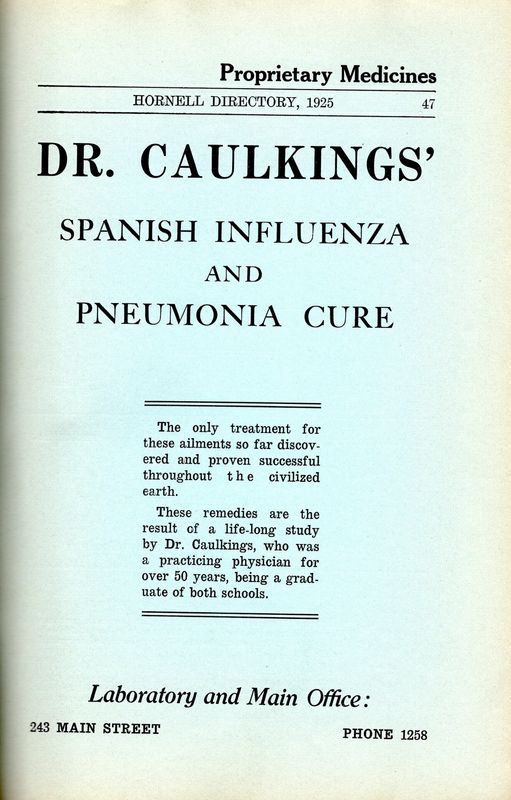
And then – it wasn’t. Sickness and death continued, but the worst of it burned out pretty quickly, perhaps because of the disease mutating – which was good news, since there was no preventive, and no treatment beyond palliating the symptoms until the caregivers fell ill themselves. The quarantines were lifted by Nov. 6, just in time for survivors to help celebrate the Armistice, five days later.
– Kirk House, of the Steuben County Historical Society, writes a column appearing in The Leader and The Spectator.
This article originally appeared on The Leader: 1918 brought multiple public health crises to Steuben County | Column
Reporting by Kirk House, Steuben County Historical Society, Special to The Leader / The Leader
USA TODAY Network via Reuters Connect
By Kirk House, Steuben County Historical Society, Special to The Leader | USA TODAY Network