With New York’s statewide opening of bass fishing on June 15, many will be on the water in boats.
But many other fishers will be angling landside, on docks, at a summer party, at a pond, or stalking the banks of rivers and streams.

Can a bass fisherman, used to fishing from a boat, transition and do it without all the necessary gear? No trolling motor, no depth finder, no rod locker, no boat?
Instead of a rod locker conveniently stuffed with rods and reels, rigged with different baits for specific applications, and tackle boxes that would give a weightlifter a hernia, we find ourselves having to scale back and down to the bare bones to fish from the shore for bass.
A good starter to downsize would be a six- to eight-inch plastic worm, always a good bet. A plastic bag can easily carry a number of colors, top choices being purple, black, blue, and motor oil green. But make sure you don’t leave various colored plastic worms in the bag very long because they may discolor each other as the colors bleed quickly on some varieties.
A good way to rig a worm to bass fish is “Texas style.” Take the hook (a sharp, long shank size 4.0 works well) and push the point down through the head of the worm, about a quarter inch, to one-half inch, and then push it out the side of the worm. Pull the hook through, so the head of the worm is covering the knot, at the hook’s eye. Then stick the sharp part of the hook through the body of the worm so that the artificial worm hangs straight. A straight hanging worm is important, more than one would think.
Two rods are better than one.
A good second choice is to tie on a white, three-eighths ounce spinner bait. I like a heavy bass rod to toss a spinner bait, usually a “medium-heavy” or “heavy,” in at least six-and one-half feet in length.
When hiking back to a pond, two rods are easy to carry, along with a little tackle box, full of an assortment of spinnerbaits, worms, extra hooks, line clippers, and extra worm hooks.
I like throwing a spinnerbait around the pond, clear water patches first. The spinnerbaits will pick up the active fish, and there are usually a few hyper hungry bass around any pond that can’t resist a spinnerbait fished just a few inches below the surface.
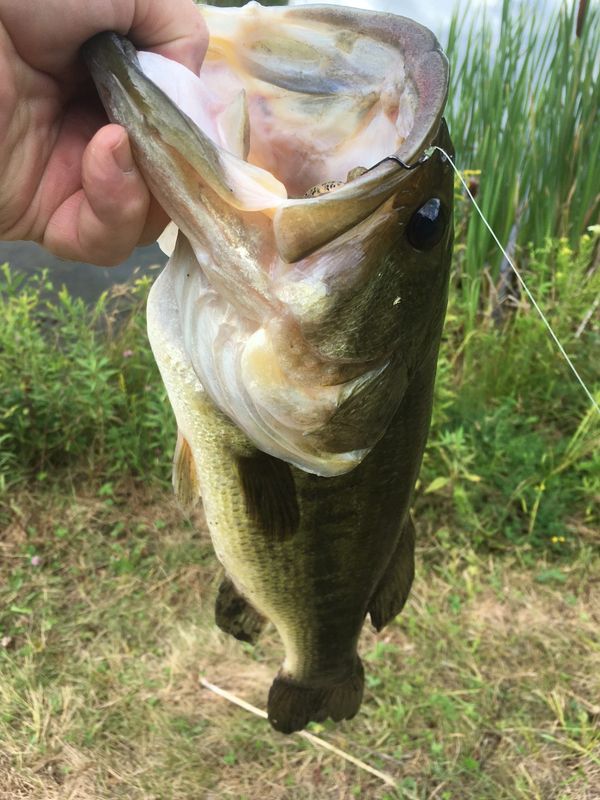
Many pond bass may not have seen a spinnerbait before and hit it without hesitation – sometimes rocketing out of a hideout next to the bank in bull rushes, or weeds, making a V-shape in shallow water as they go for the strike.
Cast the spinnerbait out into clear water, next to weeds and reel it in at a slow, steady pace so that the flashy spinners can work their magic and call up Mr. Bass.
After probing the available water with the spinnerbait, and the action cools down, pick up the worm rod with the Texas rig setup, fish slowly for the more inactive, stubborn bass. If one worm color is not working try a different color. On certain days, different colors work better than others.
Try different techniques. Most of the time, bass like a slow presentation with a worm, so cast it out, then lift it, reel a couple times, let it sink, lift it off the bottom again, crank the reel a couple more turns, lift it again, and so on.
Occasionally, bass seem to like a faster presentation, and the worm can be reeled in like a spinner. Other times, if there is surface vegetation like duckweed or lily-pads, bass may prefer to dine up on the surface. The Texas-rigged worm can be “swum” through the floating algae or duckweed and surface blowups make for an exciting time.
Speaking of topwater, a couple jitterbugs, or floating frogs are worth the extra space in the little tackle box if fish are in the mood, especially in the evening or early morning. Fish them on the spinnerbait rod. Fish the jitterbug through clear water and the frog across the floating vegetation.
Bass fishing has evolved in the last few decades on the big water, but the techniques we refined on the lakes off the deck of a bass boat can be successfully applied back in the woods, or off a dock too.
And one tip: It doesn’t cost any more money to set the hook on a pond than it does a lake. So set the hook when Mr. Bass runs with your worm like you mean it.
Catching bass is always fun, no matter where it is, even if you are standing on a dock, back in the woods next to a campsite, or off a boat.
— Oak Duke writes a biweekly Outdoors column.
This article originally appeared on The Evening Tribune: Follow these tips when bass fishing from the shore | Column
Reporting by Oak Duke, Outdoors Columnist / The Evening Tribune
USA TODAY Network via Reuters Connect
By Oak Duke, Outdoors Columnist | USA TODAY Network