The organization behind the report showing racial disparities in the stops made by Cincinnati police officers is set to launch a public website where the data will be available.

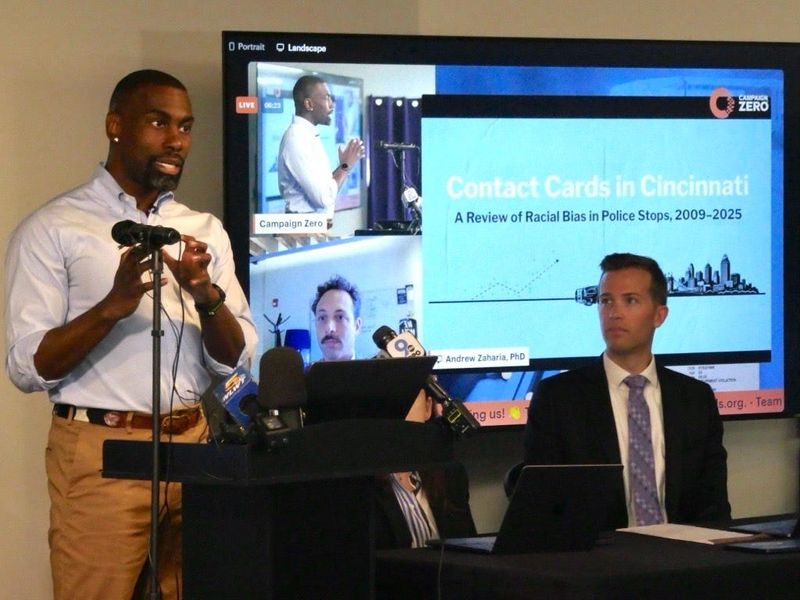
Representatives from Campaign Zero, a nonprofit focused on police accountability, held a press conference June 15 walking through the report that analyzed stops of about 472,000 people from 2009 to 2025 recorded by police on contact cards. These are forms filled out when an officer initiates a stop of a driver or a pedestrian.
The website, contactcards.org, includes maps to explore the number and racial makeup of stops down to the block level. Viewers can also search officers by name and see a dashboard about the racial makeup of the stops each officer has made.
The report, released June 11, finds that citywide Black people are stopped about three times as much as White people. The data shows the disparity between Black and White stops was nearly gone in 2012, but has rapidly expanded since the pandemic.
Once a stop happens, the researchers found that Black people are twice as likely to be searched than White people, nearly twice as likely to be arrested and about twice as likely to have force used against them.
DeRay Mckesson, the executive director of Campaign Zero, said the report separates the fact there are disparities from the reasons why they might be occuring. Once the researchers identified the disparities in the data, they looked at some explanations for the disparities.
Mckesson said crime rates, calls for service and poverty do not explain these disparities. The statistics do show that the racial makeup of the neighborhood where the stop has happened is a big predictor.
“The Whiter the neighborhood in Cincinnati, the higher the disparity is,” Mckesson said.
Mckesson also called out city officials for criticizing the report prior to its release. City Manager Sheryl Long said Campaign Zero did not work with the city during the development of the report.
McKesson said his organization reached out to the city on June 2, offering to meet later that week, but the city declined to meet. He said the report was sent to the city on June 4 and a meeting did occur on June 8.
He said interim Police Chief Adam Hennie, who called the report’s methodology “flawed,” was silent during that meeting. He said other city officials provided feedback, which was integrated into the report.
The city provided beat information of all officers to Campaign Zero. This allowed researchers to better compare the racial makeup of an officer’s stops to the population they are patrolling. This information is reflected on the website.
The researchers also added in highway stops, weighted in information about poverty, 911 call information and looked at daytime population verses residential population. The disparities still exist and in some cases are higher.
Campaign Zero had agreed to delay the release of the report to continue the analysis city officials had requested, but then found that news of the report had leaked on June 11 and decided to make it public.
Mckesson said he stands by the methodology of the report, and said the analysis is continuing. For instance, Cincinnati police also have a number of task force officers, who do not work on specific beats. Mckesson said an analysis of these officers’ stops will be released next week.
City Manager Long has convened a problem-solving group to look at the data, and will ask an independent expert to analyze the data as well.
This article originally appeared on Cincinnati Enquirer: Campaign Zero website to track Cincinnati police stops by race, area
Reporting by Cameron Knight, Cincinnati Enquirer / Cincinnati Enquirer
USA TODAY Network via Reuters Connect
By Cameron Knight, Cincinnati Enquirer | USA TODAY Network