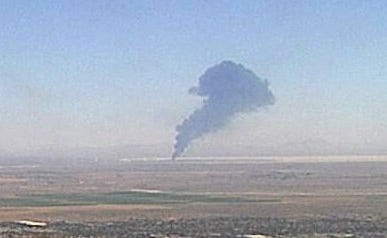
Eight people are believed to be dead after a U.S. Air Force B-52 Stratofortress bomber crashed at Edwards Air Force Base in Southern California on Monday, June 15, according to officials.
U.S. Air Force Col. James Hayes, a base deputy commander, said at a news conference later in the day that the crash was “deemed to be unsurvivable.”

“Today, Edwards Air Force Base experienced a horrible tragedy and we lost eight great Americans,” he said. “Our thought and prayers go out to the family members. This is a tragedy, and this is going to be the worst days of their lives. We understand that.”
The bomber, on a routine test mission, crashed after taking off around 11:20 a.m. Monday morning, according to Air Force officials. The aircraft contained both military members and civilian contractors, officials said. The identities of the victims were not released.
The military base is located just northeast of Lancaster and just east of Mojave in the Southern California desert.
“A United States Air Force B-52 Stratofortress crashed shortly after takeoff on the Edwards airfield,” according to a statement from Edwards AFB.
“Initial indications are that the crash was not survivable,” the Air Force announced in an afternoon update. “Emergency response personnel are on scene, and officials are working to account for all personnel.”
Congressman Vince Fong, who represents California District 20 where the Air Force base is located, took to social media to share the news.
“Please join me in praying for the B-52 crew at Edwards Air Force Base and the entire Edwards community,” Fong said in an X post.
Authorities shut down the airfield and diverted all incoming aircraft as the investigation situation continued to develop on Monday afternoon.
“Additionally, all non-commercial visitor passes have been suspended until further notice to allow the installation to focus entirely on emergency response operations,” base officials stated.”
What is the B‑52 Bomber that crashed at Edwards Airforce Base in California?
The Boeing B-52 Stratofortress, first brought into service in 1955, is a long-range heavy bomber employed in a wide variety of missions, according to the Air Force.
The subsonic aircraft can reach altitudes of up to 50,000 feet.
“It can carry nuclear or precision guided conventional ordnance with worldwide precision navigation capability,” according to an Air Force fact sheet. “In a conventional conflict, the B-52 can perform strategic attack, close-air support, air interdiction, offensive counter-air and maritime operations.”
Where is Edwards Air Force Base?
The base, spread across parts of Kern, Los Angeles and San Bernadino counties, is located about 100 miles north of Los Angeles.
Many of mankind’s historic achievements in aviation have taken place over a dry lake bed in the Mojave Desert known as Edwards Air Force Base, and continue to this day.
Edwards Air Force Base was established in 1942 at what was then known as the Muroc Dry Lake and has since steadily grown to more than 300,000 acres in size, or 470 square miles, retired Air Force Lt. Col. and 412th Test Wing spokesman Mike Paoli said.
The base functions as a town with more than 11,000 residents, consisting of roughly 20% military personnel and 80% civilians, he said.
According to military archives reviewed by USA TODAY, the last crash at the base took place on May 18, 1992 when a twin-engine Mitsubishi MU-2 Marquise crashed during landing, killing two crew members on board. Seven passengers also suffered serious injuries.
The aircraft was completing a liaison from China Lake, an unincorporated community in Kern County, for the U.S. Navy when on final approach it hit the ground.
History of other B-52 bomber crashes
Since it was first brought into service in 1955, the bomber has crashed 119 times, including Monday’s crash, according to the Aviation Safety Network.
The site is part of the Flight Safety Foundation, a nonprofit that focuses on aviation and aerospace safety.
The last crash happened at Minot Air Force Base in North Dakota on Feb. 23, 2024, according to the site.
This story has been updated to add new information.
Ernesto Centeno Araujo covers breaking news for the Ventura County Star. He can be reached at ecentenoaraujo@vcstar.com, 805-437-0224 or @ecentenoaraujo on Instagram and X.
This article originally appeared on Ventura County Star: 8 suspected dead after B-52 bomber crashes near SoCal Air Force base
Reporting by Ernesto Centeno Araujo, Brian Day, Natalie Neysa Alund and Michael Loria, USA TODAY / Ventura County Star
USA TODAY Network via Reuters Connect
By Ernesto Centeno Araujo, Brian Day, Natalie Neysa Alund and Michael Loria, USA TODAY | USA TODAY Network