Why would an embattled landlord facing one of the city’s largest nuisance orders in recent memory show up to a meeting about cracking down on nuisance properties?
In the case of David Tomblin, it wasn’t to shed new light on his efforts to fix up his properties.

In interview with the Milwaukee Journal Sentinel ahead of the meeting, Tomblin said he was there to show face at a public meeting, but declined to comment on any current legal action against him involving his Milwaukee rental empire.
The city’s steering and rules committee was meeting to discuss how the city targets nuisance properties and owners and how the Milwaukee Police Department can improve its systems for tracking calls for service that could be used as evidence for nuisance orders.
Tomblin is facing multiple lawsuits in Milwaukee and California regarding his business practices , including a U.S. Bank lawsuit filed in January against one of Tomblin’s multiple LLCs owning properties in Milwaukee. Tomblin owes roughly $355,000 in tax debt to the City of Milwaukee.
In March, the City Attorney’s Office filed legal action declaring Highgrove Holdings Management LLC and Tomblin’s complex network of business entities after investigations into widespread property neglect, code violations, unpaid property taxes, and safety and security concerns.
Highgrove has overseen an estimated 260 properties, most of which have been left vacant and dilapidated as far back as 2020.
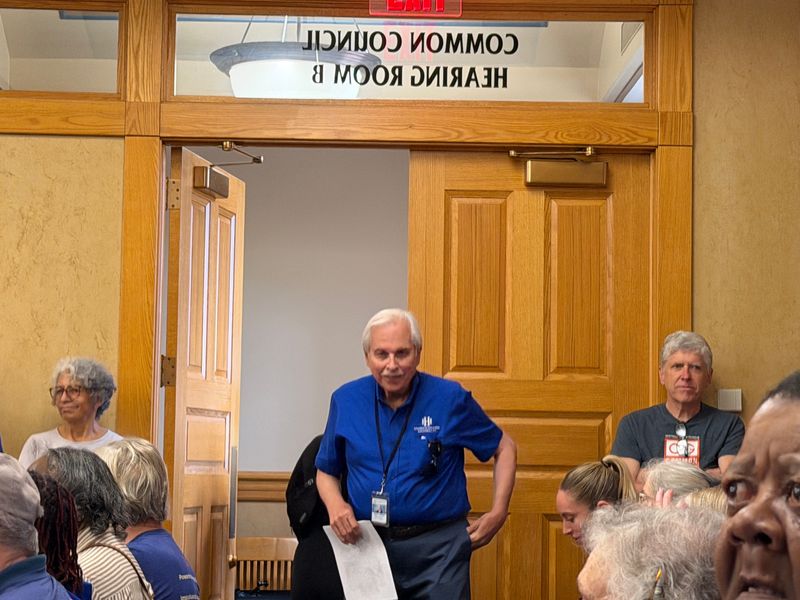
His appearance at City Hall ended in a fiery hallway exchange with the senior associate organizer of Common Ground, a grassroots organization that focuses on housing and health care rights. Common Ground worked closely with the City Attorney’s Office in the lead up to its legal action.
When asked whether Common Ground’s Kevin Solomon and Tomblin have met in-person before, the two said “no.”
“It’s unfortunate. You know, we tried,” Tomblin said. “We’re not here to create a problem.”
When grilled over why he was present at a meeting about nuisance properties given the pending litigation, Tomblin argued that he was addressing the issues with his properties, but declined to comment further.
Additionally, when questioned about the timeline to fix the issues flagged by tenants at his properties, Tomblin said he had already addressed them. Solomon was quick to dispute his claim, and Tomblin dodged requests to prove he had resolved issues, including a ceiling that had collapsed on a tenant.
Solomon said Common Ground had extended an invitation to Tomblin over a year ago but did not receive a response. Tomblin said that wasn’t true.
Tomblin argued that 85% of his tenants were happy with Highgrove Holdings without bribing or making deals, according to a forthcoming survey conducted by Tomblin’s company. Solomon quickly interjected, saying the interviews were carried out under duress by a paid staff member, a response that resulted in explosive back-and-forth shouting between Solomon and Tomblin.
When asked again why he was present, Tomblin said there was no reason.
“This a confrontation,” Tomblin said before walking away from Solomon and members of media.
Of Tomblin’s presence and lack of answers to questions about his properties, Solomon said:
“It’s political, and it says that our pressure is clearly getting under his skin. The lawsuit will play out. Common Ground will stay on it,” Solomon said.
Despite the heated encounter, Solomon said the city’s steering and rules committee meeting was a “big victory” for Common Ground.
“In the meantime, today we just helped push Milwaukee Police Department and the Common Council to reform the way that crime is handled in this city proactively not reactively,” he said.
During the meeting, Milwaukee Police Department Chief Jeffrey Norman and his staff explained the complex process of how property nuisance enforcement is carried out by his department, and that not all problem properties end up with a nuisance order from the city.
Under city ordinance, a property is qualified as a nuisance when there are at least three phone calls for service in a 30-day period or two complaints of vice, violence, or gang activity, including harassment, drug activity or littering, in a year. Calls related to domestic violence or mental health are not eligible. All calls must be substantiated by police for a property to be named a nuisance, triggering fines for the owner.
Norman vowed to council members, including Common Council President José G. Pérez, that his department was committed to improving it tracks nuisance properties after members of Common Ground spoke to the committee about their five-step safety plan for Milwaukee’s south side that focuses on holding problematic landlords to account.
Vanessa Swales covers Milwaukee local government and incarceration for the Journal Sentinel’s Politics team. Contact: vswales@usatodayco.com.
This article originally appeared on Milwaukee Journal Sentinel: Embattled landlord’s presence at city meeting leads to confrontation
Reporting by Vanessa Swales, Milwaukee Journal Sentinel / Milwaukee Journal Sentinel
USA TODAY Network via Reuters Connect
By Vanessa Swales, Milwaukee Journal Sentinel | USA TODAY Network