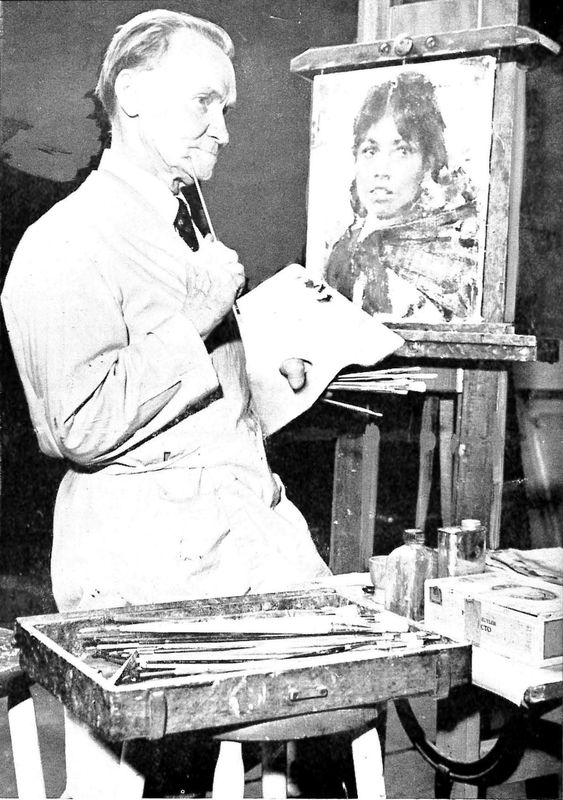
One painting depicted eggs in a skillet. The unusual picture was by Nicolai Fechin and displayed at the Grand Central Galleries. Fechin’s acclaim in artistic circles had preceded his arrival in New York in 1923 after escaping Bolshevik Russia and unspeakable privation. The humble egg canvas of breakfast represented much from whence Fechin came and impressed two particular and prominent viewers.
One was Clyde Forsythe, the painter and cartoonist of popular strips “Joe Jink,” “Dynamite Dunn,” and “Way Out West.” He was sojourning in the East and caught the gallery’s show. The other awestruck viewer was John Burnham, art collector, painter and son of the famous architect Daniel Burnham, the designer of the Chicago World’s Fair, the Columbian Exposition of 1893, and the ingenious Flatiron building in Manhattan among many other now iconic buildings.

“Burnham obtained Fechin’s address from the Grand Central Galleries and went to call on him in the modest flat where the Fechins were attempting to get settled in the strange new country to which they had fled. Despite the language barrier, Burnham and Fechin became friends at once” reported Ed Ainsworth of the Los Angeles Times. Burnham thought Fechin had no equal yet living and immediately commissioned a portrait of his mother. “Burnham whisked him onto a fast train for Chicago.”
“The friendship caused Fechin a little later to go West and to fall in love with the vast bright country in which he was to paint so many masterpieces in the years to come.”
Forsythe likewise was able to make invaluable contacts in the West for Fechin who would travel to Taos, and through the Rio Grande, to Mexico and to the South Seas in search of the light and the exotic faces he could render in portraits.
“Onto his canvases he transplanted all the people and scenes that stirred his imagination so mightily. The immensity of the distances filled him with a new consciousness of the sublimity of Nature. His love for music seemed to find response in the bast silent symphonies of the rolling mountains, and he reacted as if to a hymn amid the concertos of watercourses in purple arroyos.”
“When he was not painting, he was contemplating … during this period, he suffered grievously from personal troubles. Later, driven by them, he sought surcease of spirit by travels in Mexico and in the South Seas where he painted avidly the extraordinary faces of natives on far-flung islands, and tarried for a time amid the flamboyant colorings of Bali.”
“Always, though, the desert beckoned him. It was the balm for the inner turmoils that marked his life.”
In Southern California, Burnham enjoyed homes in Pasadena and Palm Springs and Fechin would visit him in both places. Ainsworth notes, “Around Palm Springs, in the mountains above San Bernardino and Redlands, and on the Mojave Desert the freshness and quiet of Early California still prevailed. Burnham, himself an ardent painter, took Fechin camping in these remote realms where an almost primeval simplicity spread its enchantment.”
“Often, they would paint all day without saying a word, both feeling somehow in tune with the message of the earth and of nature radiating from billowing sand, fragrant safe, giant boulders, sun-drenched vistas, colored hills. At noon they would gravitate to their campsite for a simple meal. Once again during the long, brilliant afternoons they would place on canvas the illuminations of their inner spirits gained from gazing upon the infinite wonders spread before them.”
“At night, sometimes, while the desert stars reached low and large as if to peer with friendly comradeship into the affairs of humans, they would talk of the prismatic colors they had seen that day, of the wanderings of mankind in the desert places, of the unceasing search of the human heart for a reason in life, of the days when Fechin had dwelt in a different land amid terror and despair.”
When not camping though, Fechin and Burnham were often found perched on the San Jacinto mountainside. “One long interlude of enjoyment and accomplishment was spent in early-day Palm Springs on a ‘Street in Spain’ as they called a little lane leading up to the rocky slope behind Nellie Coffman’s Desert Inn toward the home of John Burnham on the escarpment of Mt. San Jacinto. Here, with two or three other painters and Burnham, Fechin learned even more fully the spirit of the desert. Occasionally he joined the artist group that went to down to painter John Hilton’s house at Thermal for session of talk and guitar music, or companionable painting forays into the Mecca Hills or Box Canyon.”
Quite a sensation was caused in the press once while visiting Palm Springs. He was scheduled to show at the famous Stendahl Galleries in Los Angeles. However, the paintings for the show were inexplicably still in Palm Springs requiring drastic action to avoid further delay. “Mr. Stendahl got an airplane, loaded up the paintings, flew to Los Angeles with his precious cargo and caused a furor because it was the most valuable cargo of art ever carried in a plane up to that time!”
Ainsworth, without the slightest hint of insincerity, praised the painter, “Straight from the Renaissance might Nicholai Fechin have come to flash his incomparable crimsons and blues and greens and turquoises upon the startled gaze of his fellow human. His technique certainly ranks, in form and artistry, with the creations of Leonardo da Vinci.”
His renown in the art world was practically unparalleled, “naturally, even the most promising and established American Artists sought to become his pupils. One of these, Dean Cornwell, the muralist who numbers the great murals in the Los Angeles Public Library among his accomplishments, says of the teaching of Fechin: ‘I think I can say my beginning to learn to draw started when Fechin, in criticizing a still life, said to me, ‘You have drawn AN apple, not THE apple.’”
“The second greatest thing he taught me was to explain how a thing or a human figure works. He would say to me ‘exaggerate the principle.’ In other words, go beyond how it looks.”
Fechin “went beyond” in portraits, figures, and landscapes. Ainsworth attributes his insightful style as emanating from the desert, “always the desert, the inscrutable desert … It can never fail to be associated with Fechin. He matched it in silence and simplicity and honesty. From it he drew strength … He saw in it the answer to sorrow. From his own dark and gloomy past in the forest of the Volga he emerged, spiritually into the sunshine of a better life in the American desert. There he found its soul and his own.”
Tracy Conrad is president of the Palm Springs Historical Society. The Thanks for the Memories column appears Sundays in The Desert Sun. Write to her at pshstracy@gmail.com.
This article originally appeared on Palm Springs Desert Sun: Artist Nicolai Fechin ‘found its soul and his own’ in California desert
Reporting by Tracy Conrad, Special to The Desert Sun / Palm Springs Desert Sun
USA TODAY Network via Reuters Connect
By Tracy Conrad, Special to The Desert Sun | USA TODAY Network