Unless you’ve been living on the moon, you’re likely aware that this coming July 4th will mark the 250th birthday of the United States of America. And while that’s somewhat of an arbitrary date, it’s as good as any and at least will justify all the beer, hotdogs, baseball and heartburn that will likely result. We will be seeing a lot of American flags fluttering over the next month, too, and the more the merrier.
Despite the issues we face today, the Stars and Stripes remains a symbol of unity, strength and greatness. Let’s explore its history.

Even as many of us still hold true that Betsy Ross designed the first American flag with its 13 stars and stripes, its actual origins are less clear. The first version was introduced in 1775 and is now known as the Continental flag with a Union Jack in lieu of stars. The stars weren’t introduced until two years later. Thereafter, it went through a number of iterations with nearly every element having a particular meaning.
The 13 stripes and like number of stars represented the original 13 colonies, and the collection of stars with its deep blue background was imagined as a celestial galaxy that could be expanded. Insofar as the flag was initially used an identifier aboard ships and land-based military installations, the use of high-contrast primary colors also aided in visibility.
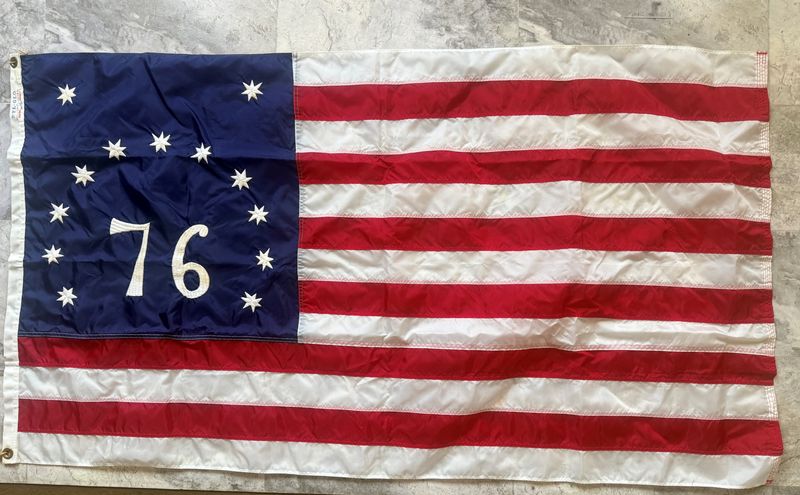
Once the basic form was settled, there were a few 18th century variants but not many. The configuration of stars sometime changed, and occasionally a flag appeared with blue stripes added to the red and white. In 1795, two stars were added to recognize the statehood bestowed upon Kentucky and Vermont, and it was that flag that prompted Francis Scott Key to write “The Star-Spangled Banner.” Thereafter, the American flag remained distinctly identifiable, and by the time of the Civil War it was widely recognized as a symbol of the American union. That war tested its mettle, but in 1865 Old Glory emerged bloody but unbowed as symbol of a reunited country.
Since that first flag, there have been 27 different versions of the Stars and Stripes, most having to do with the addition of stars as new states joined the union. The star pattern has varied widely, from linear rows to circular patterns to stars made from stars. A few appeared only briefly as the admission of new states quickly followed one after the other, and others have been around for some time.
Today’s 50-star flag was adopted on July 4, 1960, to honor the admission of Hawaii as the country’s 50th state. Next month’s Independence Day will mark its 66th year in service, making it the longest tenured flag in U.S. history.
In second place is the 48-star flag, which flew from 1912 to 1960, itself with an impressive 48-year run.
So, there you are. If there was ever a time to show your colors and fly the American flag, this coming month is the time.
There will be countless events and celebrations all over the country, undoubtedly prompting over-indulgences of all kinds.
Just like most of us individuals, the US of A has survived some hard times, including the Civil War, McCarthy era, Vietnam and today’s contentious environment, to name just a few. Still, there’s no reason to think the 300th anniversary of the U.S. is anything but certain. We still have a way to go.
Mike Rivkin and his wife, Linda, are long-time residents of Rancho Mirage. For many years, he was an award-winning catalogue publisher and has authored seven books, along with countless articles. Now, he’s the owner of Antique Galleries of Palm Springs. His antiques column appears Sundays in The Desert Sun. Want to send Mike a question about antiques? Drop him a line at silverfishpress@gmail.com.
This article originally appeared on Palm Springs Desert Sun: July 4 is coming. How much do you know about Old Glory?
Reporting by Mike Rivkin, Special to The Desert Sun / Palm Springs Desert Sun
USA TODAY Network via Reuters Connect
By Mike Rivkin, Special to The Desert Sun | USA TODAY Network