In the four months after winning two golds and a silver medal at the Milan Winter Olympic Games, 22-year-old speed skater Jordan Stolz has been on a whirlwind tour of promotional events and public speaking appearances.
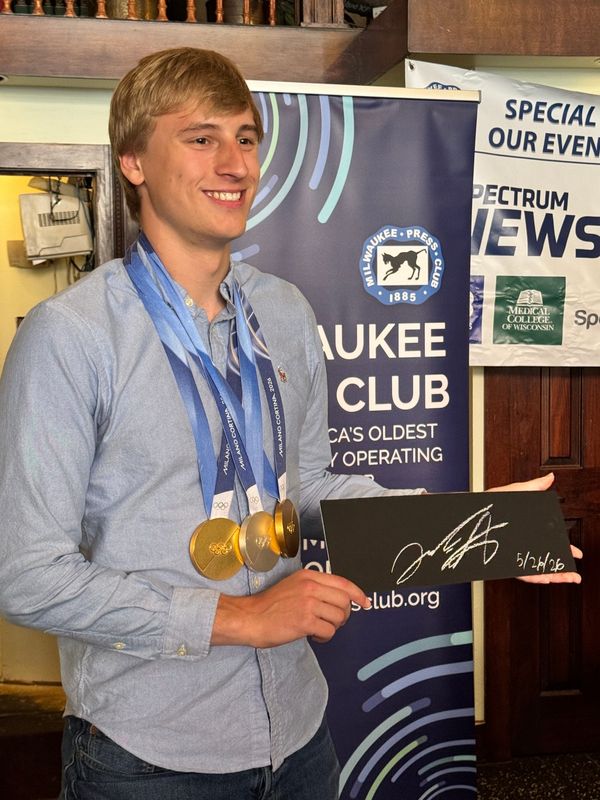
He most recently spoke at a Milwaukee Press Club luncheon at the Press Room in Milwaukee on May 26 where he once again declared his intentions to compete in the 2030 Winter Olympic Games.

He also shared Olympic behind-the-scenes stories – some known, some new – from Italy.
Stolz has been generous in sharing his medals with everyone he meets, allowing fans to hold the heavy items. It’s a thrill for many fans, who say it’s the first time they’ve ever touched an Olympic medal.
Here are the highlights of that May 26 luncheon:
Q: Let’s talk about the 1,000 meters, your first race in Milan. It is your calling card, your signature race. You got the world record in Salt Lake City in the 1,000 two years ago at age 19. You are known for being unflappable, very cool, composed on your starts, but later on, after everything ended, you confessed that you were a little bit nervous.
Stolz: I found more pressure because I’d been winning every single 1,000 that World Cup season, and for three years, and now it’s the final one that actually is most important, and if I don’t win this one, it’s going to be pretty bad. The one that actually mattered. And then that would give Jenning de Boo, who was my biggest competitor, a chance at winning two golds.
After the last three years of winning almost every single 1,000 meter, I kind of felt pressure in that way. It was something that I had to do.
Q: OK, let’s introduce your competitor. Jenning de Boo, who is also 22 years old. He’s a Dutch speed skater, and I think that’s about all you have in common. I wonder if the Dutch kind of like to mess with you a little bit with their warm-up routines during the Olympics. You had a little thing in 2022, too, with Kjeld Nuis.
Stolz: I’m not sure what it is, but every time I’m in the warm-up room, like, on the bikes, all of a sudden, these orange people just kind of start surrounding me – they wear orange. And they do this weird spider walk thing on the ground. I don’t’ know if it’s supposed to look intimidating, but they’re like going around in a circle. And it looks like ants.
Q: OK, so you secure the gold medal in the 1,000 and that was Feb. 11th. You got your rest and recovery, but not much. On Feb. 14th, now you’re doing the 500. The 500 is wild. Hair on fire, fans love it. There’s really no room for error. I think you started with an opener of 9.55, which for you, that’s what you want. How did the rest of the race go after that?
Stolz: I think it was a perfect race. There’s not much more I could have done better. And I kind of knew it would have to be that way in order to be able to win. It was the same for de Boo, too. He didn’t skate a perfect race. It was basically going to come down to whoever skated a more technical race, because we’re both pretty strong, and I think in the end, I just gave it a bit better of a race, or we both had our best, and mine was a little bit better.
And honestly, I felt less pressure for that one just because it’s not something you can really have time to think about. You just have to go out there and do it and not really have any doubt or anything or else you’re just not going to win. So it’s one of those races where you can’t really overthink.
Q: The thing that’s really unique is that you race several distances. Your main competition for the first two races were sprinters, people who specialize in sprinting. The next Olympic race that you did was the 1,500 – a middle distance race. And Zhongyan Ning, from China is a new top competitor. Nice guy. You like him. He is 26 years old. That was a tough race. You’re entering your second or third full week in Milan, you got the silver, which is incredible; but how did that race unfold from your perspective?
Stolz: I felt like I was prepping the correct way for that race, but something in the race just didn’t feel right, and my legs didn’t feel there. Maybe it was something to do with winning the previous two races and then having five days in between. Usually we have a weekend of a 1,000 meter, 500 meter, then the 1,500 meter in three days. Now I have five days in between, so it’s different from my normal routine. So I’m not exactly sure what went wrong in there, but I thought I was feeling good going into the race.
And then Ning skates this ridiculous time that I didn’t think he was capable of doing, and now I have to go out there and try and do that time, on a day where I’m not really feeling at my best.
Q: That’s a good point, too. In the previous two sprint races, you were paired with de Boo. In the 1,500, you were not in the same pair with Ning. You guys had a warm embrace afterwards, and he was very humble in his postgame comments. He skated the race of his life. Did he say anything to you?
Stolz: I think he said, ‘Thank you for letting me win, or something like that.’
Q: I mean, who does that? Now, why do you think you said that? What’s the meaning behind that?
Stolz: Well, he had been telling me all season he was hoping to win a silver medal at the Olympics.
Q: And it probably wasn’t gamesmanship. He probably genuinely meant that.
Stolz: No, he doesn’t really play games at all. He would just tell me straight up. So he almost, in a way, kind of apologized for taking gold. I think he knew that I was the 1,500 favorite, and probably would have won, but somehow he did, so, yeah. He was apologizing for that, I guess.
Q: What was Olympic Village-life like? So many other athletes have their events and then get to be a tourist and have fun, but you had four races, unlike any other skater; you’re working constantly.
Stolz: It got mentally exhausting; not because of the four races and the amount of time, but the village is different. It’s kind of like, you have the cafeteria, then I have my own room. It’s kind of smaller than probably what everybody would think. It’s just a really small room with a single bed. That’s kind of what I was living in, with no table or anything, just my stuff scattered across the floor.
So that’s how I was living for, like, three weeks. And the bus ride to the rink was 40 minutes there and back, so that eats up most of the day, and then you got to wait, you know, 30 minutes for the bus to actually arrive. And I have to do this for three weeks that I’m staying there because I’m racing the entire span. So that kind of gets exhausting.
Q: People think ice is ice, ice is cold. But actually, the conditions in Italy were very tropical. It was, like, 60 degrees and humid. And that’s not the greatest for you to race. And even though everybody has the same conditions, the ice was so important. You knew the ice guy, Paul Golomsky, from the Pettit. Can you tell me how we need to appreciate the job that Paul did?
Stolz: Well, they have to work on that ice 16 hours a day. It doesn’t just sit there. I mean, if it gets frosty, that’s going to be slower; different ice temperatures make a huge difference. If it’s soft ice, your blade sinks in more, it creates drag. So it has to be a perfect temperature.
I would use a gauge, like a laser or temperature meter. And I would go out there and check the ice pretty much daily or I’d ask Paul from the Pettit. He made a huge difference, just giving me confidence. I mean, I could go directly to the source and ask, you know, what’s going on? So that made a huge difference.
Q: Are you are you committed to the 2030 Olympics?
Stolz: Oh, yeah. I think I’ll target the same events. Maybe not the mass start, just because it’s a little bit annoying, but, my usual 500, 1,000, 1,500 meter.
Q: You’re only 22, and you’ve accomplished so much already. Do you ever think about what’s after skating?
Stolz: No, I haven’t thought that far down the road yet. I still have four more years to go, so maybe eight more years, if I do Salt Lake City. But maybe a coaching job – possibly. I think it would be fun to have a team and try to make skaters better.
This article originally appeared on Milwaukee Journal Sentinel: Jordan Stolz shares stories from 2026 Milan Winter Olympics | Lori Nickel
Reporting by Lori Nickel, Milwaukee Journal Sentinel / Milwaukee Journal Sentinel
USA TODAY Network via Reuters Connect
By Lori Nickel, Milwaukee Journal Sentinel | USA TODAY Network