One of the most enticing primary election nights in years for political viewers in Iowa delivered drama up and down the ballot.
Perhaps the race that gained the most attention as results poured in on election night was the Republican primary for governor, as Zach Lahn upset the favored Rep. Randy Feenstra by a narrow margin to set up a November showdown with Democratic state auditor Rob Sand.

But the headlines from Election Day didn’t stop there. Both parties had contested primaries for several seats in U.S. Congress, while on the local level, multiple primaries for seats on the Polk and Dallas boards of supervisors ended up with razor-thin margins.
Here’s what else stood out from a first look at the data from Election Day.
(Note: All results from this year’s primary election will remain unofficial until certified by county auditors.)
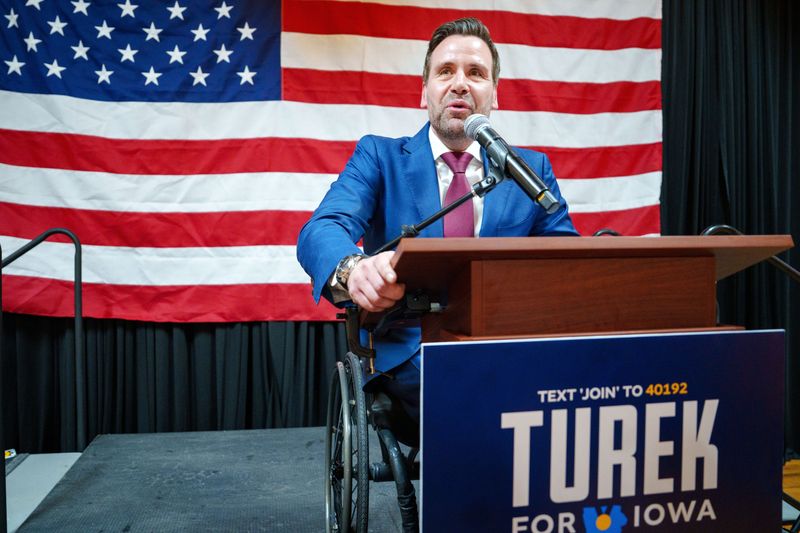
Turek’s home-court advantage fuels win over Wahls
With Sand running unopposed for the Democratic nomination for governor, the top contest on the Democratic ballot was a two-man race for the U.S. Senate nomination between State Sen. Zach Wahls of Coralville and State Rep. Josh Turek of Council Bluffs — in a way, eastern Iowa vs. western Iowa.
Both candidates won their home counties by about 3,500 votes. But go from east to west on the results map, and you’ll see the vote tilt more and more toward Turek.
Wahls kept the vote somewhat close in parts of central and eastern Iowa, but Turek racked up blowout margins in western Iowa that ultimately made for a comfortable victory.
Turek will face current U.S. Rep. Ashley Hinson, who cruised to an even larger margin of victory in the Republican primary for U.S. Senate.
Round three between Miller-Meeks, Bohannan
Democrat Christina Bohannan is seeking to unseat current U.S. Rep. Mariannette Miller-Meeks, a Republican, in Iowa’s 1st Congressional District for the third consecutive election cycle. Both candidates earned victories of more than 40 points over their primary opponents.
Will the third time go any different for Bohannan? Democrats doesn’t need much to shift in her direction to flip the seat: Bohannan lost the same matchup in 2024 by about 800 votes.
The surrounding context of the race will be different as well: November’s election will be a midterm under a Republican president.
In 2024, it was a presidential election, while 2022, in which Miller-Meeks won by about 21,000 votes, was a midterm under a Democratic president.
Both candidates have reasons for optimism coming out of this year’s primaries.
For Miller-Meeks, the 2026 primary was also a rematch of the 2024 primary, as she again faced off against David Pautsch. The race was much closer in 2024, when Miller-Meeks won by about 3,500 votes.
This time, she won by more than 11,000 — even though Pautsch earned more votes than two years ago.
Bohannan was facing her first primary challenge in this race after running unopposed for the Democratic nomination in 2022 and 2024.
Despite the opposition, Bohannan earned more votes than she had in either previous primary.
Turnout up for both parties
The simplest explanation for the boost in vote totals: increased turnout.
With competitive races at or near the top of the ballot for both parties, voters showed up. The unofficial count given for turnout in this year’s primaries was 411,525.
That number hasn’t yet been separated into parties, but results from the gubernatorial primary show no fewer than 212,324 Republicans voted.
Because the Democratic primary for governor was uncontested, more votes were cast in the party’s race for the U.S. Senate nomination. That total shows no fewer than 192,020 Democrats voted in the primaries.
Both totals represent the highest primary turnouts for their respective parties since 2020.
It’s also the closest the primary turnout has been between the two parties since 2016. That appears to be a good sign for Democrats, who lagged behind Republicans in voter registration by nearly 200,000 voters as of June 1.
Either way, it suggests the drama from primary night could be repeated in the general election come November.
Tight Des Moines-area races for Iowa Legislature …
The drama wasn’t limited to the top of the ticket on primary night.
Further down the ballot, three incumbents in the State House lost primary challenges, included a lopsided defeat for four-term Rep. Brian Lohse to Austin Stubbs in the Republican primary for House District 45.
Closer to downtown, two races on the Democratic side of the ballot revealed interesting political geography.
A four-person race unfolded in House District 33, which extends from the East Village north to the Highland Park neighborhood and east toward the state fairgrounds.
The East Village precinct voted for Cody Smith, but thanks to strong support north of I-235, including around Highland Park, Ivette Muhammad won the Democratic nomination.
The same district makes up half of Senate District 17, while the other half includes the area directly north of downtown, extending west to the Drake neighborhood.
In this race, the East Village was more aligned with the rest of the surrounding area in narrowly voting for Grace Van Cleave. But the western half of the district put Samy El-Baroudi ahead in a race decided by about 300 votes.
… and Boards of Supervisors
The tight margins in those metro legislature races were nothing compared with the margins in some of the Des Moines-area county Board of Supervisors primaries.
In Polk County, Des Moines City Council member Joe Gatto lost in an upset to Heather Jones-Brown in the Democratic primary for the county’s 4th District seat.
Gatto has represented the city’s south side for 14 years, and precinct-level results from the race show a clear delineation between the south and east sides of Des Moines, while votes from the city’s eastern suburbs were mixed.
Unofficial results showed Jones-Brown leading by 42 votes, one of the tightest results of election night.
One county to the west, Republicans had their own close Board of Supervisors race.
Dallas County recently expanded its board by two seats to five, all of whom represent the district in which they live but are elected at-large by all voters in the county.
In District 5, Dave Roszak edged out Oliver Bardwell for the Republican nomination by 86 votes, or just over one percentage point.
The precinct-level results could offer an early preview of where lines may be drawn in November’s election. Roszak won handily in West Des Moines and Urbandale precincts; Bardwell was more successful in Waukee and adjacent townships.
Tim Webber is a data visualization specialist for the Register. Reach him at twebber@registermedia.com and on Twitter at @HelloTimWebber.
This article originally appeared on Des Moines Register: 5 key voting takeaways that explain Iowa’s fascinating primary results
Reporting by Tim Webber, Des Moines Register / Des Moines Register
USA TODAY Network via Reuters Connect
By Tim Webber, Des Moines Register | USA TODAY Network