When the Beamans bottomed out: Third in a series
MENLO ― The long haul began in January 2025 when, early each weekday, Todd and Bonnie Beaman drove two of their adult children from their home in Menlo, picked up two more and a son-in-law 45 minutes away in Audubon, then trekked another hour to Ankeny.

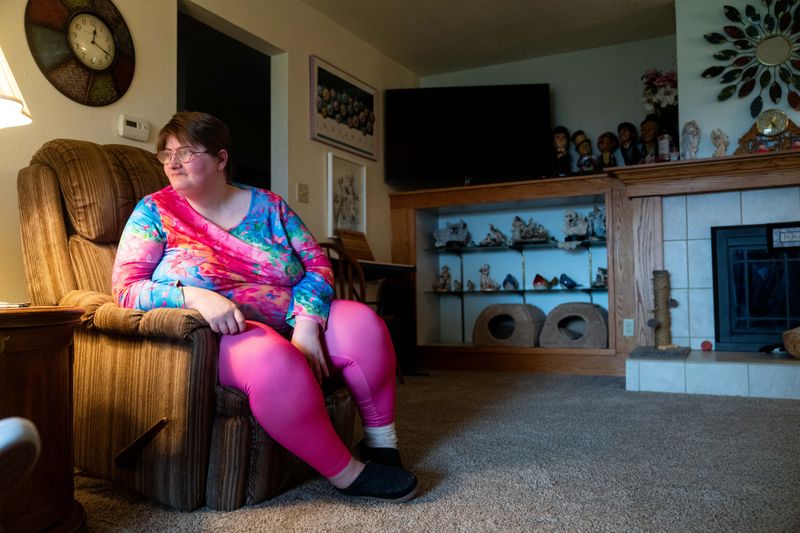
Living mostly on Todd’s Social Security Disability payments, the disabled couple had little money for gas so they stayed all day in Ankeny with daughter Sarah, the family’s most severely disabled member, while the others attended classes at Des Moines Area Community College. Sometimes, the Beamans would drive to doctor’s appointments, go grocery shopping or stroll the DMACC campus with Sarah, an unsteady walker who struggles with cerebral palsy and narcolepsy that could cause her to collapse with little notice.
In the evening, the Beamans would round up everyone for the drive home, a cycle that kept them away from their home and pets in Menlo from early morning to late at night.
It would have been an ambitious schedule for any parent, especially without any other support. But that school year, all three siblings, who all had intellectual disabilities like Sarah, were doing well ― at least in the beginning.
“They had always been told by teachers and providers that they would never be able to do it because they weren’t smart enough,” Bonnie said. “I had always taught them they could do anything they set their minds to if they work hard — and they did.”
Everyone, that is, except for Joshua Walker, daughter Charlie’s new husband. Joshua had done time behind bars, struggled holding onto a job, spent stints homeless and flunked out of DMACC right away that February, emails from the school show.
Joshua’s entry into the household, and his failure to leave, was the beginning of a downward slide that would help cause their family’s separation. In a few short months, family members would be fighting often with him as he became increasingly violent toward his wife and the others.
An abusive relationship worsens
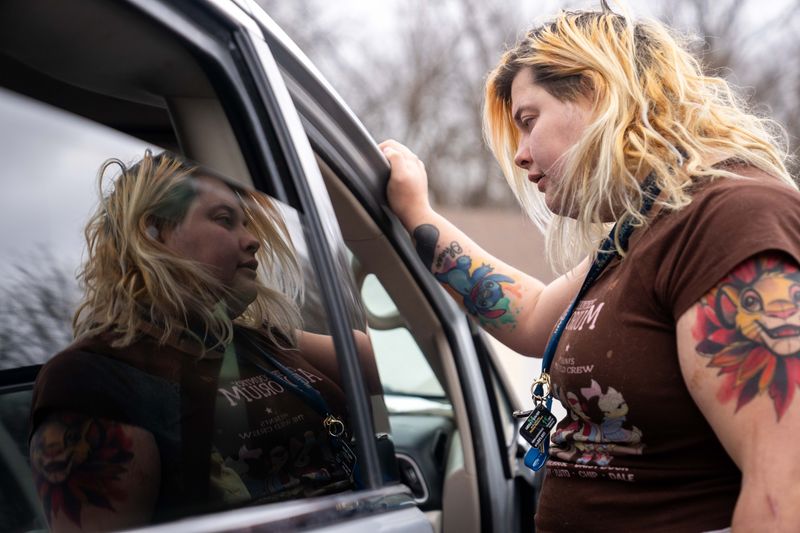
Charlie met her future husband three years ago through her brother Rex. Both had been at the Fort Des Moines Correctional Facility in Des Moines after serving stints in prison.
The couple’s life together was difficult from the get-go.
“I helped get him out of the Fort Des Moines,” Charlie said. “We were living for a while in the Fleur Lodge (motel) in Des Moines, then he lost his job, so we had to switch to a Motel 6. He lost his job again, and we went to an extended-stay motel.”
They called his parole officer and got permission for him to move into the family’s Menlo house.
Charlie and Joshua married in 2024. She, Rex and Joshua eventually moved in together in a house she was able to buy with a U.S. Department of Agriculture loan in Audubon. None of three drove and they relied on Todd and Bonnie for transportation.
Joshua, who has mental health issues, loitered at local businesses in Audubon, solicited for cigarettes and fought with family members when they came home from DMACC, the Beamans said.
Joshua could not be reached for comment. But his mother, Tina Brown, confirmed her son was abusive toward Charlie and said she saw some of her daughter-in-law’s injuries. She also said her son showed signs of bipolar disorder while still in grade school and could be highly manipulative.
Bonnie and Todd acknowledged they argued often with him, trying to get him to do more work around the home and to look after the siblings’ many dogs. By that summer, they said, they’d learned he wasn’t the son-in-law they thought he would be when they welcomed him into their family.
Todd said he tried to help the young couple with a broken sewer line at their increasingly unkempt house. He complained to the city that their workers broke it when they fixed a water line that sat above the pipe. But the city, the Beamans said, declined to do anything about it. Charlie lacked enough money to fix it.
Her parents were driving so much when the kids were attending DMACC that they were neglecting their own dogs. Joshua’s behavior worsened, and Charlie fought with her family as a result. The Beamans called police several times about domestic abuse, police and court records show.
In August, Bonnie and son Steven said, Charlie cut herself with glass from a broken backdoor window and Joshua injured her again, trying to pull her away from the family.
After a trip to the hospital, the fight continued outside their home and someone made another 911 call. Bonnie accused Joshua of attacking both her and her husband. Steven had a panic attack and Sarah passed out, their mother said.
“Even when she passed out, I had to shove (Joshua) out of the way. He was throwing punches,” she said.
After that day, Bonnie said, she told her family she didn’t want to go to the house in Audubon anymore; she wanted to go home to Menlo. But Sarah and Steven, she said, wouldn’t go with her, fearing their siblings, Charlie and Rex, would wind up dead if they weren’t around to defend them.
“That’s when we started to stay there,” she said.
On Sept. 11 last year, a witness called 911 to report a domestic assault on U.S. 71 north of Exira. Charlie was charged with domestic assault after allegedly kicking her father into a ditch, court records show.
She said Joshua had beaten her the night before and again that morning before she was supposed to go to DMACC. In the van on the way to school, she’d acted suicidal and her father tried to stop her from hurting herself. She said she kicked her father, reacting to him as if he were Joshua.
“I admitted (to law enforcement) I kicked him, but I was seeing Josh at the time,” she said. “They said they weren’t going to arrest me because they said it was a mental issue. I apologized to my Dad.”
Ostracized by the Beamans after his fight with the family, Joshua walked into the Audubon police station one day and admitted he had broken the terms of his parole. Now 30, he had been convicted at 17 of indecent exposure. Officer Melissa Mower said he looked and smelled so bad, she did not want to arrest him and told him to go home, court records show.
Then came Sept. 30, 2025.
Three arrested in a single day
Charlie said she was on a walk around town that morning, talking to her mother on the phone, when police stopped her and said they had a warrant for her arrest. After police had ignored her claims to be a victim of domestic abuse, she was charged with domestic abuse herself for kicking her father.
The same day, Bonnie managed to get Joshua picked up by police on a 72-hour mental-health hold. But by that afternoon she would be arrested, too.
A group of local officials swarmed the Audubon house, finding dog feces and urine everywhere and a layer of human waste in the basement from the broken sewer line.
Son Rex, 32, was arrested and sent back to jail for failing to register as a sex offender, and was also charged with animal abuse, court records show.
Todd was left to look after Sarah, Steven and Charlie, but he, like his wife, would be charged with dependent adult abuse and animal neglect.
The nightmare, however, would mostly affect Sarah. In the wake of the arrests, she was removed from her parents’ custody and spent seven rocky months in two group homes, away from her family for longest time in her life.
Cut off from family, rebellion grows into crisis
In the group homes, Sarah cried, lashed out at others, complained on social media she was being mistreated and attempted to hurt herself, once wrapping a seatbelt around her neck in the back of a vehicle.
She was put on a powerful antipsychotic, Haldol, that comes with a black-box warning and is supposed to be used to treat schizophrenia, acute psychosis or Tourette’s syndrome.
Before a March guardianship hearing, Sarah tried to be firm, telling others what she wanted. She told a protective worker; her temporary guardian, an aunt; and her attorney that she wanted to go home to her family.
“Sarah reported that her family is all she has,” Tammy Dorscher, a state adult protective worker, noted in an assessment of the case. “Sarah reported that when things go bad all pull together no matter what is going on to be there for each other as a family.”
But at the hearing that would decide her next guardianship, no one asked Sarah to testify about what her months-long experience in group homes had been like. No one asked how she was being treated, whether she felt safe, how she managed without medicine for her narcolepsy or how she slept ― or didn’t sleep ― while on the new antipsychotic.
Instead, the Iowa Department of Health and Human Services had hired a doctor to evaluate her. The doctor concluded she had depression, anxiety, bipolar disorder and other mental health issues.
Not long after the March 9 hearing, Judge Justin Wyatt issued a written decision in her case, saying her parents couldn’t legally be her guardians again because the DHHS had already found they’d neglected her.
“A background check… would disqualify both because of the founded adult abuse assessments,” he wrote.
Back home in Menlo, the family’s situation worsened. Todd, already in heart and kidney failure, was hospitalized March 20. He blamed the stress his family was under.
Bonnie grew more depressed and cried, fearing she might never again see her daughter.
“When someone in the family is gone, we can’t function,” she said. “I don’t know what to do during the day because everything revolved around taking care of her.”
And then on Easter weekend, Sarah’s anxiety over being in a group home boiled over, worsening her situation even more.
Ninety-five percent of the in-home services Americans receive are paid for by Medicaid, the federal-state insurance program. Amid a huge workforce shortage, tighter state budgets and historic federal cuts, those services have become increasingly scarce for millions of Americans with disabilities. After losing their support, two disabled parents of four disabled children in rural Iowa stretched themselves to their limits ― and fell on the worst of times.
Lee Rood’s Reader’s Watchdog column helps Iowans get answers and accountability from public officials, the justice system, businesses and nonprofits. Reach her at lrood@registermedia.com, at 515-284-8549, on Twitter at @leerood or on Facebook at Facebook.com/readerswatchdog.
This article originally appeared on Des Moines Register: Worried about domestic abuse, disabled family crowds into fetid house
Reporting by Lee Rood, Des Moines Register / Des Moines Register
USA TODAY Network via Reuters Connect



By Lee Rood, Des Moines Register | USA TODAY Network