(Editor’s note: A version of this story first appeared in 2018.)
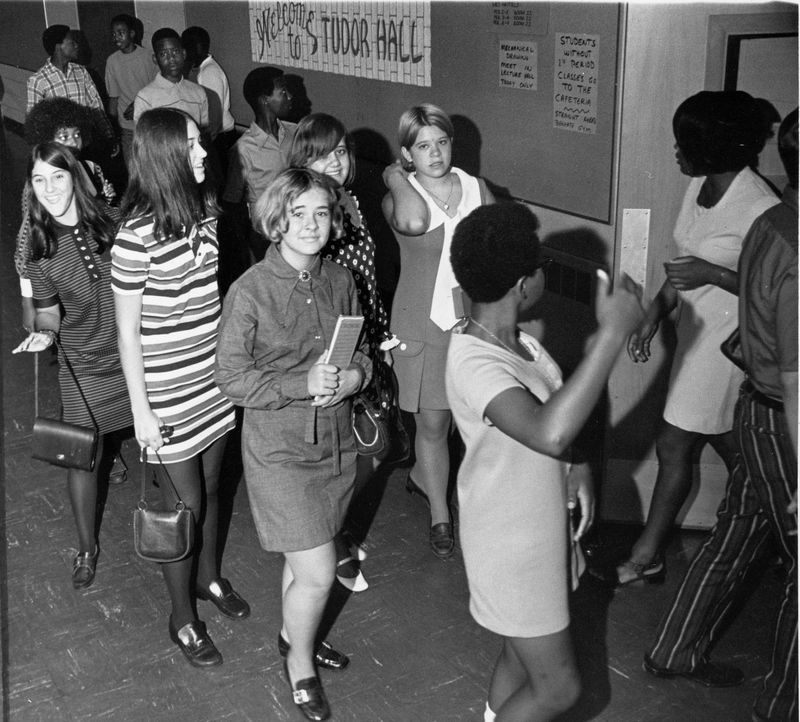
While many people point to the U.S. Supreme Court’s Brown v. Board of Education landmark 1954 decision as the beginning of school desegregation, Indiana got a jump on that in 1949 when the Indiana General Assembly passed a law requiring the state to begin integrating schools.

On May 31, 1968 the Justice Department filed a lawsuit against the Indianapolis Public Schools district, alleging deliberate discrimination against Black children.
IPS was initially slow to respond and made only incremental progress over the next few decades. Here’s a timeline:
Chronology of desegregation
May 1968: The U.S. Justice Department filed a suit in federal court, charging the Indianapolis Public Schools with racial discrimination.
Sept. 1970: IPS begins sporadic busing of students within the district in anticipation of a federal court order. The voluntary busing continues for the next two years.
Aug. 1971: U.S. District Judge S. Hugh Dillin finds IPS guilty of segregation de jure (by law) and orders it to accelerate desegregation of its staff and some schools.
July 1973: Dillin orders the busing of pupils within IPS boundaries and to surrounding suburban schools. Busing begins that September within IPS.
Aug. 1975: Dillin rules that busing students to suburbs is justified because the city failed to build public housing outside IPS boundaries and the state legislature failed to consolidate schools in Marion County when Unigov was enacted.
Nov. 1978: Wayne, Warren and Lawrence Townships ask to annex portions of IPS containing Black pupils. The plan is eventually approved.
Aug. 1981: More than 5,600 Black pupils are bused to Perry, Wayne, Franklin, Decatur, Lawrence and Warren Townships, according to an August 16, 1981, Indianapolis Star story about the man tasked with those transportation logistics . Pike and Washington Townships are excluded because they already have substantial Black enrollments. There are scattered incidents of protest.
March 1984: Dillin awards parents of children bused to the townships the right to vote in suburban school board elections.
Feb. 1991: Mayoral candidate Stephen Goldsmith and state Rep. William A. Crawford, D-Indianapolis, call for an end to busing.
Feb. 1993: Dillin allows IPS to begin a limited school-choice program called Select Schools.
March 1995: Dillin rules that IPS parents can choose to send their kids to kindergarten in IPS or to the surrounding township schools.
Aug. 1995: As the IPS district’s population gains more Black students, Dillin relaxes racial balance guidelines that would change year to year as the population changes.
May 1996: Saying that the district no longer perpetuates segregation, IPS files reams of documents and asks Dillin to lift the busing order. Later, the U.S. Justice Department files a lengthy motion opposing the request.
Jan. 1997: Dillin holds a hearing on IPS’ request to lift the busing order.
Feb. 1997: Dillin rules that his busing order will be forever “continuing and permanent.”
Oct. 1997: A federal appeals court orders Dillin to let IPS show why Black students bused to suburban township schools should return. The 7th U.S. Circuit Court of Appeals in Chicago also rules that the busing order was never meant to be permanent.
June 1998: Dillin approves a historic agreement between suburban township schools, Indianapolis Public Schools and government agencies that during a 13-year period will phase out busing inner-city Black students to township schools. In a related agreement, housing officials agree to undertake initiatives to expand affordable housing throughout Marion County. Dillin also removes his supervision of busing within the IPS district.
This article originally appeared on Indianapolis Star: Retro Indy: Lawmakers ordered schools to desegregate. It took decades
Reporting by Indianapolis Star / Indianapolis Star
USA TODAY Network via Reuters Connect
By Indianapolis Star | USA TODAY Network