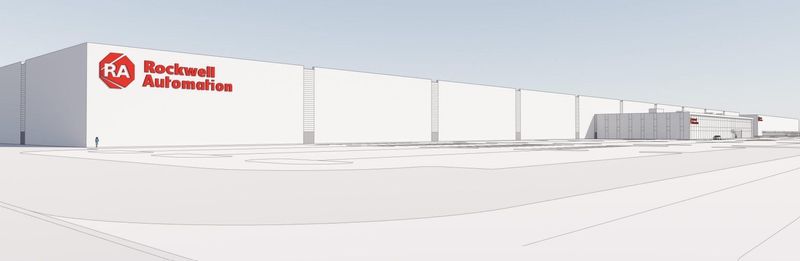
When all is said and done, Rockwell Automation’s sprawling campus in New Berlin could span nearly 200 acres and eventually consist of more than 1 million square feet of manufacturing and office space.
Not unexpectedly, Rockwell’s emerging plan has drawn concerns from dozens of residents about its scope and its impact on what is essentially farm fields surrounded by a trio of residential subdivisions, with Costco and a small commercial building also nearby. At a June 1 public hearing, dealing specifically with the plan’s hope to have the city rezone land on South Moorland Road between Grange and College avenues, those concerns found a forum.

Those speaking at the hearing were only allowed to ask questions or comment about the land use and rezoning proposals for the land where an 810,000-square-foot building would be built. They were told not to discuss the design plans. But within those limitations, the concerns were made clear.
“I’m opposed to this rezoning because I believe … the land is not zoned for this type of development,” said Joe Ross, the most vocal of a half-dozen speakers who spoke against the proposal at the hearing. “If it was, we wouldn’t be here. There were reasons why the 2020 [comprehensive plan] was approved, and it was not for something like this.”
A lot of questions from residents mark hearing
The first part of the hearing was for questions about the proposal to amend the 2030 comprehensive plan, a blueprint document that tries to anticipate how undeveloped land will be used in the future, and about the plan to rezone the property for what essentially would be a business park.
Residents came with many questions.
Jim Hall listed a series of them, including whether semis would drive in and out of Rockwell 24 hours a day (potentially, officials acknowledged), how well noise pollution would be addressed and why the city might allow a building height as tall as 60 feet. He said he’s keeping an open mind, if such concerns are addressed.
“As I stand here today, I’m opposed to this project,” Hall said. “However, my opposition is not absolute. The concerns that I have, and those that many other residents have raised, until they are fully satisfied I’m going to hold my opposition to this building.”
Scott Jentsch wondered if city officials had always anticipated an industrial use for this largely rural section surrounded by homes.
“Would the comprehensive plan changes being proposed be made, if not for this application?” Jentsch asked, noting the subdivisions that exist nearby. “Is there a reason that urban residential is no longer pertinent for that neighborhood?”
While city officials explained how comprehensive plans evolve, City Planner Greg Kessler said the discussions did in fact lean toward a land uses similar to what Rockwell now has in mind. The comprehensive plan changes are almost always developer driven, with adjustments coming as applications by developers are received.
Opponents provide more forceful voice to overall plan
When the hearing turned to public comments to those either in favor or opposed to the project, no one spoke in support. About a half-dozen spoke strongly against.
In addition to Ross, who railed against truck and car traffic generated by Rockwell’s operations and the potential noise from HVAC units atop a tall building, others listed common concerns.
Emily Feldman said despite her connection to Rockwell – her husband worked for the company at one point – she couldn’t get past what such a plan would mean for her family’s home.
“We have respect for what you bring to Wisconsin and our communities, and we fully understand the intent behind all of this,” Feldman said, addressing Rockwell representatives. “But this is going to be, like, right in my backyard. … And we just put all of our life savings into the property that we waited two years to build.
“The city plan looked like the land would say quiet and agricultural. So a massive industrial plant in between all of these [residential] neighborhoods just was kind of shocking and really doesn’t make a whole lot of sense to us as homeowners,” she added.
Terry Buss also had mixed feelings that ultimately tilted toward the concerns of invested homeowners, most of whom had assumed the land would eventually be used for more homes.
“We are all for Rockwell coming to New Berlin,” Buss said. “Just not at this location, unfortunately. … I don’t think anybody ever anticipated seeing a building of that size.”
City staff and Rockwell officials outline plans
According to planning documents filed with the city, the main facility would initially consist of 810,000 square feet of production and office space, with possible expansion to more than 1 million square feet.
Another 425,000-square-foot building, to the north along Grange Avenue, was mentioned in earlier versions of planning documents and previous Journal Sentinel articles, but Rockwell officials said June 3 they are no longer planning for a second- and third-phases of campus development. The amount of acreage included in the plan has also been reduced from 300 acres to 185 acres.
Construction isn’t anticipated prior to 2027 and is dependent on other factors, including city support and possible tax subsidies to help finance the project, as previously reported.
The development, rumored in late 2025 as Rockwell officials acknowledged plans to build what would become the company’s largest production facility somewhere in the Milwaukee metro area, was later confirmed to be in New Berlin. It’s part of an effort by Rockwell, which makes industrial automation technology and is based in Milwaukee, to increase its capacity nationally.
SunCap Property Group is the developer acting on behalf of Rockwell Automation as the plans move through New Berlin City Hall. The land consists of about 11 parcels, all with separate tax identifications.
In a presentation during the June 1 hearing, Rockwell officials said the site was considered superior not just for its available land mass but for the workforce the company thinks it can draw from the region to New Berlin. The facilities will be special, they added.
“This campus we are looking to create is really, truly a state-of-the-art facility,” said Kyle Lindberg, Rockwell’s vice president of supply chain planning and strategies. “One of the most sophisticated manufacturing plans in the world, with advanced automation, as we step forward.”
The city ultimately will have to update its 2030 comprehensive plan to update the land uses. The developer is also asking the city to approve a planned-unit development overlay, a tool that allows more flexibility within a zoning district for a complex project involving uses that don’t fit neatly into a zone. Building heights and the potential need for a We Energies substation to serve the property are among the variant issues in the plan.
SunCap’s Patrick Theodossiou, in a presentation ahead of the hearing, stressed that the current proposal is only for one building – the 800,000-square-foot facility on the northwest corner of Moorland Road and College Avenue.
Additional approvals will be required before the project could proceed. Future expansions would be dealt with separately.
The Plan Commission, which took no action at the June 1 hearing, will likely consider the land-use and zoning changes on July 15. The New Berlin Common Council will subsequently also consider those elements.
This story was updated with new information provided by Rockwell Automation about the planned size of the New Berlin campus.
Contact reporter Jim Riccioli at james.riccioli@jrn.com.
This story was updated to add new information.
This article originally appeared on Milwaukee Journal Sentinel: Hearing gauges public opinion on Rockwell Automations’ New Berlin plan
Reporting by Jim Riccioli, Milwaukee Journal Sentinel / Milwaukee Journal Sentinel
USA TODAY Network via Reuters Connect
By Jim Riccioli, Milwaukee Journal Sentinel | USA TODAY Network