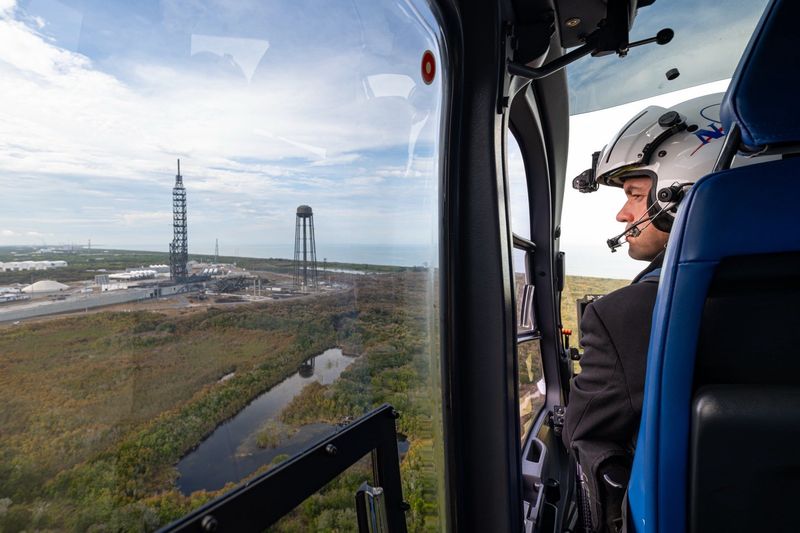
The head of NASA recently got an up-close look at the aftermath of an explosion that occurred as Blue Origin was preparing a large rocket for an upcoming launch in Florida.
Flying over the Cape Canaveral site, NASA Administrator Jared Isaacman had a birds-eye view of the charred debris and toppled infrastructure that remained where once a $1 billion launch complex stood. The remnants were a potent reminder of the untold damage resulting from Blue Origin’s towering New Glenn rocket exploding May 28 in a dramatic fireball that shook much of Florida.

Both Blue Origin and NASA had stakes in New Glenn’s continued success.
For NASA, New Glenn was a significant piece of its Artemis program to establish a foothold on the moon. For Blue Origin – the spaceflight company billionaire Jeff Bezos founded in 2000 – New Glenn was further critical to its commercial launch service ambitions.
But now, those futures appear uncertain as officials begin the arduous process of not only determining the extent of the damage, but making needed repairs.
Here’s what to know about Isaacman’s visit to Blue Origin’s damaged launch site, as well as how New Glenn fits into its Artemis program.
Blue Origin’s New Glenn rocket explodes in Cape Canaveral
Blue Origin officials have regained access to the launch pad in Florida to begin surveying the extent of the damage resulting from when one of its rockets exploded May 28 during a prelaunch test.
Standing at 322 feet tall, the New Glenn rocket is a heavy-lift launch vehicle designed to transport a variety of commercial and civil payloads – like satellites – to orbit.
Ground teams were performing an important test known as a hot fire in preparation for what would have been New Glenn’s fourth flight when the rocket exploded in a violent fireball widely seen around Florida. No one was injured, but the explosion completely destroyed the fully stacked rocket, composed of both a first-stage booster that provides the initial burst of thrust at liftoff, as well as a second-stage vehicle designed to fly in orbit.
A cause has not yet been determined.
NASA head Jared Isaacman visits site of Blue Origin explosion
Jared Isaacman, the administrator of NASA, visited the site of the Blue Origin explosion to assist in surveying the extent of the damage. Photos shared May 29 on Isaacman’s official social media account on X show the NASA chief aboard a helicopter getting aerial views of Launch Complex 36 – a site at the Cape Canaveral Space Force Station that Blue Origin previously invested $1 billion to rebuild.
Isaacman said in a post that he and a team of senior engineers also spent time talking with billionaire Jeff Bezos, who founded Blue Origin in 2000, as well as Dave Limp, the spaceflight company’s CEO.
“I appreciated the opportunity to hear directly from those working through the aftermath and better understand the challenges ahead,” Isaacman said in the post.
Both Bezos and Limp expressed gratitude on social media for Isaacman’s visit.
“Thank you for being here today. Your support means a lot to the whole team,” Bezos said on X.
“Inspiring. Thanks for all your support,” Limp added in his own post.
New Glenn to be part of NASA’s Artemis moon missions
NASA had been relying on the New Glenn rocket for missions under its Artemis campaign, which seeks to return astronauts to the moon and construct a lunar outpost to enable a longterm presence.
The rocket not only was due to launch Blue Origin’s uncrewed lunar lander to the moon later in 2026, but was due to be part of a crewed mission known as Artemis III. Slated for 2027, that mission entails NASA launching a crew of astronauts to Earth orbit, where they would rendezvous with one or both commercial lunar landers being developed by both Blue Origin and Elon Musk’s SpaceX.
The mission is envisioned as an important test before a moon landing is attempted as early as 2028 during Artemis IV.
Under the Artemis mission profiles, astronauts would board NASA’s Orion spacecraft to hitch a ride to space atop the space agency’s Space Launch System rocket from the Kennedy Space Center. Blue Origin and SpaceX would then use their own rockets – Blue Origin’s New Glenn and SpaceX’s Starship – to launch their lunar landers to orbit.
For future moon landing missions, those landers would dock in lunar orbit with the Orion spacecraft, allowing two astronauts to board it for a trip to and from the surface.
NASA head vows Blue Origin will overcome setbacks from explosion
In the wake of the disastrous explosion, it’s unclear when New Glenn would be able to fly again from the damaged Florida launch site. Analysts also fear the incident could hinder NASA’s timeline for its Artemis missions, though the agency has not yet specified if that will be the case.
Isaacman, though, acknowledged that much work is ahead for Blue Origin to recover from the setback. But he reaffirmed NASA’s commitment to helping Blue Origin make repairs and get New Glenn launching again.
“America’s greatest achievements in space were never the result of avoiding setbacks,” Isaacman said. “They came from overcoming them.”
Eric Lagatta is the Space Connect reporter for the USA TODAY Network. Reach him at elagatta@usatodayco.com. Subscribe to the free Florida TODAY newsletter.
This article originally appeared on Florida Today: NASA chief surveys damage after Blue Origin explosion at Cape Canaveral
Reporting by Eric Lagatta, USA TODAY NETWORK – Florida / Florida Today
USA TODAY Network via Reuters Connect