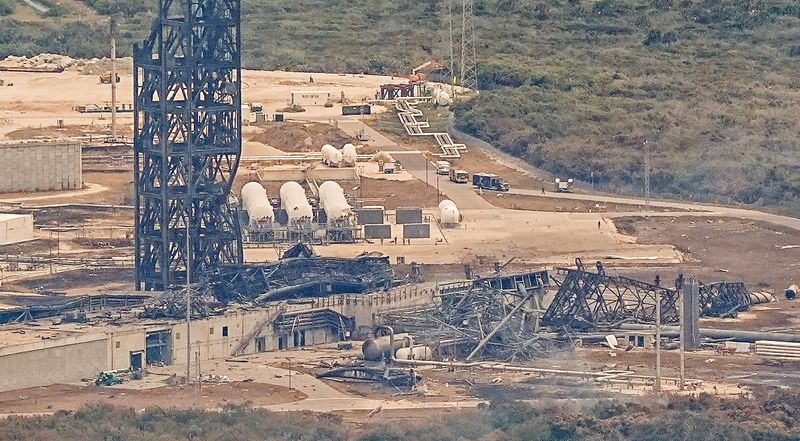
The chief executive of Blue Origin is insisting that the New Glenn rocket will fly again in 2026 after an explosion dealt heavy damage to the launch pad in Cape Canaveral.
The claims from CEO Dave Limp come as Blue Origin officials have been able to get a closer look in recent days at the site where the company’s towering New Glenn rocket exploded May 28 in a dramatic fireball that rocked Florida.

The explosion occurred as the spaceflight company founded by Jeff Bezos prepared to use the rocket to launch a batch of satellites into low-Earth orbit for Amazon, which the billionaire also founded. While the rocket was completely destroyed, it’s the damage to the launch pad itself in Cape Canaveral that has officials the most concerned.
Not only was a New Glenn rocket due in 2026 to launch from the site to send an uncrewed lander to the lunar surface for NASA, but it would have been part of a critical test flight in 2027 known as Artemis III to set the stage for a human moon landing.
Because Blue Origin has nowhere else to launch New Glenn as of now, determining just how much work is ahead in repairing the site will have enormous implications for not only its commercial partners, but the pace of NASA’s Artemis moon missions.
Here’s what to know so far in the aftermath of the late-May explosion.
Blue Origin regains access to Cape Canaveral launch pad after explosion
Blue Origin officials have regained access to the launch pad in Florida to begin surveying the extent of the damage resulting from when one of its rockets exploded May 28 during a prelaunch test.
Standing at 322 feet tall, the New Glenn rocket is a heavy-lift launch vehicle designed to transport a variety of commercial and civil payloads – like satellites – to orbit.
Ground teams were performing an important test known as a hot fire in preparation for what would have been New Glenn’s fourth flight when the rocket exploded in a violent fireball widely seen around Florida. No one was injured, but the explosion completely destroyed the fully stacked rocket, composed of both a first-stage booster that provides the initial burst of thrust at liftoff, as well as a second-stage vehicle designed to fly in orbit.
After beginning assessments Saturday, May 30, company leaders are only now getting a full picture of the damage to Launch Complex 36 – a site at the Cape Canaveral Space Force Station that Blue Origin previously invested $1 billion to rebuild.
A cause has not yet been determined.
NASA head Jared Isaacman visits site of Blue Origin explosion
Jared Isaacman, the administrator of NASA, also visited the site of the Blue Origin explosion to assist in surveying the extent of the damage.
Isaacman said in a post on social media site X that he spent time talking with billionaire Jeff Bezos, who founded Blue Origin in 2000, as well as Dave Limp, the spaceflight company’s CEO.
“I appreciated the opportunity to hear directly from those working through the aftermath and better understand the challenges ahead,” Isaacman said in the post.
NASA had been relying on the New Glenn rocket for missions under its Artemis campaign, which seeks to return astronauts to the moon and construct a lunar outpost to enable a longterm presence.
The rocket not only was due to launch Blue Origin’s uncrewed lunar lander to the moon later in 2026, but was due to be part of a crewed mission known as Artemis III. Slated for 2027, that mission entails NASA launching a crew of astronauts to Earth orbit, where they would dock with one or both commercial lunar landers being developed by both Blue Origin and Elon Musk’s SpaceX.
While the astronauts would launch in an Orion capsule atop NASA’s Space Launch System rocket, Blue Origin was due to use its New Glenn rocket to transport its lander to orbit, while SpaceX would use its Starship.
Isaacman acknowledged that much work is ahead, but reaffirmed NASA’s commitment to helping Blue Origin recover from the disaster and get Blue Origin launching again.
“America’s greatest achievements in space were never the result of avoiding setbacks,” Isaacman said. “They came from overcoming them.”
Some important hardware, infrastructure spared from damage
Limp has also noted some good news: Rocket hardware stored in the nearby integration facility appear undamaged, including another first-stage booster used in two previous missions and three second stages.
Some infrastructure was also undamaged, including the propellant farm where the rocket’s fuel is stored and distributed, as well as the water tower critical for sound suppression and fire prevention during launch, Limp said in his latest update on social media.
While Limp noted that the launch tower that supports the rocket when it’s vertical is damaged, he said, “it can be repaired in place rather than torn down and replaced.”
Blue Origin CEO says New Glenn will fly before end of 2026
The New Glenn rocket had been due to fly as early as the first week of June on its fourth mission after a January 2025 debut. The flight would have been the first time Blue Origin launched the rocket to deliver a batch of Amazon Leo satellites for a constellation aiming to compete with the likes of SpaceX’s Starlink satellite internet business.
Because Blue Origin had not integrated that payload prior to the hot fire test, those satellites were unharmed in the explosion. But because no other launch facilities in the U.S. are built to accommodate a New Glenn launch, that mission – and others using the rocket – are indefinitely postponed.
“We will fly again before the end of this year,” Limp promised, adding the Latin phrase “Gradatim Ferociter,” meaning “step by step, ferociously.”
Will Blue Origin shift focus to bigger New Glenn?
Blue Origin has previously hinted that an even bigger and more powerful version of the New Glenn rocket standing nearly 400 feet tall is on the way.
Dubbed New Glenn 9×4, the rocket is being designed with nine engines that will power its first stage and four engines on its second stage – an increase of two engines for each stage compared to the current design.
Limp, however, denied speculation that Blue Origin might now abandon its current 7×2 configuration in favor of the larger model.
“Rate manufacturing of 7×2 is going well, and we’re going to continue that at pace as planned and store the stages for use,” Limp said on social media.
Eric Lagatta is the Space Connect reporter for the USA TODAY Network. Reach him at elagatta@usatodayco.com. Subscribe to the free Florida TODAY newsletter.
This article originally appeared on Florida Today: Blue Origin CEO says New Glenn will launch again before end of year
Reporting by Eric Lagatta, USA TODAY NETWORK – Florida / Florida Today
USA TODAY Network via Reuters Connect