Facing growing concerns about the state of our parks — with grounds in bad shape, facilities being in disrepair or amenities closed — city leaders reached out to the City of Amarillo Parks and Recreation Department for answers.
“Five years ago, they identified $90 million worth of needs in assessments, to get caught up and replace a bunch of infrastructure that’s maybe 50, 60 years old in some areas,” Mayor Cole Stanley said about the parks department in a news conference Friday, May 29. “We’ve spent $36 million over the last five years. We have great improvements to the parks. The problem is, we still are $60 million short to getting everybody’s expectations met.”

Stanley said it’s easy for people to be critical of the park’s condition, but in a severe drought, after the green weeds were sprayed and killed, it left dirt with no grass. There hasn’t been a good season for that to grow. “It’s easy to be critical of the staff, because you’re not being reasonable with the conditions,” he said.
During Tuesday evening’s longer session of the Amarillo City Council, Amarillo Parks and Recreation Department Director Michael Kashuba presented an update that had been requested about the parks’ current conditions.
The comprehensive, detailed report presented May 26 focused on park maintenance and recreation beautification. It included a lot of interesting information that most citizens may not be aware of, including vandalism and damage, budget shortfalls and problems with staffing.
Some of the hot topics that Kashuba touched on have been brought up in multiple discussions and what they’ve been hearing from the public, some from staff, and some in social media, he said. These include the zoo, John Ward Park, the restrooms, swimming pools and parking lots.
Some of the pertinent facts about Amarillo PARD
Condition of the Amarillo Zoo before transitioning to nonprofit status
In answer to one of the most asked questions, “Why did the zoo look so bad when it transitioned to a nonprofit status,” the main answer was lack of staff, as well as funding.
Kashuba showed a photo of staff cleaning at the zoo in July 2025. He said they had made improvements including putting in an aquatic filter, as well as aquatic plants and fish. One of the challenges was the filter clogging from sediment and leaf drop. He also noted that a lot of the animals that have passed in recent years were from old age, and they were among the oldest animals in the country.
Full-time personnel for the Amarillo Zoo stood at eight people, with seven part-time staff and no temporary staff, for a total of 15 filled positions, according to Kashuba.
In contrast, the Abilene Zoo has 63 full-time, 17 part-time, and 35 temporary staff, making a total of 115 positions. The Clovis Zoo has 13 full-time, .5 parttime, and no temporary staff, for a total of 13.5 employees, according to Kashuba.
In comparison for funding, the Abilene Zoo had a proposed subsidy of $3.2 million and the Clovis Zoo $1.6 million, while Amarillo had a subsidy around $280,000, according to the report.
“Obviously we’re excited about the partnership with Amarillo Zoo & Sanctuary, that’s a conversation we’ve been looking to have for years and how we lease that zoo or how we found a nonprofit. But we think that’s going to be a very successful model moving forward,” he said.
Kashuba said they had about three staff out there before the transition, working above and beyond, doing overtime, trying to maintain the facility and all its animals.
Issues at John Ward Park (Medi-Park)
The hills by John Ward Park had been approved for a beautification project of wildflowers by the Park Board and Beautification and Public Art Board.
The hills of the North Lake were tilled and seeded at double the standard application rate, but with underwatering and limited precipitation since the seed was planted, very few flowers were able to grow.
According to the report, there were contractor issues, damage to irrigation systems from boring done during lighting projects, and legacy irrigation issues, which staff is working on with contractor to resolve. They’re also looking at a more centralized irrigation system that they can more closely monitor for problems.
He pointed out the positive side of improvements at John Ward Park, which include replacing the surface of the playground (that gets a lot of use), adding an ADA fishing dock, park lighting around the trails, concrete repairs and an upcoming fitness court this summer.
Phased decommission of small neighborhood park restrooms
Facing a $3.5 million deficit a few years ago, the parks department started looking at a master plan for different options, including removing restrooms due to repair and cost.
The master plan called to reduce the number of permanent restrooms and drinking fountains, especially in smaller neighborhood parks. A phased priority listed in the presentation stated “decommission of restrooms in Small Neighborhood Parks, at the end of their lifecycle. Evaluate restrooms in other parks to determine their utility and condition to determine any additional restrooms should be decomissioned,” while making an effort to provide permanent restrooms in the larger community and regional parks.
It was determined the school parks’ care should fall more to the schools. Some of the parks are under joint ownership between the school and the city, while others are under school ownership. According to the report, the council suggested keeping all restrooms open except those in school parks, which is the current practice.
Outside of the school parks, John Stiff No. 10 and East Park are both closed due to sewer line collapses and aging infrastructure. The department wants to address council for those repairs and also will suggest putting in a new restroom at John Stiff North, which is getting a lot of use.
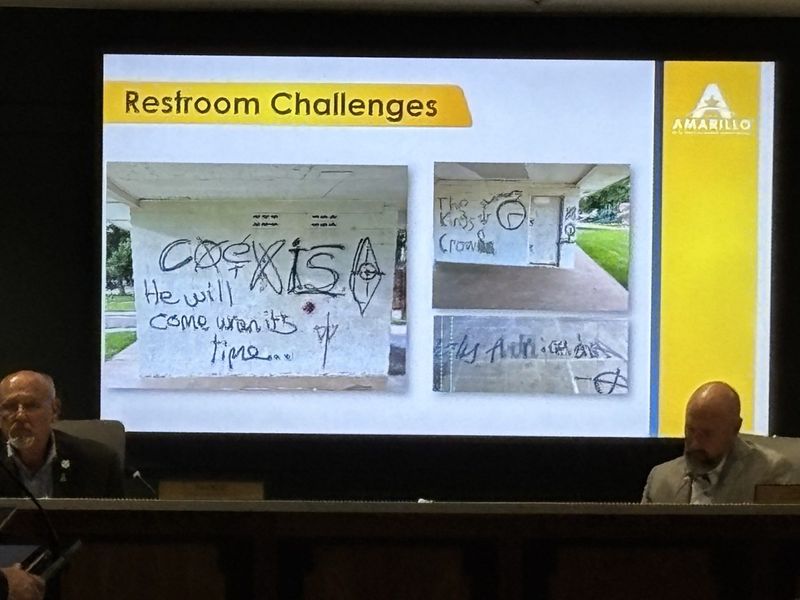
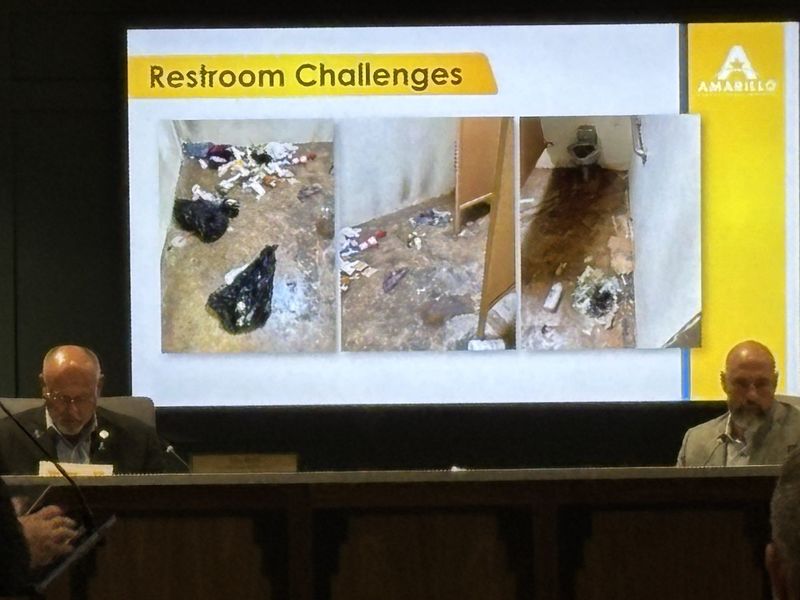
PARD staff see a lot of trash, unsanitary conditions, vandalism and damage on a fairly frequent basis. Kashuba said they’ve had instances of people living in the restrooms, and staff being attacked by individuals who were inside the restrooms that had barricaded themselves.
Currently, there are 17 restrooms in regional parks. According to the report, it would cost nearly $2 million to replace or repair all the damaged restrooms in Amarillo, including $5,000-$10,000 for metal doors.
Heavy public use of restrooms means that fixtures must withstand constant wear and rough handling. There is also a greater risk of vandalism, theft and intentional damage, which requires tamper-proof hardware and reinforced materials such as those used in prisons. Weather exposure is also a concern, with facilities subject to rain, heat, humidity, and freezing conditions.
Maintenance access is also limited, due to staffing levels, and restrooms and not always cleaned or repaired in a timely manner. A durable design can reduce such calls and breakdowns. Easy-to-clean and sanitary materials are needed, and a longer lifespan means lower taxpayer costs in the long term.
The PARD has been in communication with Amarillo ISD regarding school park restrooms and the agreements in place, while prioritizing and funding only regional and community parks.
The regional parks include John Stiff, Martin Lake, Medical Center (John Ward), Rick Klein Sports Complex, Southeast Park and Thompson. Thompson Park by itself has nine restrooms, Kashuba said. Community parks include El Alamo, Ellwood, Hines, Memorial and Sam Houston.
Neighborhood parks include Benton, Bones Hooks, Brook Hollow, East, Glenwood, Greenways, Hazelrigg, MLK, Paramount, San Jacinto, Sanborn, Southlawn, West Hills, Westover Village, Will Rogers and Pleasant Valley.
Photos of the restroom at Southeast Pool within the last two weeks — while it’s been closed — showed significant damage, including destroyed mirrors, sinks and toilets.
Swimming pools situation
WIth the two closed city pools, Southeast and Southwest, a second RFQ was put out for an aquatic viability study, according to the report, and PARD received one submission. The study will look at all outdoor aquatic facilities, including the pools and splash pads.
They received a proposal last week, Kashuba said. He said the staff and park board will review the scope of work and make a recommendation to the council, and it will be placed on a future City Council agenda for consideration.
New parking lots
The new parking lots around parks, such as John Stiff Park, are to provide extra parking for users during special use activities, to accomodate a larger crowd and more vehicles needing a place to park. The gates are closed until a request is made for a group.
They were also closed as a result of possible large gatherings after hours as well as activity including loitering, noise, and vandalism in the parking lots, as well as requests from neighbors who live nearby to keep them closed.
Some of the new parking and roads are geared to alleviate pressure at parks during larger events or multiple activities happening at the same time, where a large volume of traffic is coming and going.
How did they get there?
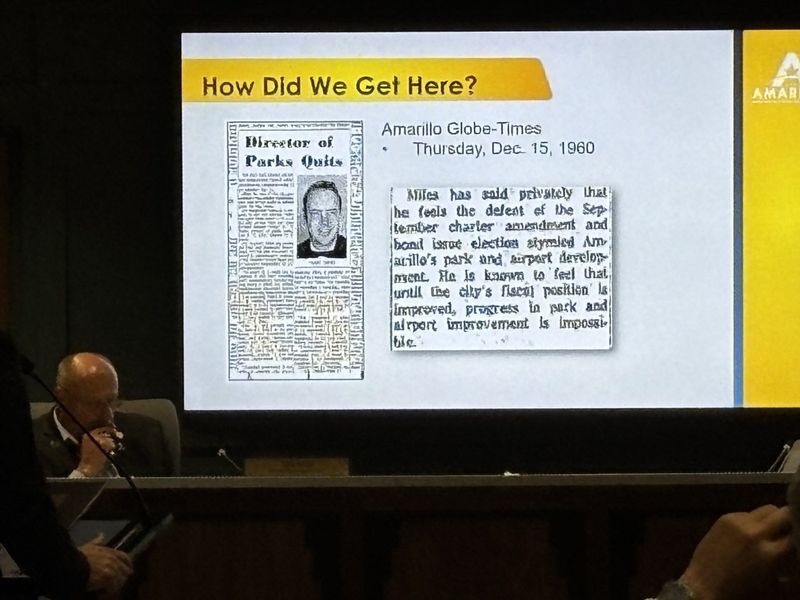
Kashuba presented old newspaper clippings from the Amarillo Globe-Times about cuts in staffing dating back to the 1960s. Some of the photos showed some of the infrastructure put in that time, which is still there today.
Historical capital funding has also decreased dramatically with time, from $1.5 million in 2011-12 to less than $100,000 in 2018-19, with costs going steadily up from 2012 to 2020.
The 2021 master plan stemmed from details of an asset management plan, which looked at which assets were high, medium and low risk areas. They also launched an awareness campaign, with red “x”s placed at facilities around the city as PARD sought public feedback on the parks’ future.
Kashuba said about 10,000 people weighed in on the master plan. The report further showed that community engagement was high, with the Bilingual Park and Recreation survey reaching 2,368 participants, and a Prioritization Challenge drawing 6,904 participants. A Community Solutions Work Session at the Civic Center drew more than 270 participants.
The master plan led to recommendations of current actions, including increasing fees and scaling back on some facilities. To meet current council and public needs, he said the master plan would need an update of about $150,000.
Strategies to address staffing shortages following Covid, included:
The report even broke down the average park responsiblity per full-time park maintenance employees (including administrative ones) to 1.16 parks per person, or 53.4 acres.
To hire staff, they’ve had to lower their minimum requirements over the years.
There are also a lot of contractors working for PARD, including for landscape maintenance, forestry, electrical and concrete contracts.
Where they’re going from here
Some agreements with other groups include the zoo lease agreement, Wonderland Park lease agreement, Rick Klein lease agreement, and a new tennis center independent contractor.
Partnerships and sponsorships PARD has put in place are with Outdoor Amarillo; Wild West Wildlife Rehabilitation Center; Trees for Texas and Phillips 66 (which helped with tree donations); Alex O’Brien Tennis Foundation; BOOM Adventures; and Texas Parks & Wildlife.
PARD has been working on completing various projects and studies to identify and address other issues, including:
The PARD total investment over the last five years in various projects and improvements has been more $36 million, through grant funds, partnerships and other avenues.
“We’ve made significant strides,” Kashuba said. “We know we’ve got a long way to go; we’ve got a lot of improvements that we still need to do.”
This article originally appeared on Amarillo Globe-News: What is the story behind Amarillo parks and pools? Director shares
Reporting by Nell Williams, Amarillo Globe-News / Amarillo Globe-News
USA TODAY Network via Reuters Connect