Editor’s Note: Jack Becker is the editor of Caprock Chronicles and is a Librarian Emeritus from Texas Tech University. He can be reached at jack.becker@ttu.edu. Today’s article about Joe Ely’s Tornado Jams is the first of a four-part series by frequent contributor Chuck Lanehart, Lubbock attorney and award-winning Western history writer.
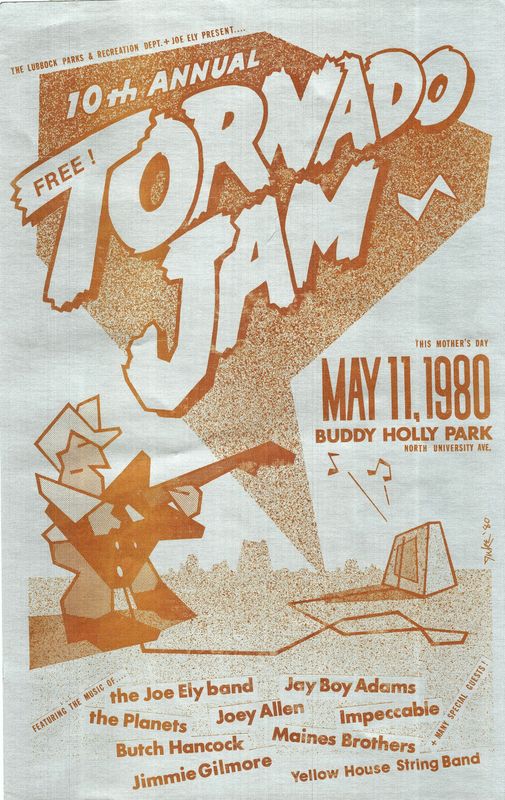
A young Lubbock musician, Joe Ely, had an idea that spawned a legendary music festival. He thought there should be a concert to celebrate ten years of progress since the 1970 Lubbock tornado devastated the city, killing 26 citizens and leveling much of the downtown area.

Earle Rewell Ely Jr.—always known as Joe—was born in Amarillo in 1947 and was reared in Lubbock. He was a rebellious young man. He drove a motorcycle down the halls of Monterey High School on his first day there and was later expelled for singing a sexually suggestive song during an assembly.
But Joe was talented, soon singing and playing guitar in local bars and dance halls, alone or with a revolving group of bandmates. In 1971, he helped form the Flatlanders, an innovative Lubbock alternative country band. After the band broke up in about 1973, he joined the Ringling Bros. and Barnum & Bailey Circus, working as a laborer, taking care of llamas and the “world’s smallest horse,” but he soon returned to Lubbock and his love for music.
By 1980, Joe was known as a prolific singer-songwriter, having released four albums, “Joe Ely,” “Honky Tonk Masquerade,” “Down on the Drag,” and “Live Shots.” He toured extensively, including England, where he opened for and collaborated with the famous British punk rock band The Clash, and even brought The Clash to Lubbock for a performance.
With the 10th anniversary of the Lubbock tornado approaching, Joe’s idea to commemorate the May 11,1970 disaster caught on, and “Joe Ely’s Tornado Jam 1980” would become a reality.
With enthusiastic support from his friends, Joe convinced the City of Lubbock’s Parks and Recreation Department to help organize and finance the project.
Joe contacted his musical buddies, and they readily agreed to become involved. The Tornado Jam was to be one day only, the event was free to all, and there were no celebrated headliners, though some acts would soon become quite famous. Nor was the festival designed as a benefit concert.
The Tornado Jam was simply a chance for Lubbock music lovers to get together to remember the tragedy in a positive way. It was supposed to be fun.
And fun it was.
The site chosen for the open-air concert was the 122-acre Buddy Holly Recreation Area, a popular park centered around Buddy Holly Lake on Clovis Road, just three miles northwest of downtown Lubbock. The date chosen for the festival was Sunday, May 11, exactly ten years after the 1970 tornado, which struck Lubbock on a Monday.
A temporary stage was erected with lighting and sound provided by Blackstar Sound of Austin, the city provided ten portable toilets, and the local power company provided a transformer delivering 3,000 watts to the stage. All musicians agreed to perform free of charge, though out-of-town acts were to be reimbursed for travel.
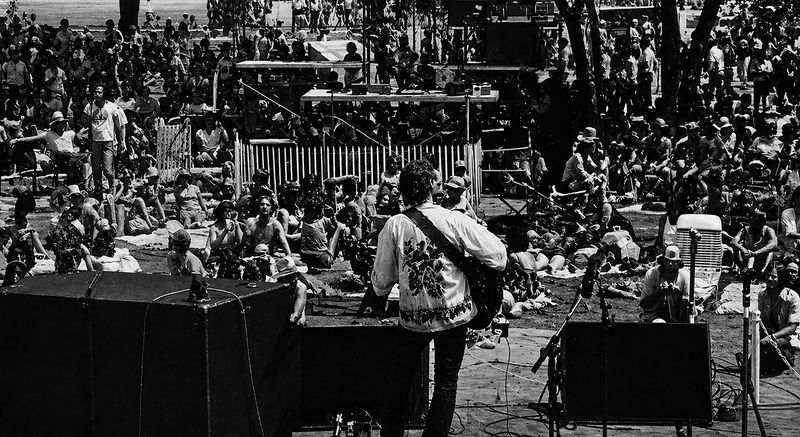
Organizers expected a crowd of perhaps 5,000 to attend the 12-hour event. Jim Underwood, recreation superintendent for the park, said, “There was no way we expected this many people.” Audience numbers varied, but police estimated 17,000 people attended, with as many as 8,000 present at any one time.
Lubbock A-J entertainment editor William Kerns covered the event, reporting the early performers—Yellowhouse String Band, Joey Allen, Butch Hancock and Jimmie Dale Gilmore— “earned response from the straight country music fans.” But “the mood began to change” with rock sets by Street Theater and Wet Sox, and “the crowd really started to make some noise when [the soon to be world famous] blues guitarist Stevie [Ray] Vaughan and his band Double Trouble did a 40-minute set.”
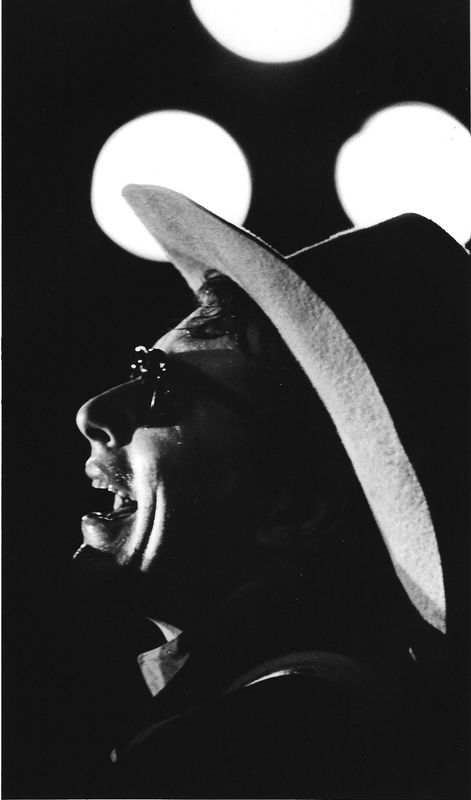
Other acts included Lubbock’s popular performers Jay Boy Adams and The Maines Brothers Band, and The Planets from Albuquerque also appeared. Joe and his band closed the show. Reported Kerns, “Ely was . . . rambunctious and energetic on stage. He was the show-closer and . . . aided by guitarist Jesse Taylor and [steel guitarist] Lloyd Maines . . . made close to 10,000 people sound like 20,000.” Kerns opined that practically everyone left the festival with “good feelings.”
Organizer Steve Moss recruited Lubbock videographer Mike Ogletree, and the two filmed the concert. Some of the performances are available on Ogletree’s “Oglepro” YouTube channel.
No major incidents were reported during the Tornado Jam, though Lubbock police arrested a few concertgoers for minor offenses. The ten portable potties were certainly inadequate, all concessions sold out quickly, and the event left quite a mess for the Parks and Recreation Department to clean up.
Nevertheless, everyone involved agreed the show was an overwhelming success. Afterward, Joe said, “We all knew that if it screwed up in any way, we’d never get to do it again.” Joe’s words were like a prophecy, spawning thoughts of a repeat for 1981, even bigger and better than the first.
Part 2 of this series will be published at a later date.
This article originally appeared on Lubbock Avalanche-Journal: Caprock Chronicles on Lubbock Tornado Jams, Joe Ely’s musical brainchild
Reporting by By Chuck Lanehart, special for the Avalanche-Journal / Lubbock Avalanche-Journal
USA TODAY Network via Reuters Connect