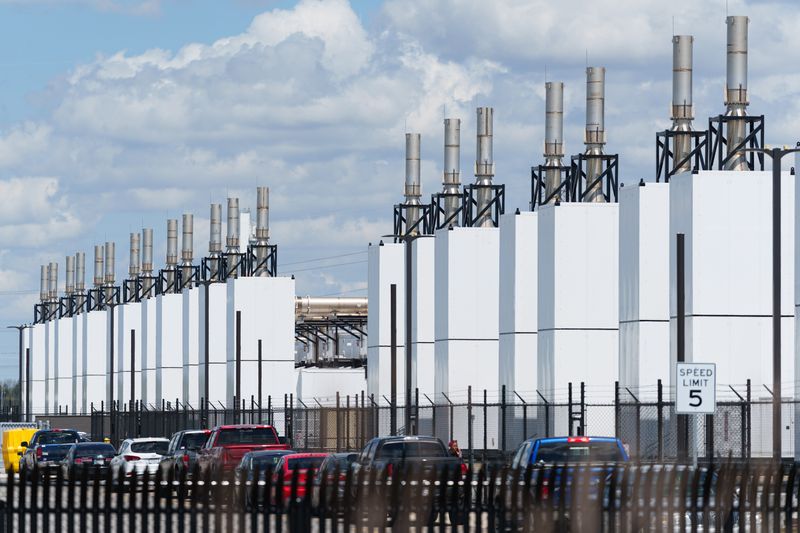
Large load data centers like the ones Meta, Google and Microsoft are building across Indiana pose challenges for utilities. They use a massive amount of electricity around the clock. And one data center’s energy requirement can rival that of an entire city the size of Indianapolis.
At this point it’s not entirely clear how they will get all the energy they need.

Some Indiana utilities are planning for the rush of data centers with new gas plants and battery storage buildouts. But because such plans are often tucked away in regulatory filings, it’s been notoriously tricky to find out exactly how the data centers will impact Indiana’s energy portfolio.
“Some information is public, other is secretive,” said Ben Inskeep, the program director for Citizens Action Coalition, an Indiana-based utility watchdog group that has been organizing against hyperscale data center development.
Filings and contracts do reveal a partial picture of how Indiana utilities are responding to increased energy demand — and the answer involves a slew of fossil fuel plants. Here’s what we know:
NIPSCO builds out energy portfolio
The Northern Indiana Public Service Company is one of Indiana’s largest energy utilities, providing energy and electricity across the northern reaches of Indiana to nearly 500,000 customers and at least two hyperscale data centers so far.
NIPSCO will provide electricity to some of the tech giants in its area through an entity called NIPSCO Generation, often referred to as GenCo, designed to service data centers.
“We have publicly announced contracts with two large-load customers who will be in Michigan City and Hobart,” a NIPSCO spokesperson wrote in an email to IndyStar.
In Hobart, Amazon has plans for a 2.4 gigawatt data center. Indiana Utility Regulatory Commission filings show GenCo will support it through 3,000 megawatts of dedicated power from two new 1,300 megawatt natural gas plants and a 400 megawatt battery.
Michigan City’s Economic Development Corporation announced that Google had acquired an $832 million data center last month, but it was not explicit about how much energy the site will use. In a May earnings call, GenCo’s parent company NiSource detailed plans to power Google’s data center, Amazon expansions and future customers with three batteries and 500 megawatts of power from an unnamed contractor.
“The capacity GenCo builds helps make the system stronger, more reliable and more resilient, helping to ensure NIPSCO can continue delivering safe, reliable service as demand grows,” the NIPSCO spokesperson wrote.
Earlier this month, the NIPSCO also confirmed an agreement with Hallador Power Company to purchase energy from the Merom Generating Station, a coal-fired power plant in Sullivan County. Hoosier Energy, which previously owned the Merom Generating Station, had scheduled its aging plant for retirement in 2023 but a last-minute sale to a coal company kept the plant alive.
Indiana Michigan Power
Encompassing a chunk of eastern Indiana and the region around South Bend, Indiana Michigan Power has a large load customer base that includes a Google data center in Fort Wayne, a Microsoft data center in Granger, and an Amazon data center in New Carlisle.
“We’ve put together a framework for serving large energy users like data centers that is designed to protect existing customers, maintain resource adequacy and reliability, and support economic development,” Stephanny Smith, an I&M spokesperson, wrote in an email.
Data centers in I&M territory will receive power from the utility’s generation resources, which the company has recently bolstered with wind power and several natural gas plant purchases from around the country, according to dockets filed with the Indiana Utility Regulatory Commission. I&M purchased an 870 megawatt plant in Ohio, and is in the process of acquiring more, like a 918 megawatt plant that will be built in Indiana’s Sullivan County and a 318 megawatt natural gas plant in West Virginia.
AES’s solar and battery buildout
AES Indiana, which services more than 500,000 customers in Central Indiana, hasn’t disclosed the resources it will use to power two recently approved Indianapolis data centers.
AES didn’t immediately respond to questions from IndyStar, but regulatory filings show how the utility plans to supply a data center further along in development: The Google facility in Monrovia will be at least partially powered by renewable energy. AES plans to acquire 130 megawatts worth of solar and more than 450 megawatts of battery storage systems to support the site.
No word yet on how the Sabey data center in Decatur Township and the Metrobloks facility in Martindale-Brightwood will receive power.
Duke’s sole customer goes carbon free
Duke Energy Indiana has only one large load data center in its territory, which services over 900,000 customers across Indiana. And Meta’s 407-megawatt data center in Jeffersonville isn’t using Duke’s power.
“They had a requirement for carbon-free power,” Duke spokesperson Angeline Protogere said. “And so we source that off of our system and provide that to them.”
Protogere said she was unable to identify the power resource due to the utility’s agreement with Meta.
CenterPoint is in talks with first large load customer
CenterPoint Energy Indiana, the utility providing electricity to the state’s southwest corner, has no large load data centers operating within its bounds. But that could soon change.
“The region continues to attract interest from potential large electric customers,” Noah Stubbs, a CEI spokesperson, wrote in an email. “Any large load customer would pay the incremental costs of serving them, protecting existing and future customers.”
In an April 2026 quarterly earnings call, Ben Vajello, CenterPoint Energy’s vice president of investor relations and corporate planning, said the utility was in talks with a potential customer.
“We continue to make considerable progress in our conversations with a large load customer on a project that would represent our single largest load in our Southern Indiana service territory, with substantial upside for additional growth,” he said.
CenterPoint’s 2025 Integrated Resource Plan suggested the utility would “likely have to go to market for capacity, energy, or tolling agreements to cover the short-term capacity need until we could build our own generation.”
Small utilities and opaque power deals
When a data center moves into a territory that falls under the jurisdiction of an electric membership cooperative, determining energy sources can prove even trickier. Typically such cooperatives are found in rural areas and service fewer customers than their larger counterparts.
In the city of Lebanon, Meta is developing a $10 billion data center under the jurisdiction of Boone Power, an electric membership cooperative that has offered little insight into its plan.
“There’s been absolutely no information about what energy sources are going to power this massive 1,000 megawatt facility that’s already under construction,” Inskeep said.
When asked for comment, a Boone Power spokeswoman referred IndyStar to a page on the utility’s website, which says the data center will work directly with the company’s wholesale power partner, Wabash Valley Power Alliance.
“Wabash Valley Power Alliance’s approach is to align each large load with a dedicated and independent power source on a one-to-one basis,” the website says. “This means our current generation resources will not be utilized to power the Meta data center. WVPA has secured a long-term contract with a supplier that has a vast portfolio of carbon-free resources.”
IndyStar’s environmental reporting is made possible through the generous support of the nonprofit Nina Mason Pulliam Charitable Trust.
Sophie Hartley is an IndyStar environment reporter. You can reach her at sophie.hartley@indystar.com or on X at @sophienhartley.
This article originally appeared on Indianapolis Star: Data centers need a lot of energy. Some turn to fossil fuels for power
Reporting by Sophie Hartley, Indianapolis Star / Indianapolis Star
USA TODAY Network via Reuters Connect