They’re up. They’re down. If can seem the 2026 Cavaliers keep looking up in need of a miracle to keep their postseason alive.
For those too young to remember, I would like to invite you to the “Miracle of Richfield.”

For those who were there, shall we go back together, 50 years later?
A retreat might be therapeutic as the current Cavaliers teeter in the NBA playoffs.
“Miracle of Richfield?” Was it?
Forget the punch-in-the-gut line − the 1976 Cavs didn’t even get past the conference finals. The “Miracle” really was amazing stuff. It generated the most joyous noise I have ever heard in sports, night after night, for a while.
It unfolded on the cow pasture on which the Coliseum at Richfield was built, 20 miles southwest of the expiring Cleveland Arena on Euclid Avenue.
They were depressed times for our pro sports. Cleveland’s baseball team was averaging around 90 losses. The Browns were coming off a 3-11 year. The Cavaliers were an expansion team (born in 1970) that hadn’t done anything.
Midway through the 1975-76 season, the Cavs were barely above .500.
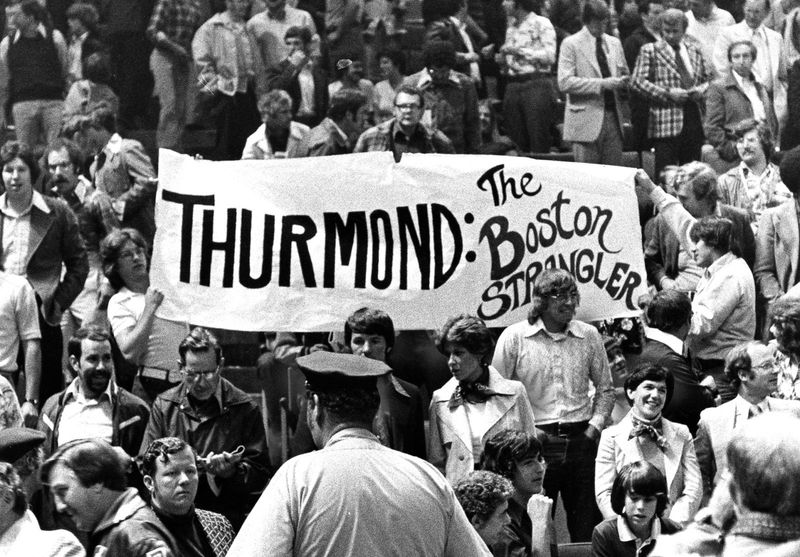
“The Miracle” actually germinated on Nov. 27, 1975, when head coach/general manager Bill Fitch traded Steve Patterson to the Chicago Bulls for Nate Thurmond.
Patterson was a nondescript big man from California. Thurmond was an Akron legend.
Incredibly, two future Naismith Memorial Basketball Hall of Famers, Thurmond and Gus Johnson, were teammates at Akron Central High School in the late 1950s.
The 6-foot-11 Thurmond turned into a monster at Bowling Green and was the third overall pick of the 1963 NBA draft. Johnson, who landed in Idaho after his wish to play for the Akron Zips fell through, was the 10th pick in that draft.
Gus the bruiser was a 6-foot-6 forward whose No. 25 is retired by the Washington Wizards (they were Baltimore Bullets when he played).
Nate the giant became a force with the San Francisco Warriors, mentioned in the same breath as Wilt Chamberlain and Bill Russell. In 1967 league MVP voting, the top four, in order, were Chamberlain, Thurmond, Russell and Oscar Robertson.
Thurmond landed in Cleveland in his twilight, on wobbly knees, at 34. He still fought like a gladiator. His past as one of the most feared defenders in NBA history still resonated, while Fitch managed his minutes.
Thurmond joined two Cavaliers centers who were 1973 NBA draft picks, Jim Chones and Luke Witte.
A big star at Marquette, Chones actually began his pro career with the ABA’s New York Nets. He joined the Cavs for the 1974-75 season and played pretty well.
Witte was local and beloved. He was “Luke the Seven-Foot Duke” as a major Marlington High School star. He was on his way to a tremendous career at Ohio State before falling victim, in 1972, to one of the most despicable on-court attacks in college basketball history, perpetrated by the Minnesota Golden Gophers.
Strangely, Jim Brewer, one of the Minnesota players who joined in the brawl, became Witte’s Cleveland teammate. Brewer was a can’t-shoot, ferocious-defense forward drafted No. 2 overall in 1973. Fitch, who had nothing to do with the attacks, was Minnesota’s head coach before the Cavs hired him in 1970.
The 1975-76 Cavs caught fire as winter melted into spring. Two days after a Coliseum concert by The Who, they beat the Knicks to start a seven-game win streak. In February, with Robert DeNiro in theaters playing “The Taxi Driver,” an eight-game win streak made the Coliseum go crazy.
The roster was full of appealing players.
It was hard to say what was more stylish, Bobby “Bingo” Smith’s Afro or his rainbow long shot. Smith was an original Cavalier from 1970, immensely popular. One of play-by-play legend Joe Tait’s best pet calls began as the ball left Smith’s hand: “B-o-b-b-y (pregnant pause) BINGO!”
There was no 3-point shot then, or Bingo might have banked a million 3s.
Guard Austin Carr joined the Cavs as a No. 1 overall draft pick in 1971. A few months before the ’71 draft, he scored 46 points in a win over UCLA, the Johnny Wooden juggernaut that then went on an 88-game win streak.
Before a 1974 knee injury, Carr was on course for the Hall of Fame. He was part of the glue of the 1975-76 team, if not the electric player he had been. With Carr’s minutes down, little rookie Clarence “Foots” Walker made a little noise.
North Canton’s Dick Snyder, probably the best all-around athlete in Hoover High history, was the Cavs’ oldest player after Thurmond, at 31.
Snyder was a favorite of player/coach Lenny Wilkens on the 1971 Seattle Supersonics. He gave Seattle almost 20 points a game and ranked fifth in the NBA in shooting percentage at 53.9, a tremendous number for a 6-foot-5 guard/forward who scored all over the floor.
The Cavs acquired Snyder in a 1974 draft-day trade in which they dropped from No. 3 overall to No. 8. Seattle spent the No. 3 on 7-foot-2 center Tom Burleson, who became an ordinary pro. The Cavs got Snyder and, with the No. 8 pick, 6-foot-8 forward Campy Russell.
Russell never missed a game in the 1975-76 season and averaged 15 points a game.
Point guard Jim Cleamons and Witte had been top players on one of the better Ohio State basketball teams of the last 60 years (it should have been in the 1971 final four). Smart and smooth, Cleamons played for an OHSAA state champion at Columbus Linden-McKinley.
The Lakers burned a first-round draft pick on Cleamons but didn’t play him much as a rookie on a team that won the 1972 NBA championship. The Cavs got him in a trade after the finals and watched him develop.
The time was perfect for a team-crowd bonding. Ohio knows hoops as well as anyone, without being arrogant about it. Tickets for the 1976 playoffs were affordable, inviting audiences from a wide swath of society. If you had seven bucks, you could see the “Miracle” live.
There had been something loveable about the expansion Cavs even when they lost big. You’ll get a smile from anyone who remembers the old days, simply by mentioning Rick “The Rocket” Roberson, Bobby “The General” Washington and Walt Wesley.
Every now and then the early Cavs would hang with a great team. Always, Joe Tait made them fun to listen to on the radio.
What did the world look like as the Cavaliers rose?
The basketball show reached fever pitch at the cow pasture on April 10, 1976, when the Cavs clinched the franchise’s first division title with a 99-94 win over the Knicks. Earl “The Pearl” Monroe danced to 30 points and Spencer Heywood had 18 rebounds for New York, but the Cavs played with purpose and balance.
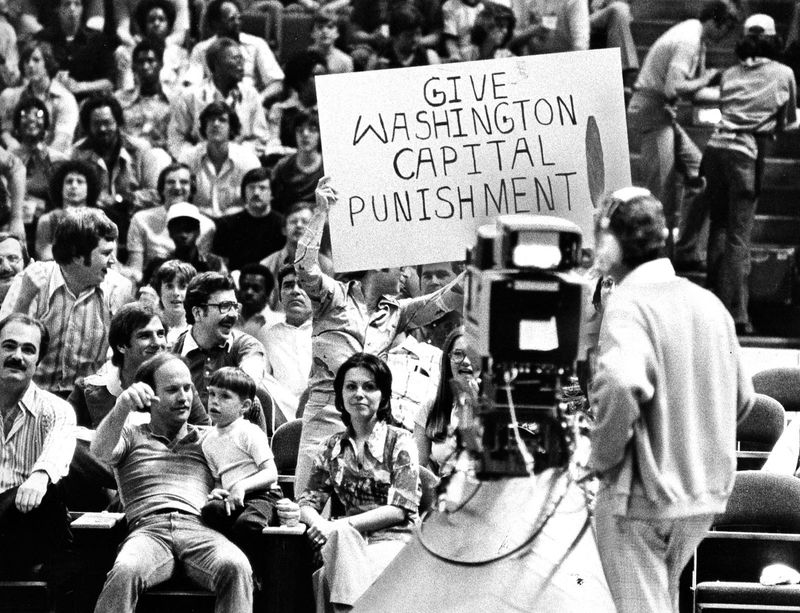
The Coliseum crowd was better than anything Madison Square Garden ever saw. Boom-voiced thespian Howie Chizek, the public address man, was magical.
Eight of the NBA’s 18 teams made the playoffs. Cleveland won its division by one game over the Washington Bullets (the Baltimore Bullets until 1973). It was Cavs vs. Bullets in the first round, best-of-seven.
Washington, 60-22 the previous year, was heavily favored, featuring future Hall of Famers Wes Unseld, Elvin Hayes and Dave Bing. Phil Chenier, whose number is now retired, was a top guard. Canton McKinley legend Nick Weatherspoon, a third-year pro, alternated with Truck Robinson at one of the forward spots.
There was no scent of “Miracle” in Game 1, in Richfield. Hayes and Unseld dominated. The Cavs trailed 56-35 at halftime and lost 100-95.
In Game 2, in Landover, Maryland, Smith sank a 25-footer over Truck Robinson with two seconds left to provide an 80-79 win. Countless listeners heard Tait bellow “BINGO!!”
“Miracle” on!
There was none of the manufactured noise and tech bombardment that assists or annoys (you tell me) at arenas now. Game 3 in Richfield was the element of spontaneity crashing into organic hunger and only-in-Ohio rhythms in a wonderful explosion.
It was so thunderously loud that cheekbones vibrated. Fitch’s clipboard shook in his hand. Players looked around in wonder. Bingo and Austin, the old Cavs names, scored a bunch in an 88-76 win.
Coach K.C. Jones’ talented Bullets brought the heat. Jones relied more heavily on Weatherspoon as the series churned along. The Cantonian played 38 minutes in Game 4, responding with 19 points and nine rebounds in a 109-98 win.
Back in Ohio for Game 5, with the Coliseum crowds now the talk of the NBA, sports-talk legend Pete Franklin kept playing the funky new “C’mon Cavs” song on WWWE. On game night, a Thursday, “Let’s go Cavs” chants began before the layup drill and got louder and louder up to tipoff.
A frenetic fight went to the final seconds with the Bullets up 91-90. The Cavs scurried to find a last shot. Smith launched, but there was no ‘BINGO!” Instead, Cleamons was in the right spot to catch the airball and flipped up a shot that hung on the rim and dropped at the buzzer. The earth shook.
Tait’s radio audience for Game 6, on the road, was an estimated everybody.
I’m guessing even McKinley people wished Weatherspoon would quit sinking his silky jumpers. “Spoon” scored 19 points in 40 minutes.
Carr had the best game of his post-injury career, but Smith and Snyder combined to shoot 2-for-15. An overtime loss forced Game 7.
The three best-ever crowd atmospheres in Cleveland sports were, in my opinion, from my experience:
It was only partly about the live audience and maestro Chizek. Tait made magic on the radio. He was Hammy before Hammy, one might say.
To take in the “Miracle,” you either had a ticket or you tuned in Tait. Along the lines of the Browns’ 1964 NFL championship game being blacked out locally, the Cavs-Bullets game wasn’t on TV.
This time, it wasn’t a blackout. The game simply wasn’t carried anywhere. Tait had everyone’s ear, though.
The cows of Richfield had to wonder what was going on in there as Game 7 went back and forth. It was the storm of the century, with 100-foot waves.
The Cavs had next-to-nothing leads after the first and second quarters. The Bullets went up 71-69 after three.
Weatherspoon played the entire fourth quarter. At one late point he switched onto Thurmond and forced a missed hook shot, but Thurmond followed his miss and scored. Cleamons ran the offense, making a layup, a 15-footer and a rebound follow to help build a four-point lead.
Weatherspoon hit a clutch shot late. After Chenier scored with 24 seconds left, it was Cavs ball, shot clock off, game tied at 85-85.
“It was just about at that point when I lost in completely,” Tait said years later.
Fitch got a timeout with nine seconds left, anticipating Snyder would draw a mismatch and face Chenier as he received an inbound pass from Cleamons. That’s just what happened.
Cleamons flipped a perfect entry. Snyder had the shorter Chenier between himself and an outside route to the basket. He dribbled into position and timed his rise to throw off a leaping Chenier. His difficult, twisting, short shot banked in with four seconds left.
The last few seconds got hairy, but the Cavs survived a missed shot and won 87-85. The crowd stayed for the longest time. In a sense, it is still there, haunting in a way, with the building gone, but roaring in perpetual echoes.
In the format of the era, just the one series win put you in the conference finals.
No one who experienced the “Miracle” doubted the Cavs had a chance to beat Boston to win the Eastern Conference and then win in the NBA Finals.
Boston’s top player was the big man, Cowens, but the Cavs had a good young center to battle him in Chones, with Mr. Thurmond available at any time.
Chones was one of nine NBA players who received at least two first-point votes in 1976 MVP balloting. He was nowhere close to deserving MVP, (Kareem Abdul-Jabbar, Bob McAdoo and Cowens were far above the crowd as the top three), but he was essential to the “Miracle.”
Two days before the Boston series began, Chones broke an ankle in practice.
Without him, Thurmond had to endure long stretches on bad knees. Witte was pressed into backup time after playing only two minutes across the seven Bullets games.
Boston won Game 1 easily, with a lineup including star guard Jo Jo White and aging Ohio legend John Havlicek.
In Game 2, again at Boston, the Cavs led in the fourth quarter before falling 94-89.
The series moved to Richfield. The “Miracle” was back on.
Cleamons was the best player on the floor in Game 3, an 83-78 Cavs win. Thurmond destroyed Cowens in Game 4. a reflection of why his retired No. 42 hangs in the rafters of the current arena. Witte played 11 minutes, hearing “L-u-u-u-u-ke” from the crowd each time he touched the ball in a 106-87 win.
Game 5 was back at the Boston Garden, tiny compared to the Coliseum. It was a tossup until late in the fourth quarter, when Fitch, believing his guys were getting hosed, drew a technical. The final was 99-94.
It went back to Richfield with the Cavs trailing three games to two. The Cavs took a lead into the fourth quarter, but Snyder and Cleamons, supermen against the Bullets, ran out of gas, going a combined 4-for-24 from the floor. The Celtics won 94-87.
Sigh.
Maybe you had to be there to understand why the “Miracle of Richfield” name fit the events of 50 years ago.
Please allow me to attest that the happiness was.
You might agree that the current Cavs could use whatever it was that made the middle of the “Miracle.”
Reach Steve at steve.doerschuk@cantonrep.com
This article originally appeared on The Repository: ‘BINGO!!!’ Inside the Cavs’ ‘Miracle of Richfield,’ 50 years later
Reporting by Steve Doerschuk, Canton Repository / The Repository
USA TODAY Network via Reuters Connect