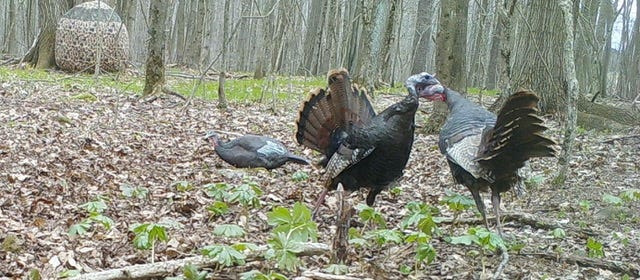
Seems like it is becoming more and more common to hear from successful hunters that if it had not been for their turkey decoy setup, there would have been one more gobbler chaser in that long, sad, tag soup line that we know so well.
And more and more of us seem to be using popup blinds on field edges and in the woods, too. Decoys and blinds go hand-in-hand.

Turkey hunting techniques have changed, evolved.
Used to be turkey hunting in the spring meant chasing gobbles up one ridge and down another, sans equipment except turkey calls and a gun.
While hunting morels near the end of the season, an inordinate amount of turkey scratching appeared in one of my favorite ‘shroom patches.
The next morning at dawn, a bird sounded off from the roost, but would not come in through the wide-open woods.
So the following morning after, a hen decoy was positioned on top of a log so that any gobbler within 100 yards could see her coyly straddling the log.
As things unfolded, three hens came in — talking, cutting, and yelping to get with “the hen” who had beaten them to the choice feeding area.
And like on a leash, there was Mr. Tom in tow … in full display, strutting right into gun range and my 12 gauge’s wheelhouse.
Back in the late 70’s, before turkey decoys were on the market, we had the idea of using a decoy.
And since I had a couple mounted toms, couldn’t they earn their keep a bit by putting them to work in the woods? One would think so.
Wouldn’t a mounted tom pull in a dominant bird at least within gun range?
But we learned through trial and error (along with a now rough-looking mount) that some toms are just not inclined to fight, just like some people (or some bucks for that matter.)
Subdominant toms and jakes (yearling toms) can in fact appear intimidated by big old boss birds. These youngsters will hightail it out of Dodge for the next ridge at the first sight of a full displayed fan and a long beard.
So what about using a hen decoy? That should always work right? No-brainer.
Well, back then (20 years before the internet), there were no hen decoys on the market that we knew about.
Finally, we did stumble upon a couple weird looking plastic pheasants at a discount store that were on sale as lawn ornaments. And with a little spray paint and a detail brush, they did touch up to make a passable impression of a hen turkey from 100 yards away if you squinted just right.
Those old homemade decoys were sure a far cry from the highly detailed, super-realistic and expensive turkey models on the market today.
A good location to set up a hen decoy is in a turkey dusting spot, often an old anthill. Yes, find one of these setups and it will work … sometimes.
The big tom that roosts in my dining room fell for that setup.
The two hen decoys were placed in the torn up anthill and a tom was gobbling off the roost and coming in.
Just like clockwork.
The anthill setup was down below, about 40 yards away. The sneaky tom came in quiet from the back, having circled and walked past.
His bad luck was he snapped a twig. A quick swing of the gun tumbled him before he could get airborne.
So decoys do work, but for every time there is a successful story, there are dozens of setups that are failures.
The newest decoys utilize psychological ploys to fool the longbeards. And undoubtedly, they would work at least some of the time, like the spray-painted plastic pheasants.
Topping the list is the decoy that is a subdominant tom, mounting a hen. Supposed to make any dominant tom strutting down the ridge insanely jealous.
And there are dominant tom decoys sold too, with submissive hens. No, not regular hens, but “submissive ones.”
And there are hens sold as floozy hens, sure to draw in any lonely tom.
A turkey hunter has to ask, “What does a floozy hen look like, compared to righteous one?” And how would anyone know what a turkey thinks?
Maybe we are getting a bit too deep here, plumbing the psychological depths of turkeys and hunters and marketing ploys.
Turkey hunting continues to evolve as we ponder the depths of that tiny brain in a tom turkey’s head and try to fool him.
— Oak Duke writes a biweekly Outdoors column.
This article originally appeared on The Evening Tribune: When hen turkey decoys are worth the effort | Outdoors column
Reporting by Oak Duke, Outdoors Columnist / The Evening Tribune
USA TODAY Network via Reuters Connect