A longstanding environmental problem in Michigan and elsewhere − massive piles of scrap tires and what to do with them − has become a solution for another chronic Michigan problem: bad roads.

A researcher at Michigan Technological University is working with more than 20 county road commissions in the state to develop formulas for using finely ground scrap tires in a mix with asphalt. On roads, the rubber adds flexibility during Michigan’s road-cracking freeze and thaw cycles. And the results show it’s working.
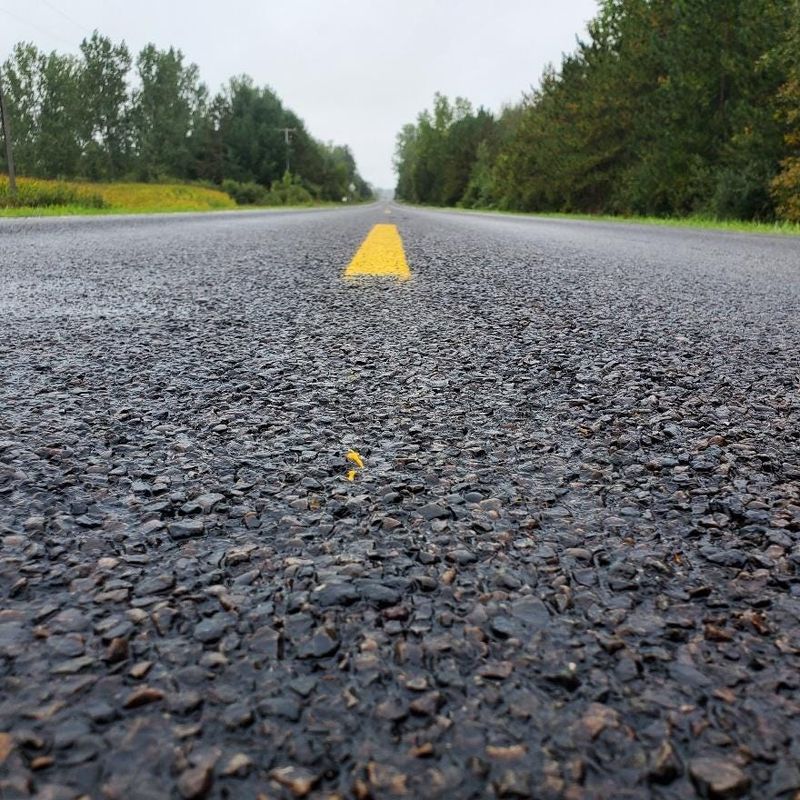
James Lillo, engineer manager with the Bay County Road Commission, at Michigan Tech’s behest, installed rubber-enhanced chip seal on a “horrible” road in his county.
“The whole road was a jigsaw puzzle; it was busted up that bad,” he said. “Chunks of road were missing that were maybe the size of your hand or a little bit bigger.”
Some five years later, the rubber-enhanced coating is still holding strong.
“Where it was filled in, it stretches, and it comes back,” Lillo said. “A traditional chip seal would last nowhere near that length of time. After the first year, almost guaranteed, it would have cracked.”
Michigan generates nearly 10 million scrap tires per year
Michigan generates almost 10 million scrap tires annually, “basically one tire per resident of the state per year,” said Kirsten Clemens, scrap tire coordinator for the state’s environmental regulator, the Michigan Department of Environment, Great Lakes and Energy.
What to do with those tires has been a problem for generations. The reservoirs from piles of scrap tires allow pooled water that’s a perfect breeding ground for mosquitoes and habitat for rodents − and the diseases they can carry. Accumulated tire piles are also flammable. “It does take a bit to get them on fire, but once they are on fire, they are very hard to extinguish,” Clemens said.
In an infamous incident in late December 1995, a fire began in a tire-shredding machine at a scrap tire processing company, Carl’s Retreading, in the Grand Traverse County community of Grawn. The fire spread to about a half-million scrap tires piled nearby and burned for 23 days before it was extinguished. Groundwater testing in the area years later showed contamination with nonstick “forever chemicals” PFAS, from the aqueous firefighting foam applied to the fire.
Tires can’t be landfilled intact; they collect gases and rise back to the surface, Clemens said. Over the years, the state has used sidewalls and treads for tires for things such as the bottoms of orange road construction barrels, or as tarp-holders in farmers’ fields.
More than 5 million tires were burned in Michigan as an energy source as recently as 2023. But Michigan has drastically cut back on burning tires for energy following a major policy shift that took effect in early 2024. Recent legal changes aimed at promoting clean energy removed tire-derived fuel from the list of renewable energy sources, causing multiple biomass plants to stop the practice.
“That’s somewhere between 2.5 million and 3.5 million tires that used to go for energy that have now come back, and we don’t really have a home for them,” Clemens said
Michigan Tech researcher hones the right road recipes
But the use of scrap tires in road paving products offers a potential solution. Technology has increased to the point where it’s more cost-effective to remove the fibers and steel from old tires, recycle them, and then reconfigure the rubber in ways that weren’t possible before.
“We now have facilities that can create down to micronized rubber, which is similar to the consistency of powdered sugar, very fine,” Clemens said. “You can put that in roads, and it binds with that asphalt binder, and it makes the asphalt more able to flex.”
Zhanping You, a professor of transportation engineering at Michigan Technological University and the director of Michigan Tech’s Transportation Institute, has been working on tires-to-roads projects for about 20 years, since his early academic days in Texas, as he saw the accumulating scrap tire problems.
In the early days of pitching rubber-enhanced asphalt to road commissions and utilities, many balked, You said.
“Some said, ‘We tried something like that 10 or 15 years ago, we were expecting it to work, and it didn’t work,'” he said.
After many years of in-house work, You was ready to partner Michigan Tech’s rubber-modified asphalt formulation with EGLE’s scrap tire program, the state agency offering 50-50 construction grants to road agencies willing to test it.
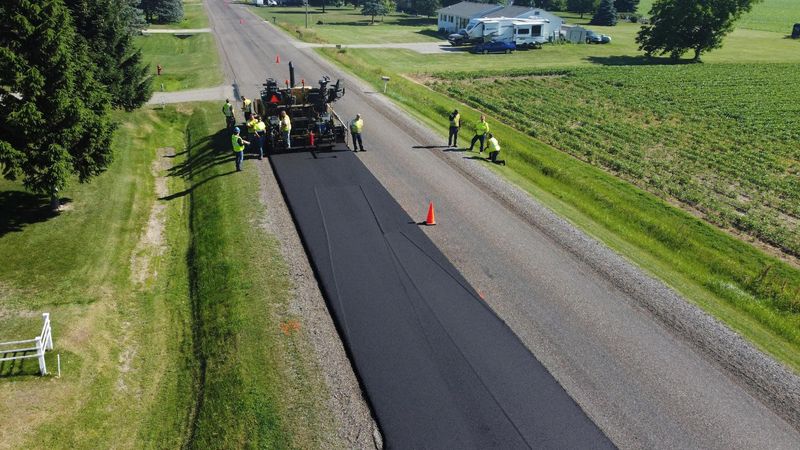
You said about 10 Michigan Tech students work with him on the program every year, and their rubber-enhanced asphalt formulas are now being implemented across approximately 30 projects in 20 counties throughout the state. Private contractors do the mixing, with the university providing the recipe.
“Each product has some uniqueness to it,” You said. “Maybe some is finer, some is coarser; different dosages, different designs. The goal is to meet local needs, the traffic and the environment. In Detroit, it’s going to be warmer than Houghton, and more traffic. So that is something we factor for in our designs.”
Putting rubber-enhanced asphalt to the road test
Dickinson County, in the far western Upper Peninsula, gets some of the coldest winter temperatures in Michigan. “It’s not uncommon to have a week or two when the lows are -20, and several days where the highs never reach zero,” said Lance Malburg, engineer with the county’s road commission.
The county has worked with Michigan Tech and the rubber-enhanced asphalt program since 2018, and has applied about 13 miles of roadways in the county with the products so far.
“The rubber gives the pavement some flexibility so we don’t get those transverse cracks or cracks across the road that a lot of times are cold-weather cracking,” Malburg said.
Road segments with the rubber-enhanced asphalt installed in 2021 are “still looking pretty much like new,” he said.
In Bay County, the road commission is using the product in three different ways: rubber-mixed asphalt; rubber-mixed chip seal applied to the top of existing traditional asphalt roads; or a rubber-enhanced asphalt layer applied over a traditional asphalt road, which is then topped with another layer of either traditional or rubberized asphalt.
All three methods are providing longer-lasting roads than with traditional materials, Lillo said.
“We are very impressed with it,” he said.
The product does require very hot oils for the tire rubber to mix with the asphalt, about 400 degrees compared to about 165 degrees with traditional asphalt, which might lead some road commissions to contract out to companies specialized in working with the materials, overexposing their staff to the potential hazard, Lillo said. It also requires some specialized equipment over what’s traditionally used with road-building, providing constant agitation of the rubber material and asphalt.
“So a couple of logistical things, but it’s definitely surmountable − we’ve done it,” Lillo said.
Added Malburg, “There is a little bit of investment up front, but you make up for it in delayed maintenance and longer life.”
Designing shareable specifications so more can use the product
Both Lillo and Malburg said they have been evangelized on rubber-enhanced roads, speaking on how it’s performed in their counties at various conventions.
“We’ve actually got townships now that have been bugging us to use it in their township because they have seen the results, too,” Lillo said.
EGLE is working with Michigan Tech, the Michigan Department of Transportation, and the Michigan County Road Association on a set of rubber-modified asphalt and chip seal specifications for the state − “so that anybody, any road owner, a village or whatever, that can’t do their own specification, their own recipe, for this can use the state specification,” Clemens said.
Lillo said he’s glad Bay County Road Commission leaped into partnering with Michigan Tech and EGLE on the rubber-modified road products.
“We are using something that’s a throwaway − scrap tires − and recycling it into something new that benefits everybody,” he said. “And it’s performing.”
Contact Keith Matheny: kmatheny@freepress.com.
This article originally appeared on Detroit Free Press: Scrap tires are helping Michigan build longer‑lasting roads
Reporting by Keith Matheny, Detroit Free Press / Detroit Free Press
USA TODAY Network via Reuters Connect