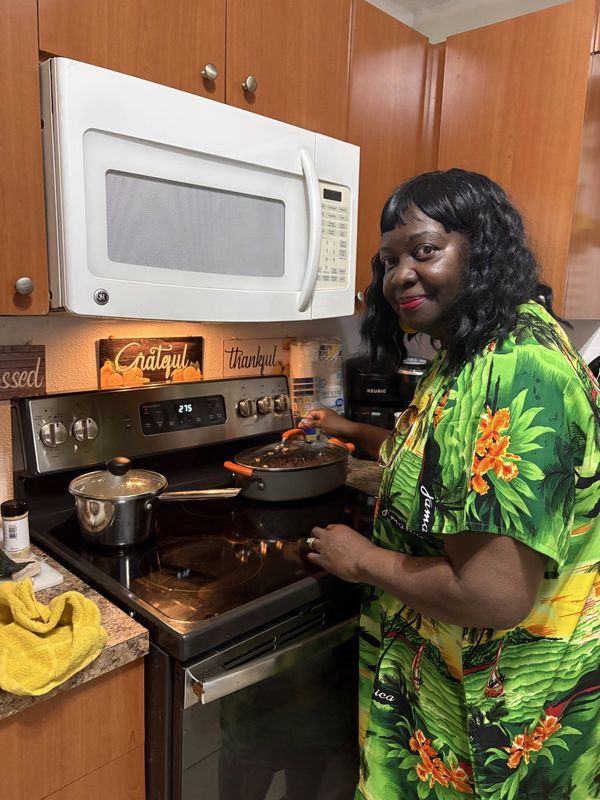
Gloria Harris has lived in Newtown her entire 70 years.

She knows every street, all her neighbors and every church.
She knows where the kids play and where the elders still gather.
What she has known equally well, for most of her life, is where not to look for groceries.
For decades Newtown – Sarasota’s historically Black neighborhood anchored by Dr. Martin Luther King Jr. Way – has existed in the shadow of one of Florida’s wealthiest zip codes without a single full-service grocery store.
“We requested it, but nothing was ever done about it,” Harris said.
“We had to do what we had to do to get food. We had to go to Walmart or Publix – way over there.”
Residents like Harris have had to drive miles past waterfront condominiums and upscale restaurants to find fresh produce, meat and dairy products.
Those without cars navigated multiple bus connections.
Seniors on fixed incomes stretched the few fresh food items they could find and afford.
Newtown has been, by every definition, a food desert. And it has been for a long time.
However, on March 10, 2026, something changed.
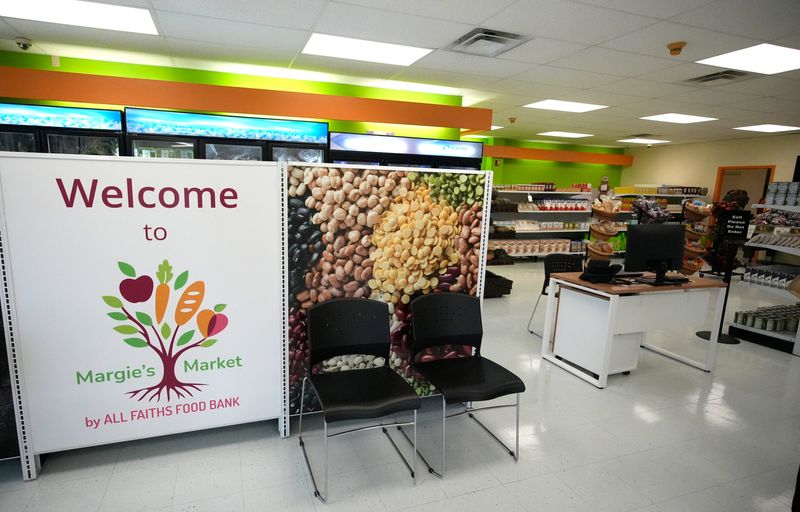
Margie’s Market – a first-of-its-kind community choice market operated by All Faiths Food Bank – opened its doors at 1781 Dr. Martin Luther King Jr. Way, bringing fresh pineapple, free-range chicken, collard greens, rice, beans and dignity directly into the heart of Newtown.
Harris was there on opening day. She has gone back every Tuesday since.
Food insecurity crisis
A food desert is defined as a community where residents lack reliable access to affordable, nutritious food.
These deserts are typically manufactured because full-service grocery stores are too far to reach, especially without a car.
In neighborhoods like Newtown, families have long relied on convenience stores and gas stations –places where fresh fruits, vegetables and healthy proteins are scarce and expensive.
The data behind the crisis is stark.
Approximately 10.6% of residents across Florida experience food insecurity – a rate that is mirrored in Sarasota County.
But neighboring Manatee County faces an even steeper challenge, with nearly 17% of residents affected.
And in Charlotte and DeSoto counties, more than 11% of households struggle to find affordable and nutritious food.
The most recent federal data, released in December 2025 by the USDA, shows that food insecurity in Florida and 27 other states is on the rise.
Between 2022 and 2024, Florida saw a 3.4% increase in food insecure households compared to the period of 2019 to 2021.
Across the United States nearly 14% of households – 1 in 7 – faced food insecurity in 2024, with 5.4% experiencing very low food security, meaning family members were forced to skip meals or eat less.
Those numbers may soon become harder to track.
In September 2025, Reuters first reported that the Trump administration terminated all future editions of the USDA’s annual Household Food Security Survey – the 30-year-old federal report that has been the primary tool for measuring hunger in America – calling it “redundant” and “costly.”
The move came just weeks after the signing of H.R. 1, legislation that cuts billions from the Supplemental Nutrition Assistance Program (SNAP) over the next decade.
“Eliminating this report does not eliminate the problem. It just hides it,” Crystal FitzSimons, president of the Food Research and Action Center said in statement following the cut last fall.
For Sarasota, the strain extends beyond statistics.
In this region, hurricanes, skyrocketing housing costs and rising insurance premiums have compounded the pressure on low-income households.
Seniors bear the heaviest burden – their fixed incomes have been eroded by inflation while the cost of groceries, medicine and utilities continues to climb.
According to All Faiths Food Bank, seniors make up 23% of the population it serves, and the organization assisted more than 12,000 seniors in the Sarasota-DeSoto region in 2024 alone.
Rates of food insecurity are disproportionately high among Black and Latino households, single-parent families and households earning below 185% of the federal poverty line – roughly $60,000 annually for a family of four.
In a neighborhood like Newtown, those categories overlap significantly.
‘We knew what they didn’t want’
Long before Margie’s Market opened, Newtown residents had been making their needs known.
Harris remembers attending one of the early community listening sessions All Faiths Food Bank organized – a small gathering of mostly elderly residents on Northgate Drive where a woman named Karissa Roosa was there to listen.
“We talked about this market coming to the area,” Harris recalled.
“(But) I didn’t know it was gonna come full circle.”
All Faiths Food Bank CEO Nelle Miller said that community proximity wasn’t just a strategy – it was a core organizational value.
Before proposing the market concept to the Charles & Margery Barancik Foundation, Miller and the All Faiths staff spent months listening to Newtown residents, community leaders and local organizations.
“One of our fundamentals is to be proximate to our neighbors – to listen to them and their voice as to what they feel they need,” Miller said. “You tell me what you want, tell me what you don’t want.”
What they heard was consistent: residents felt they were being offered things they didn’t want – food that wasn’t culturally relevant, distributed in ways that felt impersonal, even demeaning.
They wanted choice.
They wanted to see what they were taking home.
They wanted the dignity of a shopping experience.
“We knew we just couldn’t pull in there with a big white truck and people with green shirts,” Miller said.
The Barancik Foundation, which awarded a $700,468 grant to fund the one-year pilot, took the same approach.
More than a market
When Harris walked into Margie’s Market on opening day, the first thing she noticed was the refrigerators.
“All I could say was ‘wow,'” Harris said.
The design of the market was intentional – arranged like a neighborhood grocery store with food organized and arranged on accessible shelves.
Patrons make weekly appointments, arrive during their scheduled window and fill bags with the items that best suit their households. They can take up to five pounds of meat, a selection of fresh vegetables and up to 12 nonperishable items per visit.
The shopping limits were calibrated, All Faiths staff said, to feed a family for the week.
For Harris, who cooks for a family of five, the math is transformative.
“With Margie’s Market, you can take some of the money (that you’re saving) and pay other bills that you wouldn’t normally have been able to pay,” Harris said.
The shelves are stocked with cultural intent.
Collard greens, beans, rice, turkey – staples of Black Southern cooking – sit alongside other items selected based on the community feedback that shaped every aspect of the market, from its name to its hours.
“Everything from the branding to the name, to the kinds of foods we carry came from community feedback,” said Karissa Roosa, director of food and resource initiatives at All Faiths.
“We wanted the market to reflect the people who live here.”
The hours were another deliberate departure from traditional food assistance.
Most distribution programs operate on limited daytime windows that conflict with work schedules.
But Margie’s Market operates Tuesday and Wednesday from noon to 2:30 p.m. and again from 4 p.m. to 7:30 p.m.; Thursday and Friday from 7 a.m. to 10 a.m. and 11:30 a.m. to 2:30 p.m.; and Saturday from 8 a.m. to noon.
“Not everyone can get to a distribution at 9:30 in the morning,” said Nina Harrelson, senior director of strategic communications at All Faiths. “People have jobs, they have children to take care of.”
Inside the Goodwill Manasota Community Resource Center where the market is housed, patrons can also connect with staff who help them apply for SNAP, WIC and other benefits programs – making it a one-stop resource hub.
For many, these wraparound services are just as valuable as the food itself.
“A lot of people don’t even know what services are available to them or if they qualify,” Harrelson said.
Harris confirmed as much from her own conversations in the neighborhood.
“They didn’t realize they could do all that stuff.” she said of her neighbors.
Harris has taken it upon herself to spread the word, from carrying Margie’s Market flyers on her rounds to showing people how to scan a QR code and make an appointment.
“Everybody knows Miss Gloria,” she said, laughing.
The health impact of food access
The connection between food access and health outcomes is significant.
Food-insecure families carry annual health care costs that are, on average, nearly $2,500 higher than food-secure households, according to research cited by the Food Research and Action Center.
Health-related costs tied to hunger have been conservatively estimated at $160 billion nationally.
For communities like Newtown, the effects are compounded by decades of inequitable food access.
Without reliable proximity to fresh produce, lean proteins and whole grains, residents have long been constrained in their ability to manage chronic conditions like diabetes, hypertension and heart disease –illnesses that are known to disproportionately affect Black Americans.
Roosa said the market’s future programming may include cooking classes and nutrition education.
These programs won’t be designed to change what people eat, but they could help provide residents with options for preparing the foods they already love in healthier ways.
Pilot model built for expansion
While Margie’s Market is a one-year pilot, everyone involved believes it can become something more.
All Faiths is optimistic that if the Margie’s Market model works, it will lead to similar markets in other neighborhoods where there is scarce access to fresh food.
For Miller, the flexibility built into the Barancik grant is key to replicating the impact of Margie’s Market.
She said All Faiths will use the one-year period to monitor the market’s progress and talk to more people – and to “really home in on specifically what they want.”
The choice-model market concept has been tested in other cities around the country, with food banks in larger metro areas piloting similar approaches.
But what makes the Newtown iteration notable is the depth of community engagement that preceded it – including surveys, postcards and in-person listening sessions – and the cultural intentionality embedded in everything from the inventory to the volunteer staff members, who were recruited from the surrounding neighborhood.
That philosophy – community-led, community-designed, community-staffed – is a perfect fit for Newtown’s needs.
A food future
And Newtown is not alone in its needs.
Across Florida, food deserts persist in communities that share Newtown’s demographics: historically Black neighborhoods, rural communities and other areas where economic and geographic barriers compound one another.
With federal data collection on food insecurity potentially ending and SNAP funding facing significant reductions, the informal safety net built by local nonprofits like All Faiths Food Bank will face unprecedented pressure.
Recent Feeding America polling found that 95% of voters view hunger as a nonpartisan issue – one requiring collaborative solutions across government, philanthropy and community organizations.
With programs like TEFAP, the federal Emergency Food Assistance Program, already serving as the backbone of food bank operations, advocates say the continued investment in both farm-to-food-bank pipelines and community-based markets is essential.
For now, the focus in Newtown is closer to home.
On Tuesdays, Gloria Harris shows up for her appointment.
She picks out her meat, her produce and her pantry staples for her family.
The food is fresh and visible – and it is chosen by her own hands.
“Nothing is expired,” Harris said. “I get to choose it. I get to cook with it.”
In a community that has gone with so little for generations, that is not a small thing.
Samantha Gholar is an enterprise journalist with USA Today Co. She covers wellness, culture, and people for the Herald Tribune. Connect with her via email at sgholar@usatodayco.com.
This article originally appeared on Sarasota Herald-Tribune: Inside the Sarasota pilot market that could chip away at food deserts
Reporting by Samantha Gholar, USA TODAY NETWORK – Florida / Sarasota Herald-Tribune
USA TODAY Network via Reuters Connect