The moon is about to have some planetary company in the night sky for one night in May, and skywatchers in Florida should easily be able to see it.
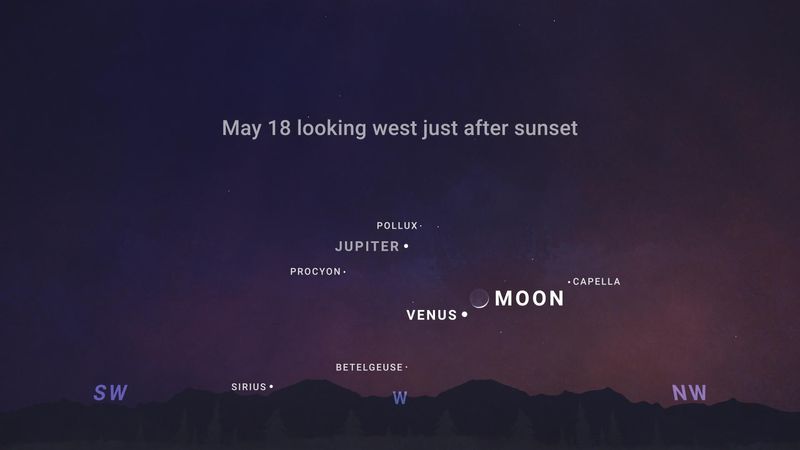
Venus will join the moon May 18 in a cosmic event known as a conjunction. The meet-up presents spectators with a rare opportunity to see a phenomenon in which at least two celestial bodies appear from our vantage on Earth to be near one another.

The conjunction, which will be widely visible across the U.S. and around the world, is the latest time that Venus and the moon have had a rendezvous in Earth’s sky. Venus, which in March appeared with Saturn, also formed a conjunction with the moon in September.
Here’s everything to know about the upcoming moon and Venus conjunction, including a cloud forecast for Florida and dark sky areas in the Sunshine State that may offer the best views.
What is a conjunction?
A conjunction is an astronomical event in which at least two planets – or, in this case, a planet and a moon – appear to our vantage from Earth to be close together in the sky.
Even though the planets are in reality still tens of millions – or even billions – of miles apart, the events present a special opportunity for astronomers and casual stargazers to see multiple worlds in our solar system at one time.
So, what causes conjunctions to take place?
As planets in our solar system orbit the sun at varying speeds, sometimes their orbital paths bring them close together on the same side of the sun. When this event lines up with our view from Earth, we get a conjunction, according to the nonprofit Planetary Society.
When is the conjunction? See Venus, moon together in sky
The moon and Venus are due to have a cosmic meetup that should be visible Monday, May 18, to us here on Earth, NASA said in a monthly skywatching guide.
Those who look up that night have not only a chance at seeing Venus – one of the brightest objects in the sky, after the sun – but a crescent moon that is just bright enough to be seen without stealing the show.
How full will the moon be? What to know about lunar phase
By May 18, the moon will be just about 5% full and in a waxing crescent phase, according to the Old Farmer’s Almanac. That means just a thing silver sliver of Earth’s only natural satellite will be illuminated as most of its near-facing side faces away from our planet, NASA explains.
Will cloudy weather spoil the conjunction? Florida forecast
Of course, clouds in the sky could also hamper the view.
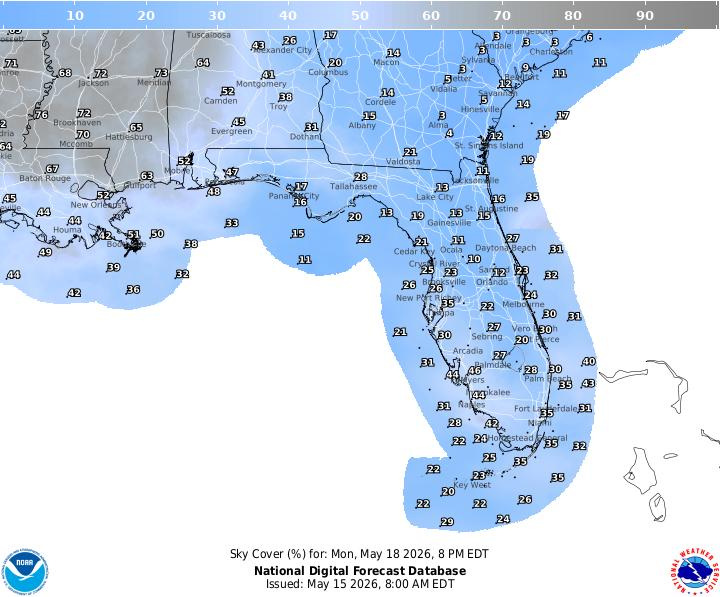
The National Weather Service shared a graphic showing cloud cover on the night of Monday, May 18, in Florida when the conjunction would be seen.
Blue shading indicates clear skies, while the grayer the shading and higher the percentage numbers, the higher the chance for clouds.
Where are Florida dark sky communities?
Want to find a dark area near you to view the conjunction? DarkSky International is a U.S nonprofit that maintains a list of designated dark sky communities around the world, including 173 in the United States.
That includes these three locations in Florida:
Where, how can you see celestial conjunction in May? Tips
For those in the Northern Hemisphere, which includes the U.S., spotting the conjunction shouldn’t prove too difficult.
Simply locate the moon in the western sky, and Venus should shine brightly underneath it.
Do you need a telescope to see Saturn next to the moon in the sky?
Telescopes certainly will enhance the view but spectators don’t need any equipment to spot the moon and Venus in the pre-dawn sky.
Eric Lagatta is the Space Connect reporter for the USA TODAY Network. Reach him at elagatta@usatodayco.com
This article originally appeared on Palm Beach Post: Venus, moon to share sky for 1 night. Don’t miss conjunction in Florida
Reporting by Eric Lagatta, USA TODAY NETWORK – Florida / Palm Beach Post
USA TODAY Network via Reuters Connect