After veering from some of the “rules” we had come to expect the Green Bay Packers to adhere to in the draft a year ago, forcing a rethink of what we truly know about their philosophy, this year’s draft was pretty run of the mill.
That is not an insult, far from it. Packers GM Brian Gutekunst stuck to the types of players he has tended to like in the 2026 draft, while also filling roster needs and finding value.

There was very little that made any of their picks unusual. Brandon Cisse is the first cornerback they have drafted in the first five rounds since 2005 who skipped the 3-cone, but his shuttle time, while below average, was the same as that of Eric Stokes, a first-round pick from 2021.
Similarly, Domani Jackson became the first corner Green Bay has taken who did not do either of the agility drills. The only changes here relate to a lack of testing, not results, and as more and more players pick and choose which tests to participate in, that is simply the new draft landscape.
The biggest surprise pick based on testing was Chris McClellan, who was reported to have by far the worst 3-cone score of any defensive tackle the Packers have drafted in two decades, and combined with a poor reported shuttle time, had unprecedented poor agility for a Green Bay pick.
However, there is some dispute over whether he actually did the agility drills at all. His scores are recorded on the Relative Athletic Score (RAS) site, but are not in Dane Brugler’s exhaustive draft guide “The Beast.”
It would be highly unusual for Brugler to have made an error of omission, especially as his guide was released well after McClellan allegedly did the agility testing at his pro day. To the best of my knowledge there are no reports online from the pro day which refer to him doing the agility drills.
The RAS site also had some unusual issues this year with player heights being recorded incorrectly and profiles not being updated to reflect improved pro day results in certain drills, so it may have been an error on their end.
If McClellan did in fact participate and record those poor scores, it tells us the Packers do not really care about agility at defensive tackle. If he did not, his athletic profile is very ‘Packersy’, with great size, good speed and explosion. We may never know, so it is something to watch in future.
Although there was not much to glean from Green Bay’s picks, there is now another variable in the mix, with Jon-Eric Sullivan, who came up in the Packers organization, running the show in Miami.
With that in mind, what can we learn from the Dolphins’ draft picks that could inform how we think about the Packers and their preferences?
For the most part, Miami’s picks are very much aligned with the core principles of the philosophy championed in Green Bay. Sullivan’s very first selection as a general manager is a great example and builds on something we learned about the Packers in last year’s draft.
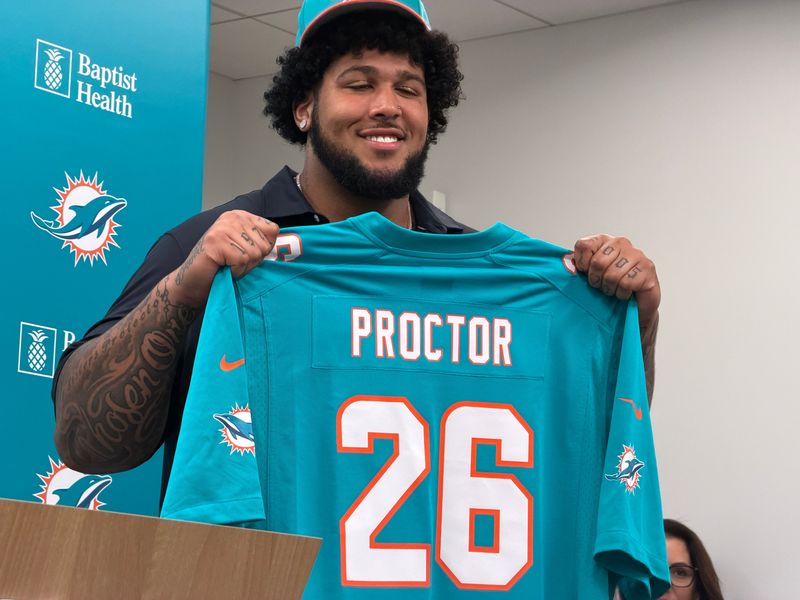
Miami selected Alabama’s mammoth offensive tackle Kadyn Proctor, who is 6-6 ½ and 352 pounds and tested incredibly well for his size.
As Sullivan has been known to say: “Fast gets slow, but big doesn’t get small.” That essentially means size is one of the most valuable commodities in the draft, and positions like offensive and defensive line are going to be prioritized over skill positions when player grades are similar.
Proctor’s size also reinforces a lesson about how the Packers view size on the O-line which we learned when they selected Anthony Belton a year ago, who weighed in the 330s, much heavier than the types of prospect they had historically drafted.
Some theorized the Packers suddenly wanted to get bigger due to their power run game with Josh Jacobs, but Gutekunst was adamant they had not changed their philosophy, and that it had always been heavier is better up front, as long as they still have strong athletic traits.
At over 350 pounds, but still passing all the athletic benchmarks Green Bay has historically used and drafted by a team with an undersized running back, not exactly a ‘power’ scheme, Proctor’s selection backs up Gutekunst’s claim and shows there is no such thing as ‘too heavy’ for this tree.
Height matters though, as players can be too tall to play guard (taller than 6-7). While Proctor is taller than all but one O-lineman Green Bay drafted since 2005, he is still viable at guard and will play there this year (following a Packers trend of drafting college tackles and moving them around).
Trey Moore from Texas is small for a ‘Packers type’ edge rusher at 6-1 ½ and 245 pounds, but he is in the Collin Oliver mold as a prospect who has played both on the edge and at off-ball linebacker, and ticks all the size and athleticism boxes at linebacker.
Similarly, Pitt’s Kyle Louis is an undersized linebacker, but some teams view him as a safety, and he passes all the benchmarks as a Packers type through that lens.
Miami’s picks of Moore and Louis reinforce that if players fit into different boxes, they could still be in play for Green Bay even if they are unconventional.
Of the Dolphins’ 13 draft picks, the vast majority were the types of players the Packers would usually take, but there were some intriguing curveballs.
Texas’s Michael Taaffe is lighter and shorter-armed than any safety Green Bay has drafted in the Gutekunst/Ted Thompson era. Maybe he slimmed down to improve his athletic testing, or perhaps Sullivan is more willing to throw some of the principles out the window later in the draft.
In the same vein, Missouri’s Kevin Coleman only weighs 179 pounds, which would be unprecedented for a Packers receiver, and his testing was not especially strong to make up for it.
Coleman was also a slot-only in college, with Green Bay historically taking receivers who played more than half their snaps on the perimeter in at least one college season, before moving them to the slot if needed.
This could have been a pick for the scouts, like Shemar Jean-Charles for the Packers a few years back. A player who did not fit what they are realistically looking for, but they simply loved the tape.
However, it could be a sign Green Bay are open to smaller receivers. There was talk following the 2023 draft that they were in on Zay Flowers in the first round if Lukas Van Ness had not been available, and he is an undersized receiver.
Completely ruling out smaller wideouts may be premature, especially if they do have elite athleticism like Flowers did coming out of Boston College.
Of course, Sullivan is his own man, and not everything he showed a willingness to do in his first draft is by proxy a pick Gutekunst would be willing to make. It is also worth noting both of these outlier selections by the Dolphins came outside the top 150 picks.
Nevertheless, it is fascinating to have another branch of the Ron Wolf tree running a team, providing extra data points to reinforce the accepted principles of Green Bay’s philosophy, and perhaps drop breadcrumbs regarding the types of players they might be open to drafting.
This article originally appeared on Packers Wire: Lessons from Packers draft philosophy in 2026, with help from Miami
Reporting by Mark Oldacres, Packers Wire / Packers Wire
USA TODAY Network via Reuters Connect