IOWA CITY — Ben McCollum’s accomplished head-coaching career has spanned 17 seasons. Fifteen at Northwest Missouri State, one at Drake and one at Iowa.
But his 18th season — and second with the Hawkeyes — will bring something different than the previous 17.

This will be the first time McCollum has coached someone who is 7-foot-3.
“No,” McCollum said about whether he had ever coached a player that tall. “Nope.”
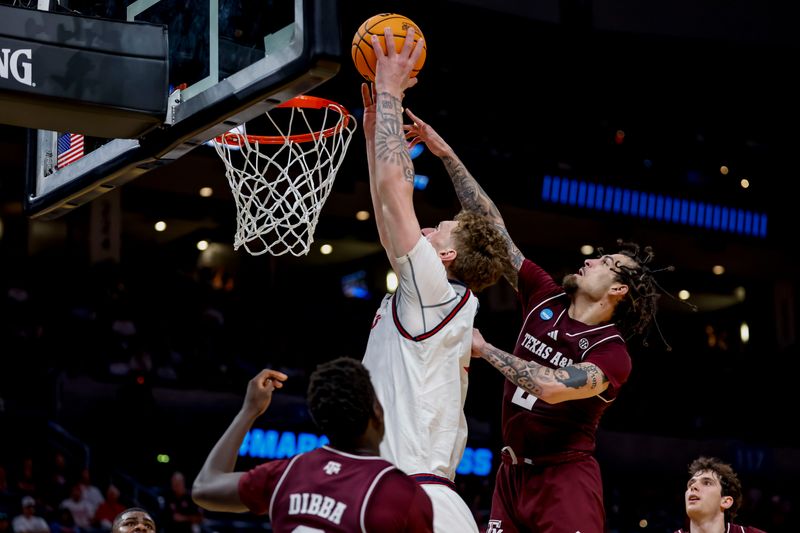
It is uncharted waters for the program, too. Saint Mary’s transfer Andrew McKeever, listed at 7-foot-3 and 285 pounds, is believed to be the tallest player in Iowa men’s basketball history.
McKeever is one of four newcomers signed with the program for the 2026-27 season — and one of two transfer-portal additions. McCollum told the Register in a May 4 interview that Iowa is still looking to add another guard to the roster. So while the bulk of the Hawkeyes’ roster construction for next season is done, it might not be entirely complete.
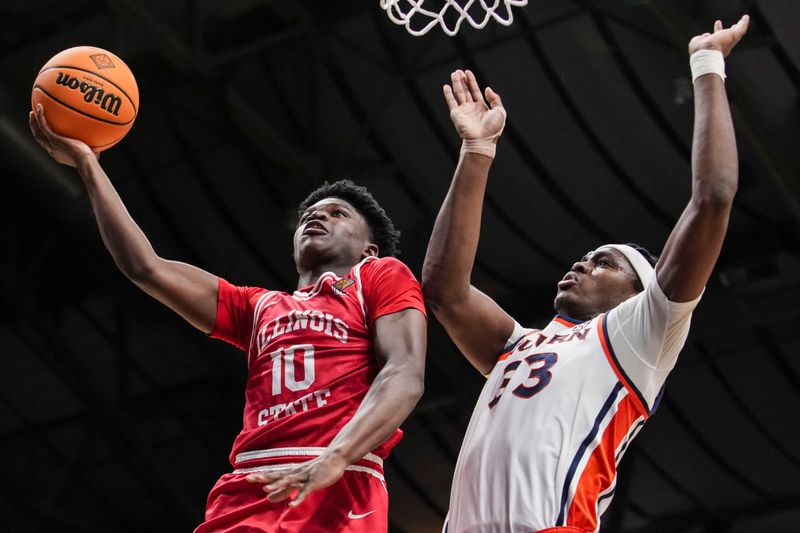
Along with McKeever, Iowa also landed former Illinois State guard Ty’Reek Coleman from the transfer portal.
When McCollum was still the head coach at Drake, the Bulldogs were involved in Coleman’s high school recruitment. But Coleman ended up going to Illinois State, where he proceeded to average 10 points, 2.7 rebounds and 1.8 assists per game as a freshman. Coleman’s shooting efficiency was impressive, considering it’s not unusual for younger guards to struggle in that department. The 6-foot-2 Coleman finished the season shooting 50.4% from the field and 41.6% from deep.
“We thought he was good (in high school),” McCollum told the Register. “Thought he’d be really good for us there (at Drake). But then watching him at Illinois State, it was like, man, he’s one of those kids that had he stayed at Illinois State for (his sophomore year), he’d probably end up averaging 18 or 20 (points per game). I think he’s one of the better guards in the (Missouri Valley Conference). I think he’s a really good player. 6-(foot)-6, 6-7 wingspan, super twitchy, more than you’d even know. And our offense is a ball-screen-heavy offense anyway, so I think that’ll help him quite a bit.”
Though it’s not exactly fair to Coleman, the Bennett Stirtz conversation is unavoidable. It’s no small story that Iowa is losing Stirtz, the team’s best player last season and a projected first-round pick in the 2026 NBA Draft.
Like Stirtz, Coleman will be making the jump from the Missouri Valley Conference to the Big Ten. But unlike Stirtz, Coleman has far less experience and production under his belt when he makes that transition. Stirtz came to Iowa having already scored more than 1,600 points in his college career, including a season in which he was named MVC Player of the Year. Coleman’s resume is nowhere near that level.
“And he didn’t play for me for three years prior (like Stirtz did),” McCollum also pointed out.
It’s easy to be excited about Coleman’s long-term potential, especially considering he still has three seasons of eligibility remaining. But it wouldn’t be wise to think that he will immediately put up the numbers Stirtz did.
So what are realistic expectations for Coleman in his first season at Iowa?
“I don’t have expectations per se because I think everybody performs to where they’re supposed to perform,” McCollum said. “So if you say, you’ve got to take over and do what Bennett did, I think those are unfair expectations. It doesn’t mean you can’t. But we’re not trying to replace Bennett Stirtz. We’re not going to. You’re trying to be what we’re supposed to be next year, not what we were last year. So every year is unique to every situation, and if you try to replace and say this guy’s got to be Bennett, (former Northwest Missouri State star Trevor Hudgins), this, this — it just doesn’t work like that.”
Back to McKeever.
Simply put, McKeever gives Iowa the type of mountainous presence that it lacked as it operated with an undersized frontcourt last season. McKeever, who averaged 8.2 points and 9.2 boards per game as a redshirt sophomore last season, should immediately upgrade the Hawkeyes’ rebounding and ability to handle bigger bodies on the interior defensively.
But something less obvious that stood out to Iowa was McKeever’s passing. His 1.8 assists per game would’ve ranked fourth on Iowa’s team last season. McKeever logged a career-high six dimes against San Francisco in January.
“He’s a really good offensive trigger, and that’s what probably people don’t see because they just see the size,” McCollum said. “But then he’s got a huge catch radius, because he’s 7-3, legitimately 7-3. So his catch radius is big. So when you couple that with the fact that then he can decision-make out of that catch radius, now he can put pressure on the paint, which is a big deal for us … But post moves, I think the thing that you do is just have him catch it deeper and go finish. Just make a layup. You just get a cheap six points in a game. But other than that, it’s triggering offense.”
A perplexing component to McKeever’s stat line is his blocks. He averaged 0.8 per game last season. For as tall as he is, that is a surprisingly low number. To put that into perspective, 7-foot-4 Zach Edey averaged 2.7 blocks per 40 minutes in his final season at Purdue. 7-foot-3 Aday Mara averaged 4.4 blocks per 40 minutes at Michigan last season. McKeever’s 1.5 blocks per 40 minutes last season pale in comparison.
Granted, those numbers don’t mean as much as long as McKeever is altering shots.
But does McKeever have more shot-blocking production to unlock?
“I don’t know,” McCollum said. “Obviously, when you’re 7-3, you naturally eat up space and you do challenge some things. I think the thing that he does do is — you watch him guard (West Coast Conference Player of the Year) Graham Ike, and it’s like, oh, he guarded him. And Graham Ike is a monster. And he was able to guard him and not put as much pressure on your perimeter defense when there’s a post feed. So, it’ll certainly help you in the post just being able to defend a post player.”
McCollum continued: “And then blocks, shot-blocking is unique. There’s a certain timing that goes with it. I don’t know that that’s like his strength. But that doesn’t mean that you can’t protect the rim at 7-foot-3, come over and get vertical. Because he’s (285) pounds. So you run into him, you’re going to stop. He’s not (Aday) Mara in regards to shot-blocking, but he’ll be able to protect the rim enough, yes.”
McKeever’s size gives Iowa the type of lineup flexibility that it didn’t have last season. The Hawkeyes have the potential to go with jumbo front lines. McCollum is confident that McKeever will be able to play alongside Cam Manyawu.
For the first time in his coaching career, McCollum has a 7-foot-3 chess piece at his disposal.
“Yeah, I’m curious, to be honest, to see what it’ll look like,” McCollum said of being able to use McKeever from an X’s and O’s standpoint offensively. “I think that we’ve got a different type of team next year, where we’ve got a ton of size, a ton of length and it’s all pretty skilled. And so, how you’re able to put pressure on that paint with that size, what speed you’re going to play, the different styles you’re going to play. Do you go big? Do you play Trevin (Jirak) and (McKeever) together sometimes? And then, do you put (Cooper Koch) out there with them? It’d be unique. I don’t know if you could guard a whole lot with that group. But you might be able to. You could mix and match and do some unique things. I don’t know. We’ll see. It’ll take us a little while to figure out during the summer.”
Follow Tyler Tachman on X @Tyler_T15, contact via email at ttachman@gannett.com
This article originally appeared on Des Moines Register: Ben McCollum’s vision for Iowa basketball newcomers Ty’Reek Coleman, Andrew McKeever
Reporting by Tyler Tachman, Des Moines Register / Des Moines Register
USA TODAY Network via Reuters Connect