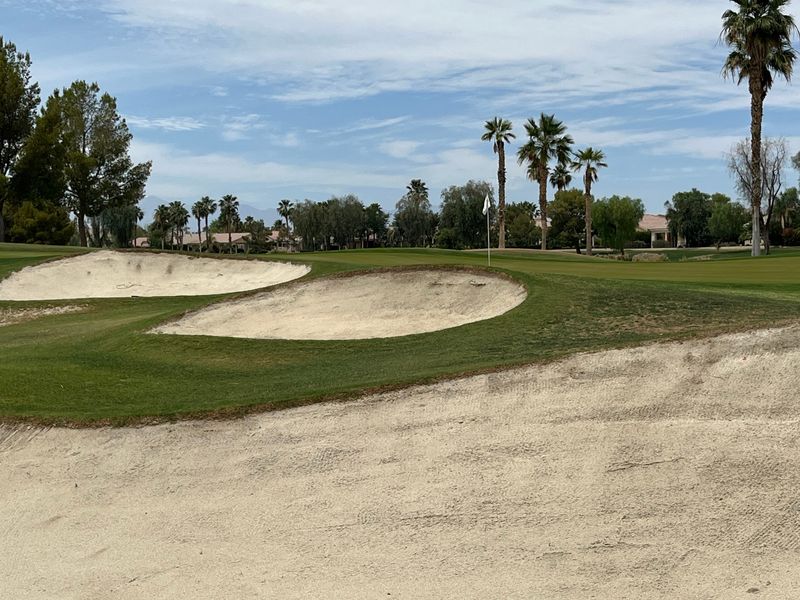
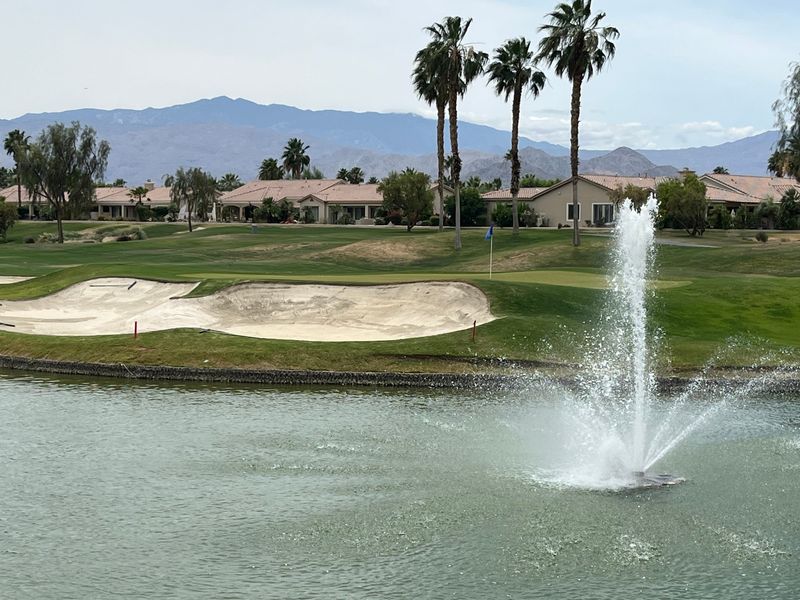
Every golfer has had this thought at one time or another. Playing a course, either familiar or new, a golfer will look at some feature on the course, a bunker, a lake or a piece of grass that seems completely unreachable and said, “Who in the world would hit the ball over there? I couldn’t hit the ball there if I tried.”
It’s fair to say that almost every golf course has some area that is maintained but receives minimal if any traffic during a typical day’s play. When a golf course like the South Course at Shadow Hills Golf Club in Indio decides it needs some renovation on its layout, where traffic flows on the course is the kind of information that can be vital.

That’s where a GPS tracking system comes in, like the one the United States Golf Association offers. For a fee, the USGA can set a golf course up with a transponder system to track where there is and isn’t traffic on the course.
“How far right are golfers hitting it in the rough on the sixth hole so we can introduce a low-maintenance rough area to save costs without slowing pace of play?” the USGA website says about the system. “How far can we move up the start of the fairway on the 12th hole without creating a carry that is too long from the forward tee?”
Shadow Hills opened in 2004 as a course for the residents at the 55-and-over Sun City development in north Indio but is also open to public play. It is one of the latest clubs to use the USGA transponder service. Management company Troon and Shadow Hills have put the data from the transponders to good use, general manager Scott Winant said.
“We put these little transponders on all the golfers for a week or so to see where they went on the course,” Winant said. “What sand traps weren’t in play at all, which ones were.”
The results of that transponder survey have led Shadow Hills to shut down their South Course for the summer starting May 18 – the property’s 18-hole par-3 North Course will not be impacted – for some significant renovations. With Gary Brawley as the architect in charge of the changes and Integrity Golf doing the construction as it has done for so many desert courses in recent years, the project will have a wide scope. That will start with information from the transponders, focusing mostly on bunkers.
“We are going to remove about 40 percent of the square footage of bunkers, either reducing size or changing the shape of them a little bit,” Winant said. Winant added that some bunkers will be removed completely in the project.
The South Course is known in part for its bunkers, large bunkers with high faces along the fairways and near the greens. Other work on the bunkers will also be part of the process, refreshing the 20-year-old course designed by Schmitt-Curley architects.
“We are going to remove all the sand from the bunkers and we are going to re-line all the bunkers,” the general manager said. “We are doing spray-on liners so we won’t have the liners sticking up anymore.”
Like most golf courses that do renovations these days, the focus will also be on the greens on the South Course. Bermuda greens that are overseeded with cool-weather grass all tend to shrink over time. Brawley and Shadow Hills will take the existing greens back to their original size, adding as much as four to six inches around the entire collar of the green. But unlike many desert courses, the South Course will not be converting to the popular MiniVerde grass for its greens.
“We are not going to change that yet,” Winant said. “It might be something we look at down the road as Troon does some more research on an annual grass that you don’t have to overseed.”
Other work on the golf courses will include irrigation work on some areas that get too much water from the irrigation sprinklers, but there won’t be a complete overhaul or changing of the irrigations system, Winant said. Some areas where Bermuda grass no longer grows will be sodded with Bermuda to aid in overseeding in the fall.
“We have wet spots just due to drainage issues and we are going to fix all of that,” he said. “We’ll do some of the landscaping on the course. We are overseeding wall to wall now instead of browning out the rough.“
The tees on the golf courses will also be leveled to make up for 20 years of traffic. It all might seem like a lot, but it is work that can be completed in one summer.
“It’s going to be a pretty big project. It’s about $2.4 million,” Winant said. “We’ll be back up after overseed. So the traditional date that we would open up, about the first of November, that’s what we are planning.”
This article originally appeared on Palm Springs Desert Sun: Shadow Hills Golf Club goes high-tech to guide course renovation plan
Reporting by Larry Bohannan, Palm Springs Desert Sun / Palm Springs Desert Sun
USA TODAY Network via Reuters Connect