When thoracic surgeon Dr. Ioana Baiu sees lung cancer patients these days, she’s often shocked.

By their age, by their gender but most of all by this fact: They aren’t smokers.
“Traditionally we saw older men who smoked, but now about 20 percent are nonsmokers and they’re younger—in their 20s and 30s—and they’re women,” says Baiu, a doctor at the Ohio State University Comprehensive Cancer Center – Arthur G. James Cancer Hospital and Richard J. Solove Research Institute.
That’s why she and many others in health care are trying to get the word out: Smoking isn’t the only cause of lung cancer, and screening is available that can catch cancer early.
Lung cancer is the leading cause of cancer deaths in the United States and caused 1.8 million deaths worldwide in 2022. The Centers for Disease Control and Prevention says while 80 percent to 90 percent of people diagnosed with the disease have a history of smoking, the remainder of cases show up in people with little or no smoking history. And because lung cancer can take years to develop, Baiu says the percentage of patients who don’t smoke will increase over time.
Stay connected to the region’s business community. Subscribe to Insider, Columbus CEO’s newsletter.
The second-leading cause of lung cancer is radon exposure, says Dr. Vincent Daniel, a thoracic surgeon at OhioHealth. Radon is a colorless, odorless gas that seeps into buildings from the ground. Longer exposure and higher radon levels can elevate cancer risk, he says. Since radon is common in Ohio, he suggests homeowners test their radon levels. Free test kits are available through the Ohio Department of Health at ohio.radon.com.
Exposure to chemicals, secondhand smoke and air pollution also are risk factors, and genetics can play a part, too, Daniel says. “There are a lot of environmental exposures we don’t have a good understanding of, and we don’t have a slew of genetic mutations we have identified,” he says. “There’s so much we don’t know.”
Ohioans have reason to worry. The American Lung Association reported in November that while the national rate of new lung cancer cases per 100,000 people is 52.8, it climbs to 63.88 in Ohio, ranking the Buckeye State the ninth-highest in the nation. Not surprisingly, Ohio’s smoking rate also is high, at 14.9 percent of the population, compared with the national average of 10.8 percent in 2023.
Not all the news is grim. For more than a decade, smokers and some former smokers have been eligible to get a low-dose computerized tomography, or CT, scan that can detect lung cancer at its earliest stage. The 30-second test detects lung lesions at a much smaller size than previous tests, Daniel says, which saves lives because those lesions can be removed before the cancer spreads.
Annual screenings are recommended for those who are 50 to 80 years old, smokers who have smoked a pack a day for 20 years and those who quit smoking within the last 15 years. The test is generally covered by insurance. It’s especially important because symptoms of lung cancer, such as chronic coughing, hoarseness, weight loss, shortness of breath and chest pain, don’t usually appear until lung cancer is well established.
“If you already have symptoms, it’s a little late,” says Dr. Talya Greathouse, vice president of medical affairs for Licking Memorial Hospital. “The key is to get screened.”
Greathouse hopes talking about screening will make people more aware of its importance, especially in counties like Licking where smoking rates are high. In 2022, 19.4 percent of its residents were smokers.
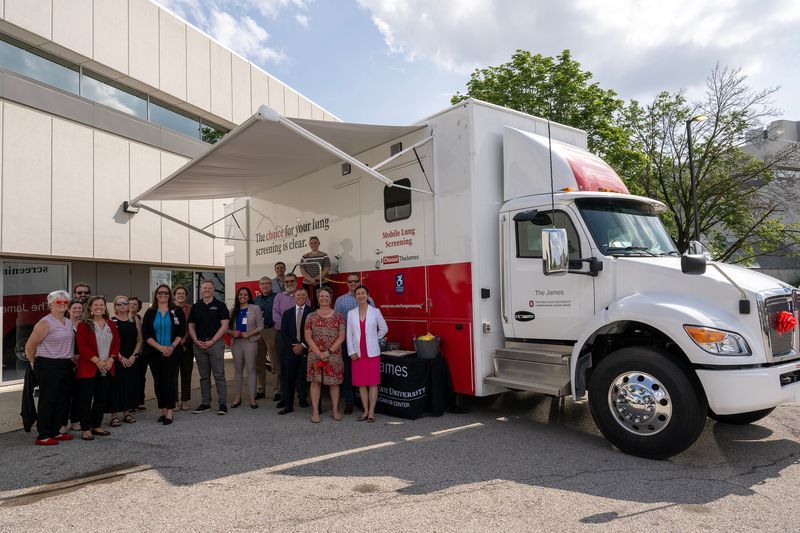
To encourage screening, Ohio State began operating a mobile CT unit in July.
Interventional pulmonologist Dr. Jasleen Pannu, director of the Lung Cancer Early Detection program at the OSUCCC – James, says the vehicle goes to community events and locations where screenings may not be readily available.
“Many people face barriers to get tested, so the mobile unit allows screening directly in the community,” she says. Patients preregister and have a telehealth appointment before the unit arrives, so the actual scanning just takes a few minutes. Experts at the James read the scans and let patients know about any concerns, Pannu says.
Nationally, just 18.2 percent of people at high risk for lung cancer were screened in 2025, according to the American Lung Association. “One life is saved from screening 320 people, while it takes 864 colonoscopies to save one person who has colorectal cancer,” Pannu says. “The test is the most successful screening for cancer there is.”
“The reason we’ve done such a poor job of treating cancer is that we’ve often found it too late,” says Daniel. He has had many patients whose lung cancer was detected when they had tests for other health issues, such as heart problems or a chronic cough.
Baiu hopes the current lung cancer screening recommendations will be expanded so more cases can be caught early. Currently, most insurance companies won’t pay for CT screening for those with risk factors other than smoking.
“Your survival rate is drastically different if your cancer is stage 1,” she says. Then, she says, you have a 90 percent chance of living for five years; that drops to 20 percent for those with stage 4 cancer.
Kathy Lynn Gray is a freelance writer.
This story is from the Spring 2026 issue of Columbus CEO. Subscribe now.
This article originally appeared on Columbus CEO: Doctors Say Lung Cancer Diagnoses Are Rising in Young, Nonsmoking Women
Reporting by Kathy Lynn Gray, Columbus CEO / Columbus CEO
USA TODAY Network via Reuters Connect