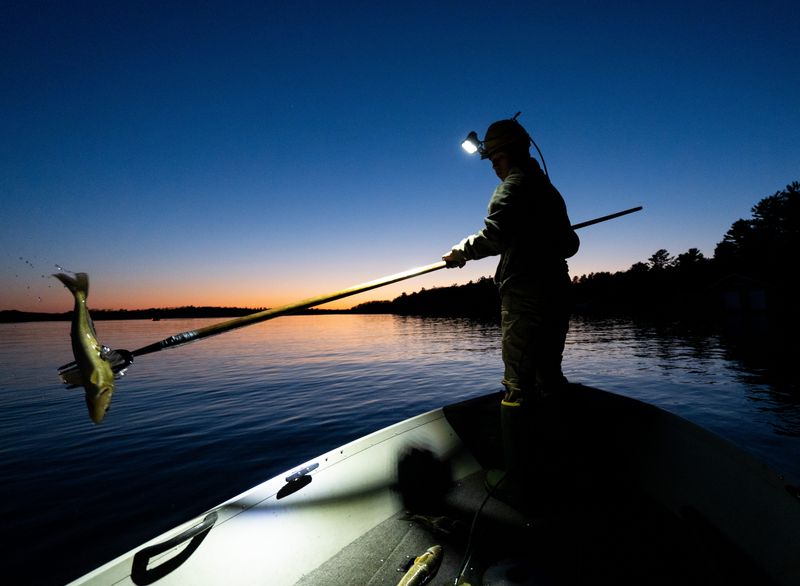
A legal battle over sovereignty, fishing rights and conservation is brewing up north between the state of Wisconsin and the Lac du Flambeau Band of Ojibwe.
In early April, the tribe announced it was prohibiting fishing by non-tribal members on several lakes within its reservation boundaries in order to protect declining walleye and musky fish populations. They said the ban was temporary to allow its fish hatchery time to replenish the waters.

On April 29, the tribe expanded its closure to non-tribal members to nearly 20 lakes within the reservation. Non-tribal members can still fish species other than walleye and musky on lakes within the reservation, according to tribal officials.
On April 30 the Wisconsin Department of Justice, under Gov. Tony Evers’ urging, filed a lawsuit seeking a restraining order against the band to prohibit it from restricting non-tribal members from fishing walleye and musky within the reservation.
“The issue is whether any Tribal Nation may prohibit any Wisconsinite, regardless of whether they are a citizen of a Native Nation, from hunting or fishing on certain lakes or dictate what may be hunted or fished,” Evers said in a statement. “The Tribe apparently decided to do so several weeks ago without any communication or conversations with the state or others in advance, and without adequate efforts to answer reasonable questions or provide basic information about this decision to the public in the weeks since.”
Evers said his administration spent weeks with tribal officials trying to understand why they approved the policy.
“Unfortunately, the lack of communication and transparency about this decision, coupled with outstanding safety concerns caused by generations of tension and violence that have surrounded Tribal rights and fishing on these lands for centuries, has the potential to unnecessarily sow division, stoke tension, and further entrench animosity between neighbors where it need not and should not exist,” Evers said. “This has left the state no other choice but to intervene and take additional legal steps.”
Tribal officials released a statement on April 30 saying they were disappointed by the governor’s decision “to file litigation rather than continue the government-to-government dialogue that had only recently begun.”
“We would have preferred to resolve this cooperatively,” LDF President John Johnson said in a statement. “We remain open to respectful dialogue with the state. But we will not stand by while the fisheries our ancestors protected for generations continue to decline. Waaswaaganing [Lac du Flambeau Reservation] has always been our home and we will protect these waters for our children, grandchildren and the Seventh Generation – as we always have.”
Tribe says ban is key to protecting fish
The tribe’s ban on harvesting walleye and musky does not include tribal members. Tribal officials said non-tribal members were banned because, following state statute, their harvests are not strictly monitored, as harvests by tribal members are. Every fish harvested by a tribal member is counted and cataloged by a creel clerk in order to limit the harvest to sustainable levels. Non-tribal members do not have to register with creel clerks.
“We are doing what the state can no longer do,” LDF Vice President George Thompson said in a statement. “Over the past 20 years, Wisconsin DNR has closed hatcheries, reduced walleye stocking by 45%, reduced musky stocking by 70% and eliminated dozens of fisheries positions. Someone has to protect these fish. If the state will not, we will.”
Tribal fish hatcheries, including LDF’s, stock fish in Wisconsin at numbers far exceeding what tribal members harvest. If only a very conservative estimate of 1% of walleyes stocked by tribal fisheries survive until adulthood, that’s still about 173,000 walleyes, more than five times what tribal members harvest every year.
There are about 500 Ojibwe spearfishers compared with about 2 million non-tribal anglers, according to the Wisconsin Department of Natural Resources.
Tribal officials argued when they closed Flambeau Lake to non-tribal harvests of walleye and musky in 2022 the fish population increased from 0.2 fish per acre to 3.1 fish per acre by 2025.
Tribal officials contend they have sovereignty over the lands and lakes within the reservation. But attorneys for the Evers administration point to a 1983 case, State of Wisconsin v. Baker, in which the courts ruled that the state, not the tribe, has sovereignty over the lakes on tribal lands.
The Lac du Flambeau Reservation is about 140 square miles and includes about 260 lakes, with about 20 now being closed to walleye and musky fishing by non-tribal members.
The dispute over fishing rights comes as the general inland fishing season for walleye opens, beginning May 2 in Wisconsin. The fishing of other popular fish, such as northern pike and bass, by non-tribal members is not in dispute in Lac du Flambeau.
The dispute also comes on the heels of state officials warning residents not to harass Ojibwe tribal members exercising their right to spear walleye this season in the Northwoods.
“The DNR fully supports Ojibwe sovereignty and the rights of tribal members to hunt, fish and gather in the Ceded Territories. These rights are guaranteed by federal treaty and affirmed by the judicial system,” said DNR Secretary Karen Hyun in an April statement.
The Ceded Territory includes more than 22,000 square miles in northern Wisconsin the U.S. took from the Ojibwe in the mid-1800s. The tribe retained legal rights to hunt, fish, spear and harvest in that land to continue their traditional way of life.
For more than 100 years, state officials ignored those tribal rights, even saying state laws superceded federal treaties. Tribal members often faced citations, harassment, even arrest.
Federal courts finally affirmed Ojibwe treaty rights to harvest, which led to the so-called “Walleye Wars” during the 1980s and early ‘90s. Non-tribal people attacked and taunted tribal spearers at boat landings in northern Wisconsin. The harassment eventually waned, but some smaller scale incidents still occur every year.
Frank Vaisvilas is a former Report for America corps member who covers Native American issues in Wisconsin based at the Milwaukee Journal Sentinel. Contact him at fvaisvilas@usatodayco.com or 815-260-2262. Follow him on X at @vaisvilas_frank.
This article originally appeared on Milwaukee Journal Sentinel: Wisconsin sues tribe over banning fishing on nearly 20 reservation lakes
Reporting by Frank Vaisvilas, Milwaukee Journal Sentinel / Milwaukee Journal Sentinel
USA TODAY Network via Reuters Connect