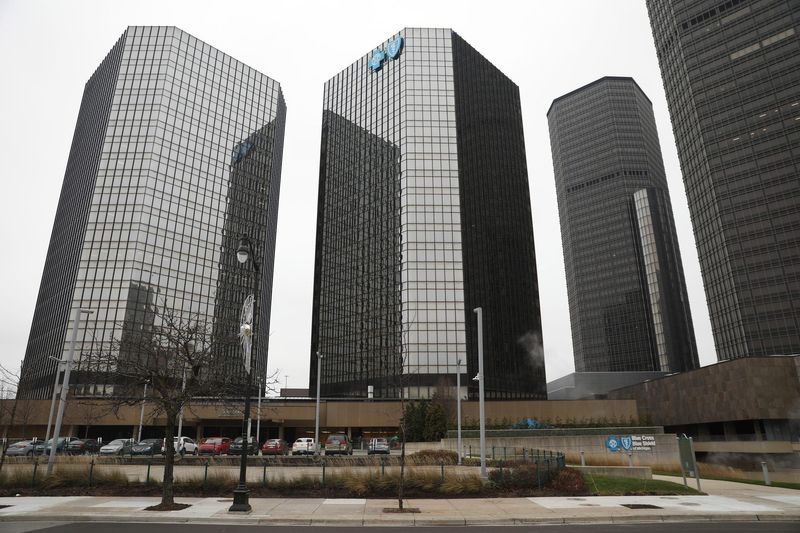
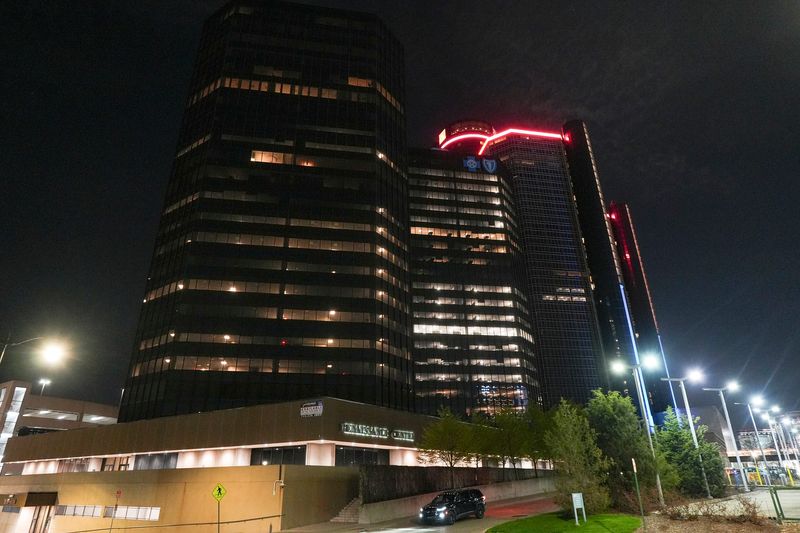
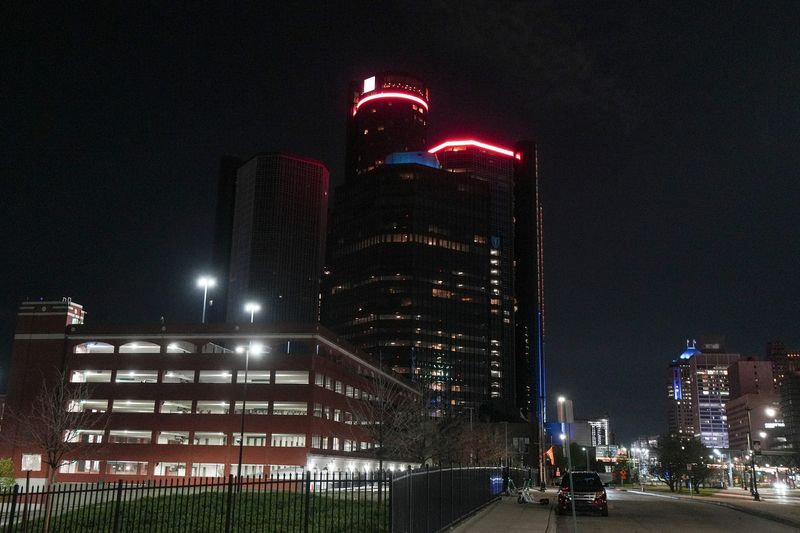
Downtown Detroit’s evening skyline gained a pair of zombie office towers earlier this year when General Motors cut the neon lights at two of the original five 1970s Renaissance Center skyscrapers.
The darkened and mostly empty 39-story buildings, Tower 300 and Tower 400, are the octagonal-shaped towers closest to the riverfront, and the ones that would come down as part of an ambitious $1.6 billion RenCen redevelopment plan that was first unveiled in 2024, yet which remains in limbo while awaiting approval from the state Legislature of a key development incentive.

Meanwhile, a local doctor who last year bought one of the two shorter 1980s Renaissance Center office towers to the east of the original towers has been working on a plan to keep his building from becoming the next zombie.
Dr. Mahmoud Al-Hadidi, 64, a retired pulmonologist, said in a phone interview last week that his plan would convert his 21-story Tower 600 into a mix of office, hotel and residential space.
Specifically, it would create about 100 apartments on the tower’s upper floors, followed by about 200 hotel rooms and leave the rest as office and commercial space.
Al-Hadidi said the next step for his plan to happen would be approvals of must-have tax abatements from Detroit’s Downtown Development Authority, as well as the city. Without the abatements, he said, “it would be very hard to sell those apartments or rent them.”
He added, “We’re hoping that we get an answer — a yes or no — within a month … and ‘no’ means this project is dead.”
Al-Hadidi and his investor group, Stockbridge Enterprises, had the $9.2 million winning bid for Tower 600 at an April 2024 online auction. Tower 600 and its twin, Tower 500, were built as the second phase of the Renaissance Center development and opened in 1981.
At the time of the auction, Tower 600 was said to be just 11% occupied. The seller at the auction was an investment group whose majority owner was said to be in California.
Al-Hadidi said he is still actively seeking office tenants for his tower, although he doesn’t believe it is practical to keep all of the building as office space.
“This building is not going to be a fully office building — it can’t — there’s no demand for that at this time,” he said.
Al-Hadidi said he has a letter of intent from an interested hotel operator, although he can’t yet name the hotel brand.
“We have lenders ready to lend; we have hotels ready to go,” he said. “We’re waiting to see if the city will cooperate with us and give us a break, so we can get this done and out of the way within two years.”
The broader RenCen plan
As for the broader Renaissance Center complex, all five original buildings are still owned by GM, even though the automaker moved its global headquarters out of the RenCen in January and into the newly constructed Hudson’s Detroit office building on Woodward.
GM has partnered with Dan Gilbert’s development firm, Bedrock, for the $1.6 billion Renaissance Center redevelopment plan. The plan calls for demolishing the two riverfront towers as well as the heavy-concrete and multistory “podium” connecting all the towers. Of the three towers that would remain, under the plan:
The plan also would create a 30-acre riverfront park and civic space around the RenCen that would be designed to be a big regional attraction.
Bedrock CEO Jared Fleisher told the Free Press in a Wednesday, April 22, interview that the redevelopment still hinges on a renewal of the state’s Transformational Brownfield program.
Developers across the state have been waiting for the Legislature to act on such a renewal for more than a year. The Transformational Brownfield program works by allowing developers of large and “transformational” projects to capture various streams of future state and local taxes generated at their project site for 20 to 30 years.
(It’s a different type of incentive than the more traditional residential and commercial property tax abatements needed by the Tower 600 redevelopment plan.)
“We are truly hoping that that breaks loose in the coming couple of months,” Fleisher said of the Transformational Brownfield renewal. “On the one hand, we take some solace that it’s not like they (state legislators) are passing a thousand things and are not in support of this program. But on the other hand, we really hope that there is a breakthrough.”
Bedrock intends to commit $1 billion in equity and debt toward the $1.6 billion plan, which, according to Fleisher, represents more of a “civic commitment” to Detroit than a business proposition.
“We’re prepared to do it with no hope of ever making a profit on it,” he said.
GM would contribute $250 million toward the project, and another $75 million would come from the quasi-public Downtown Development Authority.
The precise value of the project’s desired Transformational Brownfield incentive hasn’t been determined, Fleisher said, but would be at least $150 million.
“So we’re prepared to put in a billion dollars,” he said. “We’re prepared to do it with no hope of ever making a profit on it. But (the project) is simply so big, we cannot do it alone.”
As for Dr. Al-Hadidi’s plan to introduce housing and hotel rooms at Tower 600, Fleisher said that Bedrock wishes him well.
“We’re a champion of anyone who wants to come into this city, take an abandoned asset and give it new life,” he said.
Contact JC Reindl: 313-378-5460 or jcreindl@freepress.com. Follow him on X @jcreindl
This article originally appeared on Detroit Free Press: How a doctor aims to keep his RenCen tower from becoming a zombie
Reporting by JC Reindl, Detroit Free Press / Detroit Free Press
USA TODAY Network via Reuters Connect