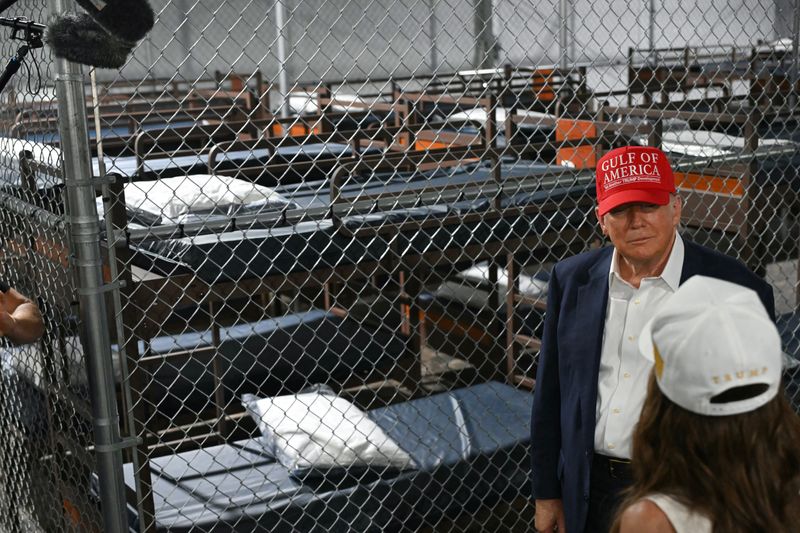
Florida officials say a judge exceeded her authority by forcing “court-ordered” speech in its detention policies for Alligator Alcatraz.
This comes a month after the judge ordered officials to expand detainees’ access to their attorneys. “Alligator Alcatraz” is the nickname for a controversial temporary migrant detention camp in the Florida Everglades, whose official name is the South Florida Detention Facility.

Gov. Ron DeSantis’ attorneys argued in a April 22 filing that all of the facility’s public postings are government speech, a doctrine in First Amendment law that affirms the state’s rights to advance its views without having to provide a platform for opposing ones.
For this reason, the state is arguing that it shouldn’t need to post online its protocols for access to counsel.
That’s why the state is asking U.S. District Judge Sheri Polster Chappell to halt her March order, which tells the state to purchase more phones for detainees to use to contact attorneys, publish protocols for lawyer and detainee visits, and allow attorneys to visit clients during visitation hours without an appointment. Chappell, who sits in the Middle District of Florida, was appointed by former President Barack Obama.
“Without a clear violation of a lawful constitutional right – which was not present on this record – it is the executive branch and detention facility administrators, not the courts, who are in the best position to determine what government speech to make and where to make it, or how many phones a facility needs to provide adequate access to counsel,” the state’s filing says.
The federal judge’s order in March affirmed the free speech rights of detainees. They argued the ability to communicate with an attorney, without being recorded or monitored by the government, is guaranteed under the First Amendment.
The state is countering that these orders compel them to engage in speech or actions they don’t want to do.
But attorneys have amped up pressure on the state in recent weeks, after some clients reported phones at Alligator Alcatraz were turned off April 2, and they received beatings when they complained.
The state is also saying that the court is costing it money, specifically $180,025 to purchase more cell phones and equipment and to pay staff to handle the installation of this equipment. Alligator Alcatraz was estimated to cost about $450 million for a single year.
Lawsuit argues free speech rights to talk to attorneys
This was the first instance of Florida officials using the government speech legal argument against publicly posting attorney access protocols, said Kyle Virgien, an attorney with the American Civil Liberties Union Foundation.
But Virgien said this isn’t traditionally a case where government speech is argued.
“This is the government being required to put up basic information about how to contact people who it’s holding in its custody,” Virgien said. “This is not what the government speech doctrine deals with, and there are all kinds of rules and regulations and court orders that require governments to put up basic information like this.”
But it is a unique argument, said Kevin Goldberg, a First Amendment expert at the Freedom Forum. The government still is obliged to make this information available to the public.
“Usually the government speech doctrine applies when you don’t want to express a certain viewpoint or you want to exclude a certain speaker from participating in event,” Goldberg said. “… It’s a different take on government speech doctrine that I’ve never seen.”
The state also argues that it already provides means for detainees to meet with attorneys – through videoconferencing or through in-person meetings – and the First Amendment doesn’t require providing a “buffet of electronic communication options.”
Goldberg said that although the state doesn’t need to provide a “buffet,” the state must validate why there is a limit.
This reporting content is supported by a partnership with Freedom Forum and Journalism Funding Partners. USA Today Network-Florida First Amendment reporter Stephany Matat is based in Tallahassee, Fla. She can be reached at SMatat@gannett.com. On X: @stephanymatat.
This article originally appeared on Tallahassee Democrat: DeSantis fights court order on attorney access at Alligator Alcatraz
Reporting by Stephany Matat, USA TODAY NETWORK – Florida / Tallahassee Democrat
USA TODAY Network via Reuters Connect