Area residents who feel overwhelmed by mental health symptoms have, in the past, had few places to go for immediate help, except a hospital emergency room.
The other option has been a call to the Mobile Crisis Assessment Team.

Since December, though, there’s been another option in Utica: the Supportive Crisis Stabilization Center of Upstate Caring Partners, which is located at 1002 Oswego St. in Utica, adjacent to the Giotto Center’s Community Health and Behavioral Services.
The center is open for children, teens and adults, around the clock, 365 days a year, to help people experiencing mental health or substance use crises.
“Providing responsive care to community members in crisis remains a critical need and a particularly challenging one, even as we have improved the scope and scale of mental health and substance use services overall,” Upstate Caring Partners Executive Director Geno DeCondo said in a statement. “Too often there are limited resources across our emergency rooms and first responders who already have a wide scope of responsibility.”
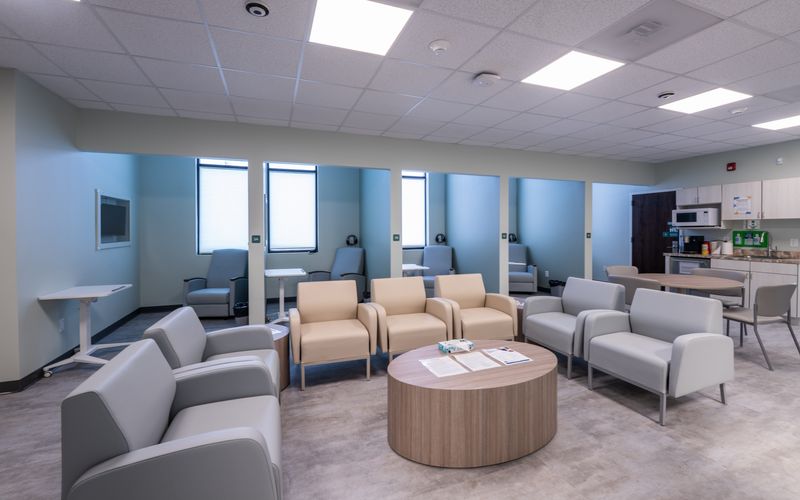
The center offers patients immediate care in a more home-like setting with the focus on stabilizing patients, helping them toward long-term recovery and getting them connected to ongoing treatment, he said.
“This strengthens the continuum of care available to those in need in our community,” he said, “and helps relieve pressure on emergency rooms and first responders, ensuring people receive the right support at the right time.”
Spreading awareness
Although the center opened in December, it just held its formal ribbon cutting on April 16.
Staff are hoping the publicity, as well as advertising such as billboards and bus signs, will spread awareness and bring in more patients, said Jenni Barlow-Gagnon, executive vice president of behavioral health services at Upstate Caring Partners.
The center has been averaging about four patients a day, she said, but it has the capacity to see at least eight adults and eight children at any given time, she said. The patients have covered a range of ages, but have, so far, been mostly adults, she said.
The center was created under a collaborative initiative between the New York State Office of Mental Health and the New York State Office of Addiction Services and Supports. Upstate Caring Partners also worked with Oneida County, which contributed some funding, and other agencies in the community.
Oneida County Executive Anthony Picente Jr. called the center “a major step forward in how we respond to individuals in crisis.”
“By providing immediate, compassionate care in a safe and supportive environment, this center will hep people get the assistance they need at the right time while easing the burden on our emergency rooms and first responders,” he said. “This is exactly the kind of investment that strengthens our continuum of care and improves outcomes for our residents.”
Barlow-Gagnon answered some more questions about how the crisis stabilization center will work:
How is the word “crisis” defined?
It’s up to the patients to determine how they’re feeling and whether they think they need the center’s services.
“We wanted to focus on how individuals define crisis and more on how each individual coming in the door feels and if they think they are in crisis,” Barlow-Gagnon explained.
Who is on the staff?
The staff includes nurses, certified peer advocates, behavioral health providers and credentialed alcohol/substance abuse counselors (CASACs) who work together as a care team to help each patient.
What happens when a patient walks in?
The center has three entrances: one for adults, one for kids under the age of 18 and one for patients being brought in by emergency providers.
But all patients will initially meet with a peer, someone with lived experience in mental health and/or substance use, Barlow-Gagnon said. And they’ll meet with a nurse for a pre-admission assessment to make sure the patient is medically stable and in an appropriate setting.
The patient will meet with the care team who will determine a care plan based on the patient’s individual situation. One member of the team might sit with the patient and provide support while others coordinate care or find community resources to help, such as a shelter for a victim of domestic violence.
The goal is to put together the tools and resources to meet the patient’s needs.
The program bills itself as offering “immediate support, de-escalation, coping skills, peer support and connections to ongoing treatment in a safe, non-clinical setting” as well as help with emotional regulation and the creation of safety plans.
Does insurance cover care?
It should. State parity laws require insurers to cover the care.
How long do patients stay?
No more than 24 hours. The center is not a residential facility and there are no beds.
Does the center offer medical care?
No. If patients bring in medications, staff can store them and help to make sure the patients take them, Barlow-Gagnon said. The nurse will also take blood pressure readings and measure blood sugar levels, but just to monitor patients and make sure they don’t need to go to another setting for acute medical care.
If patients are experiencing acute symptoms of withdrawal, they’ll be sent to the emergency room, she said.
The Rescue Mission of Utica also has an Addiction Stabilization Center, a residential program for people with substance use disorder who need support while transitioning into a treatment program. The program includes a physician and clinical monitoring.
Are patients left on their own to wait?
No. There is always a staff member nearby who can offer support if needed, although there are also areas where patients can seek quiet time if they feel they need to be on their own for a little while, Barlow-Gagnon said.
The center has a sofa and recliner, and is decorated to make it feel like a safe, comfortable spot to get help or to spend time if they don’t feel safe being on their own at home, she said.
Can teens come in alone?
The center must work to get permission from a parent or guardian to provide care. But state law does allow some circumstances in which a teen could receive at least some care even if parents have not yet given their consent, such as in an emergency, Barlow-Gagnon said.
What if someone needs a higher level of care?
The center can work on trying to get patients into inpatient care if it’s needed and does work on safety plans until the patient can find a bed.
But that’s not the main purpose of the center.
“The overall goal is for any of our services to really help maintain them in the community at home,” Barlow-Gagnon said, “and to avoid a higher level of care.”
This article originally appeared on Observer-Dispatch: How will new mental health/substance use center in Utica help?
Reporting by Amy Neff Roth, Utica Observer Dispatch / Observer-Dispatch
USA TODAY Network via Reuters Connect