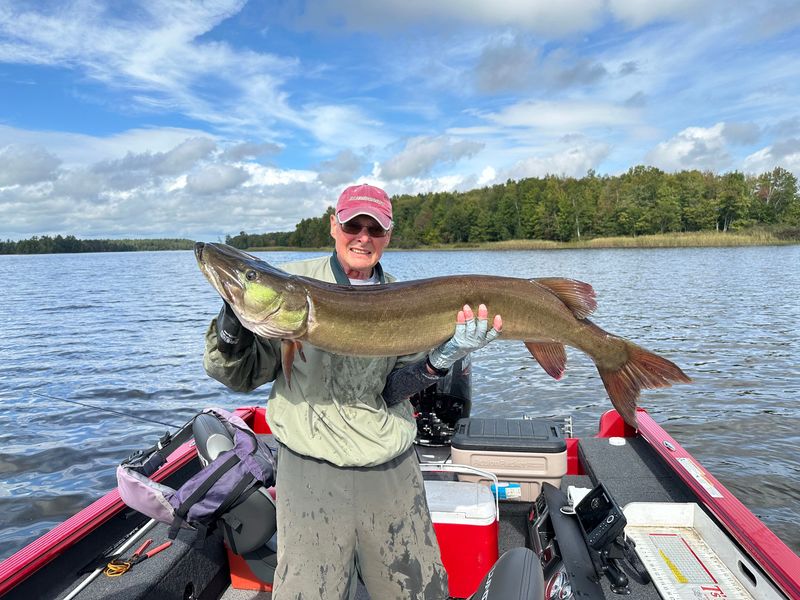
Anglers opposed to a new Wisconsin musky fishing rule started a formal bid to reverse the regulation.
The anglers submitted citizen resolutions April 13 at spring hearings in about 24 counties calling for the northern zone musky opener to be moved back to the Saturday of Memorial Day weekend, said Pete Maina of Hayward, one of the organizers of the effort.

From 1984 to 2025 the state opened the northern zone musky season about three weeks later than the southern zone, a rule designed to protect muskies during the spawning period in most of the species’ native range.
But after a years-long process, including public input through Wisconsin Conservation Congress advisory questions and Natural Resources Board meetings, the Department of Natural Resources effectively eliminated the zones to create a consistent musky regulation.
The new rule takes effect May 2, 2026, when the musky harvest season will open statewide.
The earlier opener in the north has drawn opposition primarily out of concern for the musky fishery.
“Very simply, most anglers were happy with the old rule for decades, knowing it was designed to reduce pressure on muskies as they spawned,” Maina said. “Now we have more concern over what many of us see as a declining musky fishery and want more protection for the fish, not less.”
The 2026 rule change was developed over about the last five years, said Justine Hasz, DNR fisheries director.
Fisheries biologists and managers at the DNR reviewed the proposal, evaluating the potential benefits against any concerns, and concluded a single musky opener could be implemented “with no biological harm.”
The decision factored in contemporary angler behavior and current regulations, including much more catch-and-release among musky anglers and longer length limits for the fish.
In the late 1970s to early 1980s up to 56,000 muskies were harvested annually by sport anglers, Hasz said. In recent years, that number has fallen to 237 muskies, according to the DNR’s Dan Oele.
“So based on all that information, the biology of these fish, the stability of our populations of musky across the state, we went through a pretty lengthy process of about five years reviewing the data and getting public feedback,” Hasz said at an April 7 media briefing. “The musky fishery is really now based on catch-and-release.”
Over the last couple of decades legislators have also urged the DNR to simplify regulations and increase opportunities for hunters and anglers.
“We’re really trying to increase opportunities for our anglers to have more time out on the water and also have more access to these resources,” Hasz said.
The public showed support for the earlier northern zone musky opener at the 2023 Wisconsin spring hearings, the annual meetings held in all 72 counties to collect input on proposed rule changes and advisory questions.
The 2023 questionnaire asked: Do you favor implementing a standard season structure statewide (including boundary waters and the Great Lakes) for muskellunge with opening day of the harvest season beginning the first Saturday in May and extending to December 31 in open water only?
Among Wisconsin residents who voted, the rule change was supported by 3,874, opposed by 1,279 and 2,041 had no opinion.
Hunters, anglers and others have grown increasingly disconnected from the spring hearings process, evidenced by the fewer than 10,000 people who voted in 2023. The DNR sells about 1.3 million fishing licenses annually.
Jim Lund, an angler and fishing guide who lives in St. Germain, said he didn’t think the vote was representative of musky anglers.
“Many people didn’t know [the rule change] was happening,” Lund said. “And now there is a groundswell of opposition to it. I don’t think it was a necessary or positive move and lots of us will work to get it reversed.”
Lund said he expected the earlier musky opener would have little impact on dedicated musky anglers. But he was concerned about others, such as panfish anglers, who might see an opportunity to cast at a musky in the shallows and then, whether hooked legally or not, catch perhaps their biggest fish of the year.
“If they don’t have the proper gear to land and safely release a big fish, they’re much more likely to injure or kill it, even if they didn’t intend to keep it,” Lund said. “We just don’t want to increase the odds of that happening.”
Lund attended the April 13 spring hearing in Vilas County. He said about 100 people were in attendance and “just about everybody” was in favor of reversing the new rule.
Maina attended the Sawyer County meeting and said similar public opinion was displayed there.
Results of votes at the 2026 spring hearings will likely be released in the coming weeks.
Even if the citizen resolutions show strong support for moving the northern musky opener to late May and the DNR agrees with the reversal, change won’t happen quickly.
Due to Act 21, legislation passed in 2011 that lengthened the administrative rule-making process and gave more power to the Legislature, it now takes two to three years to pass a rule change, about twice as long as it did previously.
This article originally appeared on Milwaukee Journal Sentinel: Wisconsin anglers organize against earlier northern musky opener
Reporting by Paul A. Smith, Milwaukee Journal Sentinel / Milwaukee Journal Sentinel
USA TODAY Network via Reuters Connect