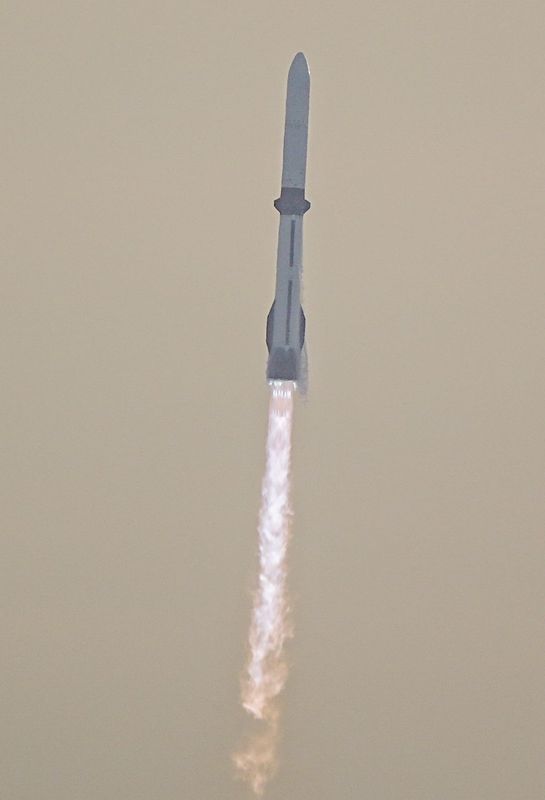
Blue Origin’s hulking New Glenn rocket rumbled off the pad and soared skyward from Cape Canaveral on Sunday, April 19, drawing cheers from spectators and notching a noteworthy first-stage booster landing on a drone ship hundreds of miles downrange.
But the NG-3 mission failed to deliver its payload. The rocket’s second, upper stage deployed AST SpaceMobile’s BlueBird 7 broadband satellite into a lower-than-planned orbit. And the satellite is doomed to reenter Earth’s atmosphere in a fiery demise.

“While the satellite separated from the launch vehicle and powered on, the altitude is too low to sustain operations with its on-board thruster technology and will de-orbited,” an AST SpaceMobile post-launch press release said.
“The cost of the satellite is expected to be recovered under the company’s insurance policy,” the press release said.
Now, the Federal Aviation Administration is requiring Blue Origin to conduct a mishap investigation. Return to flight of New Glenn rockets is based on the FAA determining that “any system, process, or procedure related to the mishap does not affect public safety.”
“The FAA will oversee the Blue Origin-led investigation, be involved in every step of the process, and approve Blue Origin’s final report, including any corrective actions,” per an FAA statement.
Sunday’s 7:25 a.m. liftoff was just Blue Origin’s third-ever launch of its 321-foot New Glenn heavy-lift rocket. New Glenns are manufactured at the company’s Rocket Park complex on northern Merritt Island, then transported about nine miles to Launch Complex 36 at Cape Canaveral Space Force Station for liftoff.
In November 2024, Blue Origin announced a multi-year agreement to propel BlueBird satellites into low-Earth orbit on New Glenn rockets. AST SpaceMobile officials say they are building “the first and only space-based cellular broadband network accessible directly by everyday smartphones.”
In a Monday afternoon tweet, Blue Origin CEO Dave Limp provided more details about the failed satellite deployment.
“While we are pleased with the nominal booster recovery, we clearly didn’t deliver the mission our customer wanted, and our team expects. Early data suggest that on our second GS2 burn, one of the BE-3U engines didn’t produce sufficient thrust to reach our target orbit,” Limp said.
“Blue Origin is leading the anomaly investigation with FAA oversight to learn from the data and implement the improvements needed to quickly return to flight operations. We have been in steady communication with the team at AST SpaceMobile, we appreciate their partnership, and we’re looking forward to many flights together,” he said.
In its press release, AST SpaceMobile officials said launches are still expected to continue every month or two this year via multiple rocket providers. BlueBird 7 would have been the company’s eighth satellite successfully deployed.
A group of AST SpaceMobile investors boarded buses Sunday morning and attended a launch-viewing event at the Kennedy Space Center Visitor Complex.
“The first stage was nominal, and the booster came back beautifully. We separated and turned on as expected, but the launch vehicle second stage did not place BlueBird 7 on its intended orbit,” Abel Avellan, founder, chairman and CEO of AST SpaceMobile, said in a Sunday afternoon tweet.
“We are (in production) on Satellite 32 and plan to ship BB8 to 10 in approximately 30 days and continue to target ~ 45 satellites in orbit this year,” Avellan said.
The New Glenn 188-foot first-stage booster — nicknamed Never Tell Me the Odds — settled down for its second straight landing atop Blue Origin’s drone ship Jacklyn in the Atlantic a bit more than nine minutes after liftoff.
For the latest news from Cape Canaveral Space Force Station and NASA’s Kennedy Space Center, visit floridatoday.com/space. Another easy way: Click here to sign up for our weekly 321 Launch space newsletter.
Rick Neale is a Space Reporter at FLORIDA TODAY, where he has covered news since 2004. Contact Neale at Rneale@floridatoday.com. Twitter/X: @RickNeale1
Space is important to us and that’s why we’re working to bring you top coverage of the industry and Florida launches. Journalism like this takes time and resources. Please support it with a subscription here.
This article originally appeared on Florida Today: Blue Origin rocket fails to properly deploy AST SpaceMobile BlueBird satellite
Reporting by Rick Neale, Florida Today / Florida Today
USA TODAY Network via Reuters Connect