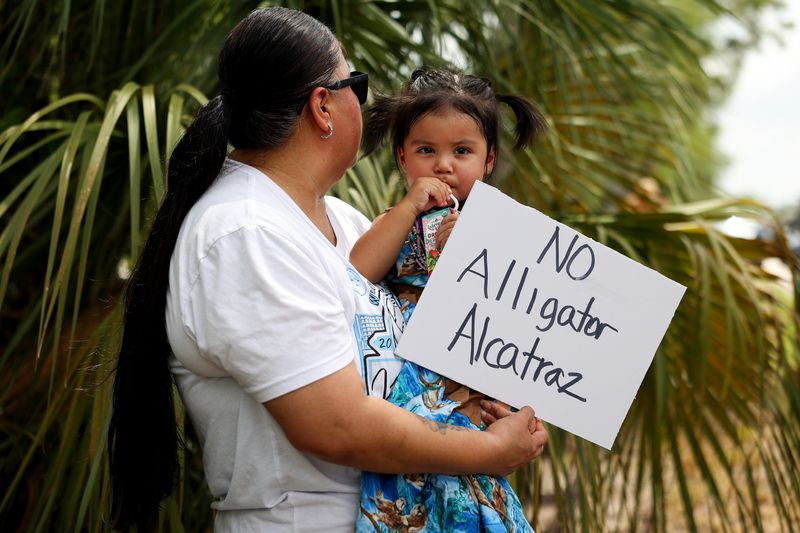
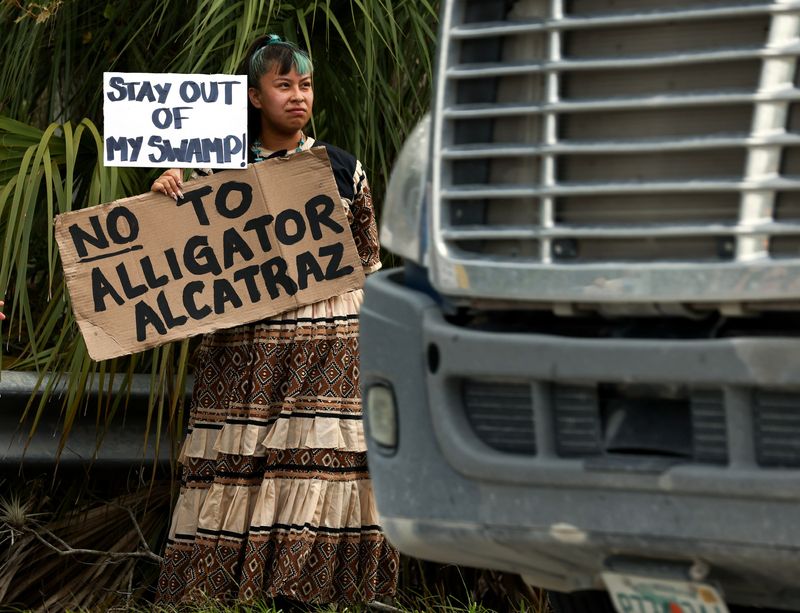
Inside a massive tent in the Everglades, men are confined 32 to a cage, using toilets in full view of one another and eating boxed sandwiches prepared nearly two weeks earlier. U.S. Rep. Debbie Wasserman Schultz shared this account after touring Alligator Alcatraz Thursday, April 9.
Her three-hour, unannounced visit to the Everglades detention center came two weeks after a federal judge in Fort Myers issued a ruling finding that conditions and practices at the site likely violate the constitutional rights of the nearly 1,500 men detained there.

“Everything about this screams inhumane and unnecessary,” Wasserman Schultz said during a press briefing after the tour. “And the cruelty is the point.”
The South Florida Democrat toured the facility alone after arriving without prior notice. State officials allowed the visit but, she said, declined to let her speak with detainees despite her carrying signed privacy releases authorizing those conversations.
What are detainees’ living conditions inside Alligator Alcatraz?
Wasserman Schultz said she spent much of the inspection inside a massive tent that holds roughly 1,000 detainees. Within that structure, men are divided into cages, each housing 32 people in approximately 300 square feet.
“It was wall-to-wall men, and just a very disturbing environment,” she said.
“They are literally housed in cages with three small toilets that essentially require them to urinate and defecate out in the open,” she said. “There’s a small little wall that blocks the toilet, but if you are using the facility, then you are having to do that in front of the 31 other people that are in your cage.”
She described the air inside the tent as intensely humid, with a strong smell of urine. She said she saw feces and urine around toilets and that the sinks above the toilets were dirty.
Those observations mirror sworn testimony from federal evidentiary hearings held in Fort Myers in late January. During those proceedings, former detainees described toilets that were visible from the waist up to everyone in their cage and characterized the experience as humiliating and degrading.
State officials testified in January that sightlines and partitions complied with detention standards. Detainees offered conflicting accounts, describing conditions they said were demeaning, unsanitary and constant.
Democratic members of Congress who toured the south Florida facility July 12 called the arrangements “inhumane” and “gross.”
Is the food being served to detainees safe?
Wasserman Schultz said her inspection raised serious concerns about food quality, freshness and portion size.
Meals are not prepared on site, she said, but arrive boxed and pre-packaged. During the tour, she examined boxed turkey-and-cheese sandwiches labeled “fresh” that had not yet been served.
“The date on the box was March 28. Today is April 9,” Wasserman Schultz said. “And those sandwiches with turkey and cheese still had not been served.”
She said lunch portions consisted of a single small turkey sandwich, a bag of chips and a granola bar, which she said appeared insufficient for adult men.
Testimony during the January hearings similarly described detainees complaining of constant hunger and food that arrived spoiled or inedible. Some witnesses said they were told meals contained maggots or were so poorly prepared that detainees threw them away.
Who is actually running Alligator Alcatraz?
In court, both state and federal lawyers have argued that Alligator Alcatraz is a state-run project and therefore not subject to federal detention standards that apply to U.S. Immigration and Customs Enforcement (ICE) facilities.
Wasserman Schultz said what she observed on Thursday undercuts that claim.
“I asked and was specifically told that there is a permanent ICE presence at the facility on a daily basis,” she said. “And that any decisions related to the detainees’ movement, referral there, their access to legal counsel, any decisions related to the way they are processed, is decided by ICE.”
She said staff from the Florida Division of Emergency Management repeatedly deferred operational questions to ICE officials on site. Despite that, she said ICE personnel declined to answer her questions during the tour.
Are detainees able to access lawyers confidentially?
Legal access is one of the most contentious issues surrounding the facility.
On March 27, U.S. District Judge Sheri Polster Chappell ordered the facility to provide confidential, unmonitored legal phone calls and to publish all attorney access policies in multiple languages.
“Defendants may continue operating Alligator Alcatraz, and ICE may continue to deport illegal aliens. But they must do so by respecting the most basic constitutional rights,” Chappell wrote in her 47-page order.
During her tour, Wasserman Schultz said she was not allowed to speak with detainees despite having signed privacy releases, calling the denial emblematic of a broader lack of transparency.
She acknowledged changes to legal infrastructure since last summer, including an expanded visitation area with Zoom cubicles and laptops. But she said detainees still appeared to lack basic tools to understand or exercise their rights.
She said she saw no attorney phone numbers posted inside housing units and observed no access to paper or pens. That account echoes testimony from detainees who told the court in January that they wrote lawyers’ phone numbers on bed frames using bars of soap.
Wasserman Schultz said she was not given clear answers about how detainees are classified by risk level or how referrals to the site are made.
How does this inspection compare to detainee testimony?
Across sanitation, privacy, food quality and legal access, Wasserman Schultz’s account closely aligns with testimony presented during the evidentiary hearings in Fort Myers in late January.
Testimony described cages, visible toilets, spoiled food and barriers to legal communication. State officials offered sharply different accounts, with some acknowledging they had not visited the site for weeks or months prior to testifying.
What happens next for the Everglades detention center?
A status conference is scheduled for April 13, at 2 p.m., during which the court will review whether officials are complying with the injunction. Requirements include maintaining at least one operable phone for every 25 detainees and publishing the detainee handbook on ICE and Florida Division of Emergency Management websites.
Wasserman Schultz said her findings will inform her continued push for the No Cages in the Everglades Act, legislation that would shut the facility down.
For now, Alligator Alcatraz remains open, under court supervision, as legal challenges continue over who controls the site and whether its conditions pass constitutional muster.
Mickenzie Hannon is a watchdog reporter for The News-Press and Naples Daily News, covering Collier and Lee counties. Contact her at 239-435-3423 or mhannon@gannett.com.
Do you have an opinion about this topic? Write a letter to the editor and send it to letters@naplesnews.com and/or mailbag@news-press.com. Keep it to 250 words or fewer and include your contact info. Have more to say: Send a guest column of no more than 600 words.
Please support local community journalism and stay informed about Southwest Florida news by subscribing to The News-Press and Naples Daily News; download the free News-Press or Naples Daily News app, and sign up for daily briefing email newsletter, food & dining and growth & development newsletters here and here.
This article originally appeared on Naples Daily News: Cages, expired food, feces: What a U.S. Rep. saw at Alligator Alcatraz
Reporting by Mickenzie Hannon, Fort Myers News-Press & Naples Daily News / Naples Daily News
USA TODAY Network via Reuters Connect