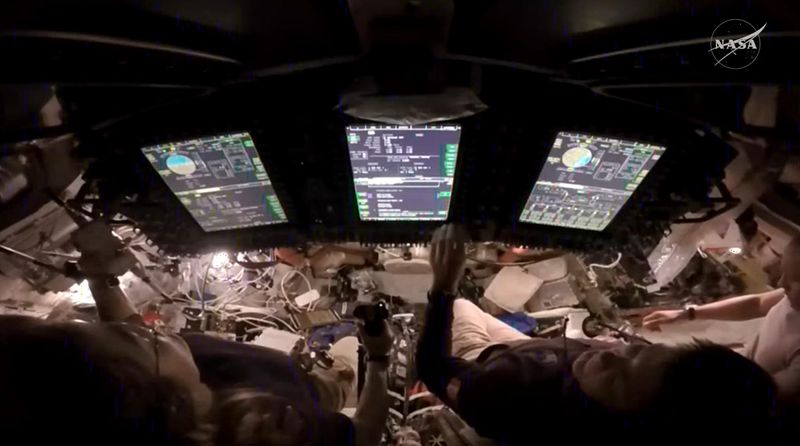
Before NASA’s Artemis II mission journeyed to the far reaches of space, the Orion spacecraft underwent rigorous testing right here in Ohio.
Engineers spent nearly a decade putting Orion through deep-space stress tests before Artemis II at NASA’s Neil Armstrong Test Facility in Sandusky, according to the NASA Glenn Research Center in Cleveland. And that’s not the only role Ohio has played in the first human lunar flyby since Apollo 17 in 1972.

Ohio researchers spent years developing, managing and testing key parts of the Orion spacecraft now carrying four astronauts on their 10-day mission around the moon and back.
Aaron Weaver, chief of the Human Exploration and Space Operations Projects Office at NASA Glenn Research Center in Cleveland, said the Artemis II mission is both a point of pride for Ohio and a chance to showcase the state’s role in aerospace innovation.
“Artemis is a platform to showcase all of the great work we do in Ohio and the great jobs that are here to do this really intense, out-of-this-world kind of work,” Weaver said.
The milestone mission also builds on Ohio’s broader legacy in spaceflight, from the state’s 25 astronauts to its long-standing role in NASA engineering and exploration.
“For Ohio in general, it gives a sense of pride in the type of work and the things we can do within the state,” Weaver said.
How NASA Glenn in Ohio helped Artemis II
NASA Glenn Research Center manages Orion’s service module, the critical component that provides the spacecraft’s power, propulsion, and air and water systems for astronauts.
The module, built by the European Space Agency (ESA) and Airbus, is designed to safely support astronauts farther from Earth than any humans have traveled before.
“The service module provides the propulsion needed to perform the mission,” Weaver said. “It provides the power, the communication, water and air— the things the crew need to survive and the mission needs to be successful.”
NASA Glenn works closely with ESA and Airbus to ensure the system is mission-ready, according to the research center.
Many Glenn experts were also expected to support the mission from Kennedy Space Center in Florida, with some later assisting from Mission Control in Houston as the spacecraft’s performance is monitored.
Ohio testing helped prove Orion was ready
Orion underwent testing for the better part of 10 years at the Neil Armstrong Test Facility in Sandusky in preparation for Artemis II, according to the research center.
The facility also conducted an 11-month post-flight testing campaign after Artemis I, when Orion returned from its 1.4 million-mile journey around the moon.
Those tests helped validate the spacecraft for future long-duration Artemis missions.
“A lot of what we do in human spaceflight is to buy down risk, primarily risk to the crew,” Weaver said. “The testing at the Armstrong test facility in Sandusky were important steps to making sure the spacecraft is as safe as we can make it for the crew.”
Ohio’s space legacy continues
The mission also reinforces Ohio’s deep roots in American space exploration.
The Buckeye State has produced 25 astronauts, including Neil Armstrong, Jim Lovell and Judith Resnik, while continuing to serve as a center for aerospace engineering and testing.
That combination of astronaut history and spacecraft innovation keeps Ohio at the center of missions that may eventually return humans to the lunar surface.
“It gives you that connection to the work that we’re doing, knowing those important space figures and current space figures are from the state of Ohio,” Weaver said. “It’s motivating for the current workforce and hopefully inspirational for the future workforce.”
Weaver, who grew up in Elyria and studied mechanical engineering at Ohio State University, said the university helped create a direct pathway into aerospace through a co-op opportunity at NASA Glenn.
“Ohio State was a great foundation for me to pursue my career in aerospace,” Weaver said. “And they are continuing to make those connections throughout the state with NASA and other places for their students.”
Artemis II is the second in NASA’s long-term lunar mission series, which aims to establish a sustained human presence on and around the moon for science and exploration.
“Artemis II is demonstrating that SLS and Orion are safe and capable of performing the mission,” Weaver said. “We’ll build on that for future missions as we add landing systems, rovers and habitats on the lunar surface.”
Trending reporter Amani Bayo can be reached at abayo@dispatch.com.
This article originally appeared on The Columbus Dispatch: Artemis II moon mission made possible by work at Ohio NASA facilities
Reporting by Amani Bayo, Columbus Dispatch / The Columbus Dispatch
USA TODAY Network via Reuters Connect