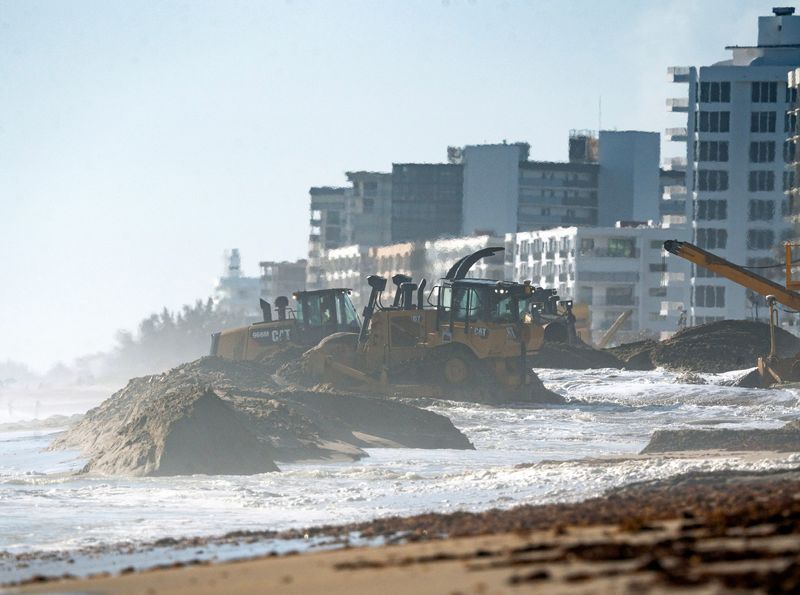
The Army Corps of Engineers will soon start a third beach restoration project on the Treasure Coast that potentially could be disruptive to sea turtles that have begun their nesting season.
Starting April 2, crews ― using with bulldozers, dump trucks and other heavy equipment ― will be placing approximately 360,000 cubic yards of sand along 4 miles of “eroded shoreline” on Beachwalk-Pasley Beach on Hutchinson Island in Martin County, spokesperson John Paul Rebello said. The sand for the $14.6 million project will be extracted from the ocean floor some 6.3 miles offshore of the beach.

The Army Corps expects to finish by the end of April, which Rebello said shouldn’t be a problem becuase May is the start of the peak of sea turtle nesting season. However, Florida’s sea turtle nesting season begins earlier, in March, on the Atlantic coast from Brevard to Broward counties, according to the Florida Fish and Wildlife Conservation Commission.
1 project in Martin County, 2 in St. Lucie County
The Army Corps has not answered TCPalm’s questions about whether Manson Construction Co. will work 24 hours a day, seven days a week, like the other two projects it has underway in St. Lucie County. They began:
Florida has strict sea turtle nesting guidelines
Special protections are required on beaches from Brevard through Broward counties from March 1 through Oct. 31 “because of the high density of turtle nests,” FWC says. Noise, activity, obstacles, uneven sand and the wrong kind of sand can stop sea turtles from nesting, the FWC website says.
“If the renourishment is done during nesting season, there is also a possibility nests will be buried too far underground or be run over by trucks,” FWC says. “If the sand is of a different consistency or is too compacted, the nesting behaviors of turtles can be drastically altered.”
Artificial lights also can disorient mothers and hatchlings, directing them away from the ocean. They can die from dehydration, exhaustion, predation and being hit by cars if they make it to A1A, FWC says.
After nesting, some mothers “often travel hundreds of yards in the wrong direction, ending up in parking lots, swimming pools and on busy thoroughfares,” FWC says.
Turtle nesting starts early on some Florida beaches
Hatchlings emerge about two months after their mothers laid their eggs, “from about June through October, though sometimes as late as winter,” FWC says.
“Nesting sea turtles look for dark, quiet beaches to lay their eggs. Lights from buildings along the beach distract and confuse the females,” FWC says. “Any distractions may frighten and disorient her, causing her to return to the ocean before completely covering and camouflaging her nest.”
Four leatherbacks got an early start this season, laying their eggs on Hutchinson Island in St. Lucie County in February.
“The fewer obstacles sea turtles have to overcome, the better their chances of successful nesting,” FWC says.
The article continues below.
How to help Florida sea turtles and hatchlings
Tim O’Hara is TCPalm’s environment reporter. Contact him at tim.ohar
This article originally appeared on Treasure Coast Newspapers: 3rd Florida beach restoration to begin despite sea turtle nesting
Reporting by Timothy O’Hara, Treasure Coast Newspapers / Treasure Coast Newspapers
USA TODAY Network via Reuters Connect