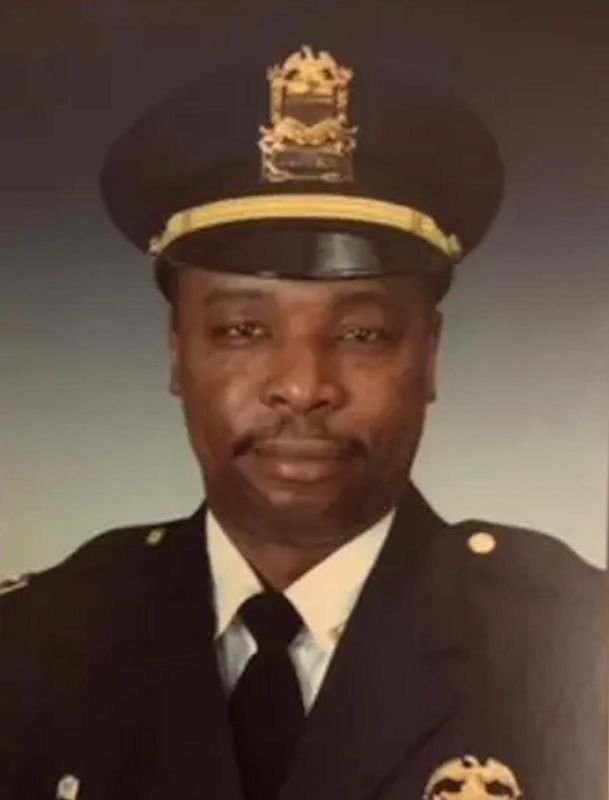
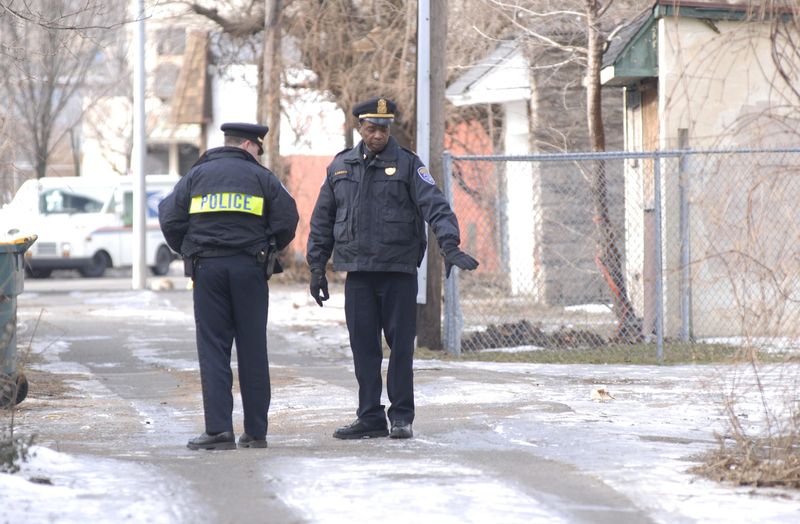
In his long career with the Rochester Police Department, Capt. Sherman Scott had a variety of roles. He recruited officers; he commanded sections; he was a hostage negotiator; he was the department spokesperson and contact with the community.
And always, he led by quiet example.

“He was one of those guys who never raised his voice,” said Charlie LoFaso, a retired RPD officer who now teaches courses in criminal justice at Rochester Institute of Technology. “He inspired through quiet leadership. You would run through a brick wall for him.”
Capt. Scott, who died Feb. 19, 2026, at age at 73 after suffering a stroke, served with the police department for 36 years before retiring in 2011.
One of the most significant accomplishments of his career may be the many bad things that didn’t happen because of him, thanks to his ability to settle disputes, to resolve differences. He stressed the need to be calm within chaos and to always see things through the eyes of the person on the other side of the divide.
Born Feb. 22, 1952, to the late James and Pauline Scott, Capt. Scott grew up on Glasgow Street in Rochester in what was then the Third Ward and is now Corn Hill. His was among many Black families who lived in that area before urban renewal emptied out streets and businesses.
He graduated from the former Madison High School and then from SUNY Oswego with a degree in electrical engineering. He spent two years at Eastman Kodak Co. before beginning his career with police.
He was encouraged to do this by Capt. Charles Price, a friend of his parents who had become the department’s first African-American officer in 1947.
“I’m not sure they knew he was always talking me into joining the force,” Capt. Scott said in a 1996 story in the Democrat and Chronicle on the racial and ethnic makeup of the department. “He would pick me up sometimes and just talk about being a police officer and how wonderful it was.”
Capt. Scott rose through the ranks, going on to command various police sections.
Rochester Police Chief David M. Smith was a fairly new sergeant assuming a leadership role when he served under Capt. Scott.
“He was a very patient person,” Smith said. “He was good at helping us new bosses see the bigger picture. He was sensitive, but he wouldn’t beat around the bush. He could be candid with you and not hurt your feelings at the same time.”
Capt. Scott would also serve as a hostage negotiator, and in the 1990s, he was the department’s spokesman, answering press and public inquiries about incidents involving the police.
“He was a very public face for the department, always very soft-spoken, very kind and nice,” said Bob Duffy, the former chief of police who went on to become Rochester mayor, New York state’s lieutenant governor and now Greater Rochester Chamber of Commerce’s president and chief executive officer.
Carlos Garcia, who joined the police force in 1986, had been recruited to join the force by Capt. Scott as part of a department effort to recruit officers from under-represented groups to truly reflect the entire community.
A few years later, Garcia would follow in Capt. Scott’s footsteps as the department’s spokesperson. Capt. Scott emphasized to him that he had to establish trust with the media, just as the media had to establish trust with him.
Capt. Scott also worked in internal affairs evaluating citizen complains about police actions, and he was a department liaison with the Center for Dispute Settlement.
“Sherm was always able to thread the narrow line between plaintiffs and the police,” said Frank Liberti, the center’s former director. “There was huge skepticism about the police. There he was, a police officer, a captain in uniform reassuring people that things will be done right.”
Sherry Walker-Cowart was the center’s director of programs and operations in the 1990s when Capt. Scott created a training program for panelists tasked with resolving complaints. “Captain Sherman Scott was the personification of the ideal law enforcement officer,” she said.
For Walker-Cowart, it was a reunion of sorts, as she had known Capt. Scott since they were children in the Third Ward attending School No. 3. “We were lifelong friends and extended family,” she said.
After he retired Feb. 25, 2011, Capt. Scott volunteered with the center, mediating a variety of disputes.
His death has hit those who knew him hard.
“It’s a loss to the community,” Garcia said, “not just to the police department, not just to those who knew him, but to the community.”
Capt. Scott is survived by his wife, Sonia; his son, Daryl (Ashley) Scott, stepdaughter, Venester (Maurice) Perry and four grandchildren, Amir and Sy’ir Perry and Raven and Violet Scott, all of Atlanta; his sister, Teresa Scott of West Virginia; and his brothers, James (Patricia) Scott of Missouri, Texas, Nathaniel (Cathy) Scott of Elgin, South Carolina, and Gary (Wendy) Scott of Washington state. Besides his parents, he was predeceased by three brothers, Sam, Jerold and Stephen Scott; a sister, Cassandra Hendricks; and his stepson, Fitzroy B. Vines Jr.
This article originally appeared on Rochester Democrat and Chronicle: Remembering RPD Capt. Sherman Scott, who led by quiet example
Reporting by Jim Memmott, Special to Rochester Democrat and Chronicle / Rochester Democrat and Chronicle
USA TODAY Network via Reuters Connect