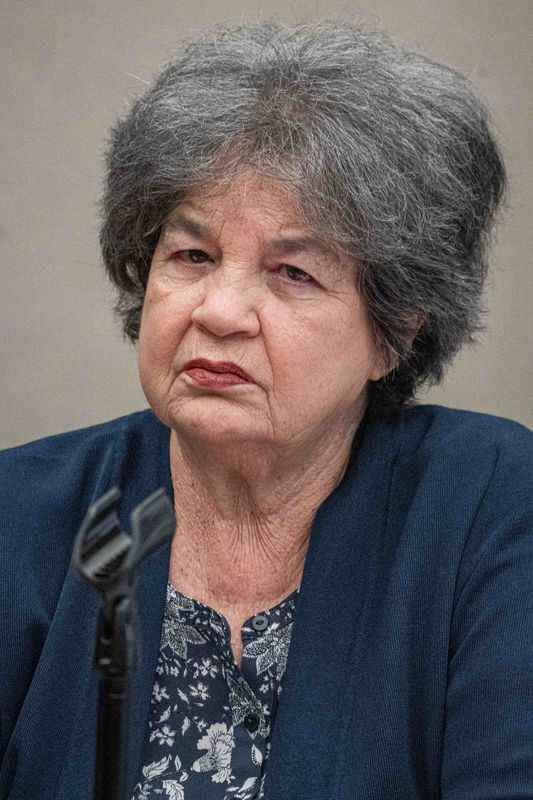
What Florida Man Gov. Ron DeSantis has done — making the state the second to outlaw the addition of fluoride to drinking water, Florida Woman U.S. Congresswoman Lois Frankel seeks to undo, or get reconsidered.
In recent legislation, Frankel is highlighting how the Centers for Disease Control and Prevention recently designated fluoridated public drinking water as one of the greatest health achievements in the 20th century that saves lives and money.

The 180-degree turns might have your head spinning.
Many adherents to the “Make American Healthy Again,” which is adjacent to President Donald Trump’s “Make America Great Again,” consider water fluoridation on the same level as COVID vaccine mandates — forced medication.
But the Democrat from West Palm Beach’s congressional resolution seeks to remind Florida and the rest of the country that fluoridation of drinking water is still listed on the CDC’s website as one of “Ten Great Public Health Achievements — United States, 1900-1999.”
A year before Florida’s legislation forbade adding fluoride to drinking water, the CDC under President Joe Biden found that optimally fluoridated water saved $6.5 billion in dental treatment, reaching a total of 144 million Americans. That’s a return on investment of $20 for every $1 spent, according to more material on the CDC website.
What is the controversy about fluoridated drinking water?
Still, the current Health and Human Services Secretary Robert F. Kennedy Jr. spoke against fluoridating public drinking water even before he was confirmed in his current role as the country’s top health official, calling fluoride a “dangerous neurotoxin” that reduces children’s I.Q. points. Most scientists agree, however, that adding fluoride at the safe levels found in drinking water has not been shown to reduce intelligence.
Still, the secretary in April 2025 said he planned to tell the CDC to stop recommending the fluoridation of public drinking water. Utah banned it the next month, and DeSantis signed legislation that went into effect July 1, 2025 shortly after.
But Frankel is pushing back, although her legislation hasn’t called for it to be put back in.
“Fluoride is safe, effective, and backed by decades of science,” Frankel’s prepared statement said. “Ignoring the experts puts children and families at risk. This resolution is about protecting public health and standing firmly on the side of science.”
Anti-fluoride activists have been around almost as long as local governments started adding it to public drinking water in 1945. Fluoride’s ability to strengthen tooth enamel and resist decay was discovered when a dentist noticed that although pockets of the population had brown stains on their teeth, those same people had noticeably lower levels of tooth decay, according to the National Institute of Dental and Craniofacial Research.
Fluoride bans have been instituted and repealed
Pinellas County in 2011 stopped fluoridating its water in response to anti-fluoride activists. But then the pro-fluoride won a majority on the County Commission in the next election and almost immediately set about flipping the fluoride switch back on.
Delray Beach City Commission in February 2025 voted to keep fluoride in its city water supply after a presentation from state Surgeon General Joseph Ladapo urging them to end the practice. When the statewide ban went into effect on July 1, however, the city stopped fluoridating its water supply.
For Delray Beach City Commissioner Juli Casale, the ban is one of a rash of preemptions from the state Legislature that’s taking away home rule found in the Florida Constitution.
“We have a large population of economically challenged individuals, and that was why I thought in the beginning that we should continue doing it (fluoridating the water),” she said. “Dentists appeared before us spoke about the benefits of fluoride. There’s a downside (to stopping fluoridation) for children who don’t get regular dental care.”
Frankel’s resolution contains the names of people who died from what started out as tooth decay.
State Sen. Keith Truenow, who sponsored the bill that became law said he wasn’t concerned it would preempt cities that wanted to put fluoride in the water and framed it as a matter of personal choice.
“If someone doesn’t want to use the fluoride in the water system, you can’t really opt out” when there’s fluoridation, he said as he introduced the legislation.
Some city water systems have natural fluoridation
In northeastern Florida, though, fluoridation goes on — coming via Mother Nature from the Floridan Aquifer System. The JEA which supplies that water to Duval County and the northwest portion of St. Johns County as well as the Yulee area, Mayport, and from Ponte Vedra south to Vilano Beach, says recent tests of its water shows the amount of fluoride ranges from 0.385 parts per million to 1.22 parts per million, depending on the location of the water treatment plant. Fluoridation is considered “optimal” for water supplies when it’s 0.7 parts per million (or 0.7 milligrams per liter).
Dr. John Paul, president of the Florida Dental Association, predicted an uptick in Medicaid reimbursement to dentists filling cavities and that it will be more apparent in areas without natural fluoridation. The full force of this reversal in public health policy will be apparent in five to 10 years, he predicted.
It’s going to be interesting to see how much less Medicaid reimbursement for cavities filled will be needed in areas with natural fluoridation, said Paul, whose practice is in Lakeland.
“We are all part of an experiment, whether we know it or not,” he said.
An earlier version of this story misidentified the chairman of the Pinellas County Commission.
Anne Geggis is statewide reporter for the USA TODAY NETWORK FLORIDA, reporting on health and senior issues. If you have news tips, please send them to ageggis@usatodayco.com. You can get all of Florida’s best content directly in your inbox each weekday by signing up for the free newsletter, Florida TODAY, at https://palmbeachpost.com/newsletters
This article originally appeared on Palm Beach Post: Nearly a year after Florida’s fluoride ban, where do its cities stand?
Reporting by Anne Geggis, USA TODAY NETWORK – Florida / Palm Beach Post
USA TODAY Network via Reuters Connect