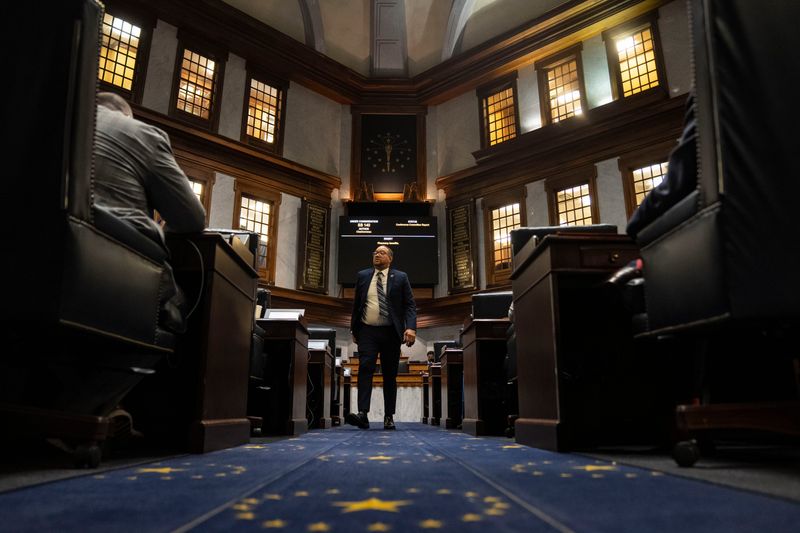
In the arms race between Indiana and Illinois to attract the Chicago Bears, Indiana lawmakers made a pivotal step on Feb. 26, passing a bill that outlines their financial package.
Within hours, Gov. Mike Braun signed the bill into law.

Indiana’s Senate Bill 27, which lists the financial incentives and authority to build a stadium in northwest Indiana, passed the Senate by a 45-4 vote.
“We sure give the Bears a lot to think about to come here, because Indiana is the state it is,” Sen. Rick Niemeyer, R-Lowell, said. “It’s a very good time for Lake County.”
Meanwhile, in Illinois, a House committee approved a bill to lock in property tax rates at the site the Bears already own, the former Arlington Racetrack, in a bid to keep the Bears in-state, but that bill still has a long way to go.
The Bears have made a verbal committment to “finishing the remaining site-specific necessary due diligence to support our vision to build a world-class stadium near the Wolf Lake area in Hammond, Indiana,” including pledging to contribute $2 billion to the construction of the stadium, but leaders in Illinois say they are still in the running. But there’s no formal deal signed.
In a statement, the Bears called recent legislative developments in Indiana “important steps” and said they are grateful to Braun for signing the bill.
“We continue to work on the necessary due diligence and appreciate the ongoing engagement with Indiana state and local leaders,” the statement reads.
But in the same statement, the team did not close the door on efforts in Illinois.
“We recognize and appreciate the advancement of mega project legislation by the Illinois House Revenue and Finance Committee, and we look forward to continued engagement as the lawmakers determine the legislative path forward,” the statement reads.
The idea for the Bears’ migration first surfaced when the team’s president penned an open letter in December, in which he expressed his frustration with the pace of negotiations in Illinois and his interest in looking for a new stadium site elsewhere, such as in northwest Indiana.
The package in Senate Bill 27 includes a number of local taxes that Lake and Porter counties, as well as the city of Hammond, would need to adopt in order to repay the state-backed bonds to build a stadium.
There’s great optimism in the region, though, that the economic development and associated infrastructure improvements would surpass the cost to taxpayers.
“We’re looking at the largest project, the greatest generator of jobs and growth in the region since the construction of Bethlehem Steel and the development of the Port Of Indiana, the largest inland port in the United States,” said Rep. Chuck Mosely, D-Portage. “There was a time sometime back, where the region was the economic engine of the state of Indiana. And this is going to bring back that moniker that we enjoyed so many decades ago, for many decades to come.”
What will this cost taxpayers?
Revenue generated from the special taxing district that would be adopted in the area of the stadium would go toward paying back the bonds on the stadium, combined with a number of new taxes if the local governments approve them.
The taxes would expire once the bonds are paid off. In the meantime, here’s how much those new taxes would yield, according to estimates from the Legislative Services Agency:
The LSA can’t know yet how much the special taxing district would yield since it hasn’t been drawn, but notes that it would be less than the one surrounding Lucas Oil Stadium, which captures about $16 million a year.
Contact IndyStar Statehouse reporter Kayla Dwyer at kdwyer@indystar.com or follow her on X @kayla_dwyer17.
This article originally appeared on Indianapolis Star: Gov. Mike Braun signs Indiana’s Chicago Bears stadium bill: What it will cost
Reporting by Kayla Dwyer, Indianapolis Star / Indianapolis Star
USA TODAY Network via Reuters Connect