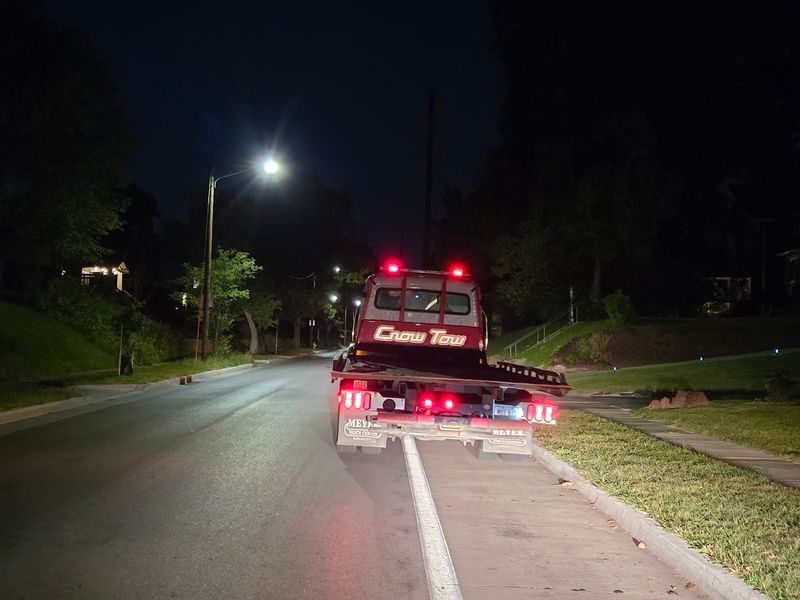
The manager of one of Iowa’s largest towing companies is claiming that Des Moines’ monthslong bidding process for police impound towing was biased toward Crow Tow, resulting in the controversial southside family business once again being selected despite widespread public complaints.
Tyler Mortvedt, manager of Central Iowa Towing and Recovery, said his company filed a formal appeal of the city staff’s recommendation of Crow Tow for the new multi-year contract. The appeal will further delay a City Council vote as the current contract, already extended, is set to expire.

Mortvedt said city officials largely ignored including new consumer protections in their request for proposals after widespread complaints about Crow Tow’s charges and practices.
He said he believes a desire for the status quo ― and sizeable campaign donations to some city elected leaders by a Crow Tow co-owner and lobbyist ― affected the city’s decision.
“It stinks,” said Mortvedt, whose company owns a fleet of about 110 tow trucks in central Iowa. “I think they’re just so set in their ways. And they’ve never had good service, so they are used to the mediocre.”
Crow Tow lobbyist Marc Beltrame declined a request for comment on behalf of himself and Randy Crow, who owns the business with his wife and son, referring questions to the city staff.
Peter Zemansky, a spokesperson for Des Moines, said city officials will not comment on the contract while the process continues.
Several City Council members, Mayor Connie Boesen and Des Moines police spokesperson Lt. Paul Parizek did not respond to emails sent Feb. 3 seeking comment about Mortvedt’s allegations.
The selected contractor will be paid by the city, as well as vehicle owners who retrieve the roughly 3,500 vehicles a year that police order impounded after crashes and crimes or for other infractions, such as expired registrations. Auction proceeds from those vehicles are worth hundreds of thousands of dollars annually.
City Finance Director Nick Schaul said in a statement before the city’s Crow Tow recommendation that “City Code limits communication between proposers and potential proposers and the city. Of note, city staff and officials are prohibited from communicating about (requests for proposals) with proposers/potential proposers, directly or indirectly.”
Council members and Boesen received an email Feb. 2 from City Manager Scot Sanders saying action on the selection will halt until the appeal process is completed.
“I will determine whether the appeal will be resolved based on a written record or thorough hearing, which may be conducted by the city manager or a designated hearing officer,” Sanders wrote. “If the proposer’s objection is affirmed, the city manager or designated hearing officer shall reject the recommendation of the selection committee and send it back to the committee for re-evaluation. If the objection is overruled, the award … will go to Council as currently recommended. The Legal Department will advise the Council once the appeal has been resolved and the matter is appropriate for further consideration.”
In an interview Tuesday with Reader’s Watchdog, Des Moines City Council member Josh Mandelbaum, who has long advocated for a new towing ordinance amid widespread complaints of predatory towing, expressed frustration with the impound contract bidding process, which he said lacked transparency.
Mandelbaum said he’s not surprised Crow Tow’s only competitor appealed.
“The process has stunk from a council member’s perspective,” Mandelbaum said. “… Towing practices in this city are a real concern. This should have been discussed by the council before the RFP. But the whole process has been shrouded in secrecy.”
Mandelbaum said he believes the city manager’s office was doing the bidding of other council members pushing for Crow Tow behind the scenes. He said he believes the city has no choice but to start the process over and/or develop an ordinance.
Rob Barron, who was elected last fall to the council, also said the city’s administration had shared little information with council members about the impounding contract.
Barron said Reader’s Watchdog’s “reporting on predatory towing practices from the last two years should be enough to convince my colleagues that we need a contract that requires customer-friendly business practices.”
No new consumer protections specified in city’s bid request
The city sought new bids on the police impound contract last November following a Reader’s Watchdog series that showed Iowa’s abandoned vehicle law was possibly the weakest in the country.
The series arose from complaints to Watchdog after a May 2024 column about the effects of Crow Tow’s sweeps of private parking lots for towable vehicles and the toll it took on low-income owners.
The stories highlighted common complaints about excessive fees Crow Tow charged, allegations of employees’ demands for cash payments, and other alleged predatory business practices.
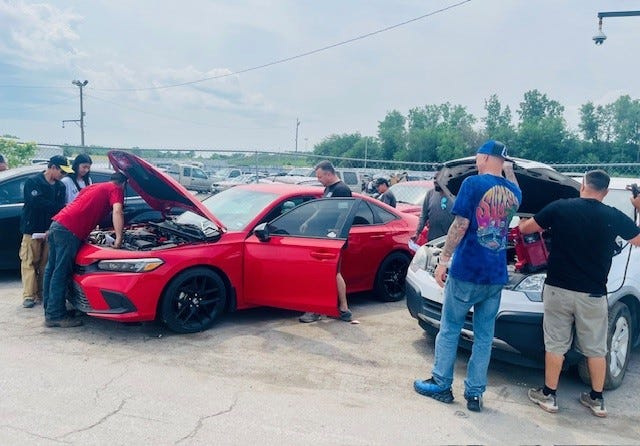
It also documented hundreds of disputes, several of them violent, over the years on Crow Tow’s lot at 826 SE 21st St. that necessitated police assistance. Calls to police about Crow Tow numbered 116 in 2024, police said in response to an open records request.
Randy Crow, who has said he helped write Iowa’s existing unclaimed vehicle law, has insisted his employees and company follow that law.
Records of towing complaints Watchdog obtained from police and the Iowa Attorney General’s Office showed Central Iowa Towing had far fewer complaints than Crow Tow.
At the same time, state campaign finance records showed, Boesen and several Des Moines City Council members had received sizeable campaign donations from Dawn Thornton, a co-owner of Crow Tow and wife of Randy Crow, as well as Beltrame, one of the family business’ lobbyists.
Watchdog also revealed how Crow Tow underbid competitors for its previous contract, but last year started keeping the proceeds from the auction of vehicles impounded by police ― money that previously went to a state road use fund. That practice, the company said, is allowed under Iowa’s abandoned vehicle law.
Before the new bidding process that began in November, James Remington, a top official in the city finance department, said in an email: “The city is well aware of citizens’ concerns around the towing contract, so there will be an angle of determining how best to address those in the contract that spawns out of the process.”
But the new request for proposals included no new language about consumer protections.
The old contract said “all services shall be provided in courteous and professional manner.”
The new request said the winning bidder would have to follow the law and “must maintain a clean, neat and safe environment during all public transactions and ensure courteous and professional behavior by employees.”
It also said City Council “will by resolution approve the proposal which it selects as the best proposal and authorize execution of a contract, either by the Mayor or by the City Manager or a department director. Prior to the City Council’s approval of the contract, the Procurement Administrator shall give notice advising the Proposer whose proposal was selected what actions must be taken to complete the formation of the contract.”
Central Iowa Towing and Recovery, which also owns Roy’s Towing and Recovery and Capital City Towing, ultimately came in second this year in the new bidding process, which employed a 101-point bidding system.
Central Iowa Towing, Mortvedt said, scored higher than Crow Tow on pricing, which was worth 20 points. But it received fewer points than Crow Tow for “technical capacity,” which included performance history and current contracts, worth 40 points, and “demonstrated capability,” including equipment and storage, also worth 40 points.
In his appeal, Mortvedt said, the request for proposals never asked for any information from bidders on the existing contracts or staffing levels.
“Our companies … currently hold fleet and heavy-duty towing contracts with the city. We have a strong performance history on both contracts and have consistently been selected as a vendor based on our reliability, responsiveness and service quality,” the appeal said.
Additionally, Mortvedt wrote, “our workforce, number of locations, and overall operational capacity more than double that of the selected vendor. We currently operate a fleet of over 110 units, allowing us to meet and exceed service demands efficiently. Our storage facilities meet or exceed all city requirements. Furthermore, our new facility will exceed the required storage capacity by more than three times, providing enhanced capability, security and scalability for city needs.”
Campaign donations remain a sticking point
While campaign donations by Crow Tow insiders are legal under state campaign finance laws, they have generated anger among residents at City Council meetings and Mortvedt’s allegations of bias.
From 2015 to 2023, Thornton gave southside City Council member Joe Gatto $11,500, with $6,000 donated during his last council race. Council member Linda Westergaard received $8,900 from Thornton during the same period.
Former council member Chris Coleman received $2,500 from Thornton in 2023, while council member Carl Voss received $1,000 in 2021 and Boesen received $6,000, state records show.
Crow Tow lobbyist Beltrame gave at least $12,600 last year to Polk County Supervisor Mark Holm — an exceptionally large donation in a county supervisor race. He also gave $2,301 to Supervisor Jill Altringer ― and actively campaigned for both.
Not long after, a newly reconfigured county board, including new supervisors Holm and Altringer, awarded a sheriff’s towing contract to Crow Tow in a 3-2 vote with Supervisors Chair Matt McCoy.
Altringer did not respond at the time to requests seeking comment. Holm acknowledged that Beltrame ran his campaign and was his legal adviser.
But Holm said he was not aware at the time Beltrame also worked for Crow Tow, or that as a lobbyist he had registered in 2025 against a bill in the Iowa Senate, supported by consumer groups, credit unions and rental car companies, that would have attempted to reform Iowa’s towing and abandoned vehicle laws.
Beltrame also donated $2,500 last year to McCoy and $250 to Gatto in his current bid for election as a supervisor.
Neither Mortvedt or its owner donated money to the city or county, Watchdog found.
Towing debate ongoing at the Legislature
Unlike some municipalities, Des Moines, the state’s largest city, has no towing ordinance. One reason Mandelbaum and others have advocated for one is because of Iowa’s weak abandoned vehicle law.
This year, state legislators are considering new legislation that would mandate more protections for credit unions that provide liens on vehicles, as well as some consumer protections. But it’s still unclear what, if anything, might pass by the body’s first funnel deadline on Feb. 20.
Lobbyists for towers said they would be meeting with key legislators on Wednesday, Feb. 4, and some debate was scheduled in a subcommittee later in the afternoon.
In a statement sent to Watchdog before the Central Iowa Towing appeal this week, Crow and wife Thornton sent Watchdog an email saying their business continues with “lawful advocacy” before the Iowa General Assembly.
Beltrame said the situation with regard to any legislation is still fluid.
“We will be making public comments about the legislation at subcommittees scheduled in the near future,” he said in an email.
Lee Rood’s Reader’s Watchdog column helps Iowans get answers and accountability from public officials, the justice system, businesses and nonprofits. Reach her at lrood@registermedia.com, at 515-284-8549, on Twitter at @leerood or on Facebook at Facebook.com/readerswatchdog.
This article originally appeared on Des Moines Register: Company alleges bias in favor of Crow Tow in police contract bid
Reporting by Lee Rood, Des Moines Register / Des Moines Register
USA TODAY Network via Reuters Connect