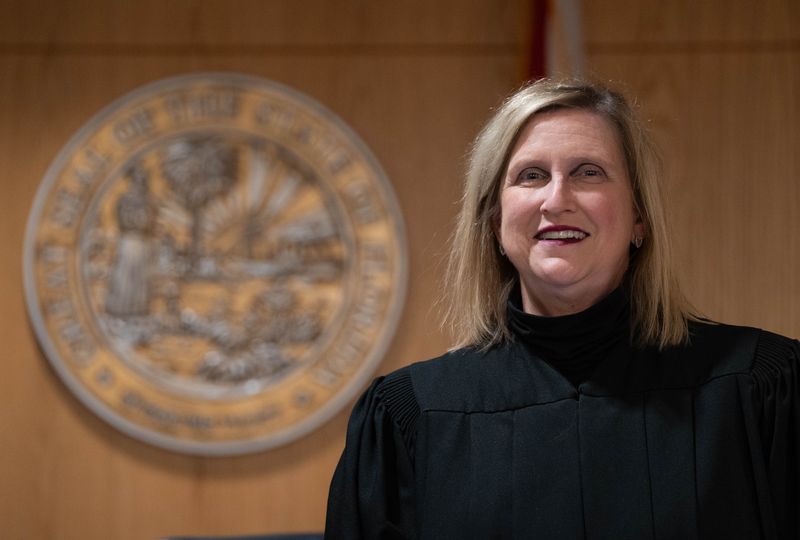
After 25 years sitting the bench and presiding over thousands of cases, Linda Nobles and Jan Shackelford don’t just consider each other coworkers but close friends.
Now, after becoming judges in 2000, presiding over all types of cases in Florida’s First Judicial Circuit and leaving their mark on the world of law in Northwest Florida, both Nobles and Shackelford will be hanging up their black robes.

“Of course there’s the usual we want to spend more time with family, we want to enjoy our lives while we’re healthy, travel, but also a quarter of a century feels like the right time to say that you’ve done your work and to leave it to others,” Shackelford told the News Journal. “Something that people don’t think about is that people come in here and they’re sad or angry or have grief, and they need us to fix their problems—and we do—but there’s no way for us to not internalize some of that, and there’s a cumulative effect after 25 years.
“So, we’re grateful for the job and the career, but this feels like a good time to end,” she added, looking toward Nobles.
Shackelford, who was appointed as a judge by former Florida Gov. Jeb Bush in June 2000, retired following her final day in court Dec. 31. Nobles, who was elected as a judge in 2000 and took the bench in 2001, will retire following her final day in court Jan. 11, 2026.
Taking the opportunity to discuss each other’s accomplishments, Nobles noted that Shackelford was the longest serving woman judge in the First Judicial Circuit. Shackelford, likewise, noted that Nobles is the only woman to serve as chief judge for the First Judicial Circuit.
Possibly one of the biggest accomplishments in Shackelford’s career was keeping court operations running after 2004’s Hurricane Ivan left the court house nearly unusable for nearly a year. Shackelford at the time was the Escambia court’s administrative judge, a position often seen as the chief judge’s right hand who maintains daily order.
“The justice system doesn’t stop,” Nobles said. “We have timeframes that are given to us by the legislature and by the Supreme Court, it doesn’t stop.
“At that time, Jan was the administrative judge, and she had to find a way to keep justice going,” Nobles added. “We literally rented the Civic Center (and) held court. We built mock courtrooms with folding chairs and we picked juries and we had cases.”
The second time Shackelford became administrative judge was in 2020 during the COVID-19 pandemic that shut down much of the world for months to years, and again, according to Nobles, justice doesn’t stop.
“Court houses and court rooms were not made for social distancing, but we still had to (oversee cases),” Nobles said. “Crimes didn’t stop, divorces did not stop, adoptions did not stop, and we had to figure out how to do them.”
Even something that is seemingly a minor inconvenience to some people such as the “snow-pocalypse,” dubbed by Shackelford, in January 2025 where Pensacola saw nearly 9 inches of snow, judges and court personnel were figuring out how to maintain defendants’ rights, scheduling first appearances and getting documents signed while many of the city and county roads were closed.
This, according to both Shackelford and Nobles, is all part of the job of a judge that many people may overlook and is what both built their careers on—being present and being prepared.
“I think we truly believe that we are public servants,” Nobles said, “and, regardless of what comes our way, we have to make sure that we serve and that we keep the public trust while we’re doing it.”
Nobles, likewise, had a “highlight” case early during her tenure as a judge. Less than two years after being elected, she was assigned to be the presiding judge on State of Florida v. Timothy Hurst on July 31, 2002, according to court records, a case that Nobles said “literally changed the way we handle the death penalty in Florida.”
Hurst was convicted in 1998 and sentenced to death for murdering his Popeyes manager Cynthia Harrison after she was found in the restaurant’s freezer bound and gagged with her throat slit by a box cutter.
His case was appealed all the way to the U.S. Supreme Court, which ruled that Florida’s death penalty processes violated the Sixth Amendment because judges, as opposed to jurors, decided the factors permitting death sentences.
The SCOTUS ruling led to multiple rewrites of Florida’s death penalty requirements, and most recently Gov. Ron DeSantis signed a bill in 2023 allowing an eight-juror majority, instead of a unanimous jury, to sentence a defendant to death.
Nobles presided over the Hurst case from 2002 until the final penalty phase in March 2020, when a jury chose to not recommend the imposition of the death sentence, automatically giving Hurst life in a Florida prison.
“Going back to when Jan was elected and I was elected, there were a lot of people that supported us all the way back then, and I’ll always be grateful for those people,” Nobles said. “Which is part of the reason I know both Jan and I have worked as hard as we have.”
“We wanted to exceed their expectations,” Shackelford added. “We appreciate all the people that have supported us either in a work environment or supported us emotionally and encouraged us through our careers. Thank you to those folks.”
This article originally appeared on Pensacola News Journal: After quarter century on bench, two history-making Escambia judges retiring
Reporting by Benjamin Johnson, Pensacola News Journal / Pensacola News Journal
USA TODAY Network via Reuters Connect