I’m pleased to announce the Daniel Hoan Foundation contest for 2025 Innovation in Government.
The Daniel Hoan Foundation launched a series of contests two years ago asking the public to share innovative ideas to address the most challenging problems facing our community. The winners are selected by a panel of independent judges led by Jim Bohl, the city of Milwaukee’s Innovation Officer.

This year’s winners proposed public works and housing innovations that employ AI and robotics in one instance and good old common sense in the other. The winning ideas include:
Making ‘granny flats’ work with far less red tape
Milwaukee has a housing affordability and supply crisis. Montavius Jones has a solution.
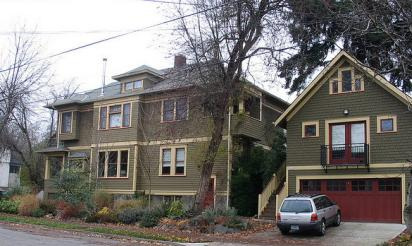
The average age of purchasing a new home has now increased to 40 years of age. He points out that Auxiliary Dwelling Units (sometimes called ‘granny flats’) are a powerful tool for addressing the housing shortage.
The Common Council recently passed legislation to permit the building of Auxiliary Dwelling Units, or small secondary homes, typically located on the back lots of single-family homes. But, as Jones states, the legislation has severe flaws that will negate actual development without changes.
The fatal flaw is that the current Milwaukee ordinance requires a separate sewer and water line for the new unit directly to the street at a cost of tens of thousands of dollars. Additionally, the main home in which a new flat is sought must be owner-occupied at the time of construction, which presents yet another barrier.
Jones points out that other cities have addressed these issues, including South Bend, Indiana; Memphis, Tennessee; and Seattle.
In addition to eliminating separate sewer and water hookups and ownership requirements, Jones proposes that the city reduce redundant plan review by pre-permitting templated approvals, lower upfront costs for homeowners and developers, and make the process more affordable for our fellow citizens. It would not take much work. Simply creating the best LED permitting process for ADUs will get the job done.
This represents real cost savings. Less money will be spent on the city bureaucracy, and our fellow citizens can build more affordable housing. That’s a double win!
Utilize artificial intelligence to get caught up on infrastructure
Currently, Milwaukee’s Public Works Department, which focuses on infrastructure, has fallen millions of dollars behind in deferred maintenance and has other services that are not fully efficient. So, the other winner is Ryan Durkin, who points out that:
His solution is for the city to transform DPW’s vehicles into an intelligent, mobile-sensing fleet. This has been successfully tried in other cities, including Boston, Tempe, Arizona, and St. Louis. Smart vehicle technology can automatically detect road surface conditions with 90% accuracy.
Boston has seven vehicles equipped with smart detection cameras, enabling quick identification of unregistered vehicles in its vicinity. In St. Louis, their investigatory unit using smart equipment generates $4 million in annual savings and collects an additional $92,000 in fines.
Most systems are driven by a transparency dashboard that tracks key metrics and provides results. Durkin further points out that this is an ideal opportunity for the city to partner with the private sector, especially the Milwaukee School of Engineering, Marquette University, and UW-Milwaukee, to leverage their talent to develop data analysis tools and create predictive maintenance models needed to keep the system functioning.
Hoan Foundation awards pilot grants to help begin efforts
In the private sector, any new venture requires a “proof of concept” pilot that provides the information needed to move ahead with the initiative. The city is willing to do just that. I’m excited about the potential savings for the city and the improvement of the government’s efforts for our fellow citizens. So, the Hoan Foundation will award pilot grants to help the city test these concepts. The city’s Innovation Office will lead the program to ensure the pilot grants are properly deployed and evaluated.
Milwaukee must continue to be a city that innovates and reduces costs. In doing so, Milwaukee will not be a city where people seek to leave, but will draw residents as a well-run city that offers a quality of life at a price people can afford — concepts my grandfather, former Mayor Daniel Hoan, would approve of.
Daniel Steininger is president of the Daniel Hoan Foundation. He is the grandson of former Milwaukee Mayor Daniel Hoan.
This article originally appeared on Milwaukee Journal Sentinel: Fixes for housing and infrastructure will make MKE stronger | Opinion
Reporting by Daniel Steininger, Special to Milwaukee Journal Sentinel / Milwaukee Journal Sentinel
USA TODAY Network via Reuters Connect